LinkToLooks · Guides · Reference Desk
Reference Desk
Is this enamelware vintage or new?
Probably new. Of 167 live in-stock US enamelware listings we matched on 2 September 2026, only 7 came from a resale marketplace. The mottled speckled finish is no help — that process dates from 1875 and has been in continuous production since. Judge it on weight, rim construction, base wear and seams instead.
First, the base rate
Before any physical test, know the odds. Of 167 live in-stock US enamelware listings we matched on 2 September 2026, 7 came from a resale marketplace and 160 were current retail stock. A single contemporary brand accounted for 23 of the 60 rows we read one at a time.
| Source | Rows of 167 | What it means |
|---|---|---|
| Large general home retailer | 89 | New |
| Replacement-china specialist | 39 | New open stock from current brands |
| Design-led home retailer | 16 | New |
| Department stores | 10 | New |
| Other home retailers | 6 | New |
| Resale marketplace | 7 | Could be either |
Method: CJ product API, US advertisers, in-stock only, keyword pull filtered to listing titles, de-duplicated, 2 September 2026.
So the honest prior is: a piece of enamelware you find for sale online is probably new. Start from that and make the seller's evidence move you off it.
Last verified 30 September 2026 for the Granite Ware, mug and table-lighter prices, against the CJ product feed; the source classification of 167 matched listings is from the 2 September 2026 pull
Five physical tests, in order
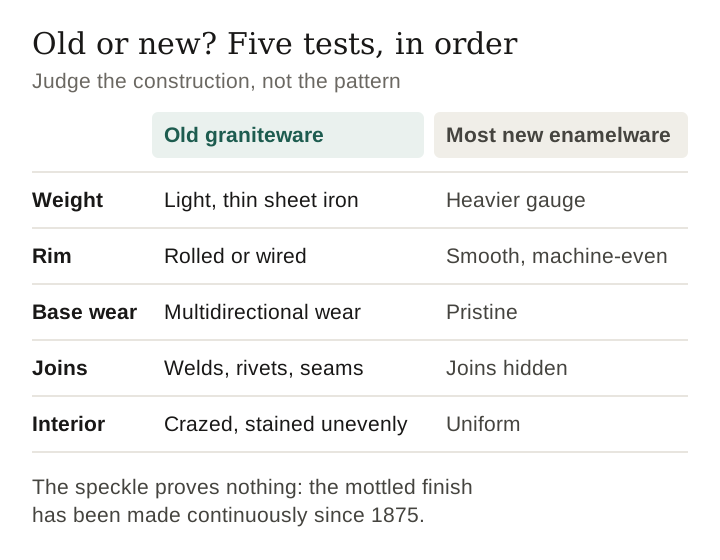
- Weight for size. Old graniteware is thin rolled sheet iron and startlingly light. Much modern enamelware is heavier gauge, and enamelled cast iron is in a different weight class entirely.
- The rim. Old pieces commonly have a rolled or wire-reinforced rim, sometimes with a contrasting dark edge where the enamel thinned. Modern rims are usually smooth and machine-even.
- Base wear. Decades of being set down leave fine multidirectional scratching and dulling on the foot. A pristine base under an ‘antique’ finish is the strongest single warning sign.
- Handle and seam construction. Look for spot welds, riveted handles and visible seams on old work. Contemporary pieces hide their joins.
- The interior. Old enamel crazes, stains and discolours unevenly around the food line. New enamel is uniform.
The speckle is not evidence
A contemporary Golden Rabbit swirl-pattern enamel mug was listed at $11.99 by Replacements Ltd. in September 2026: the decorative vocabulary of antique graniteware is in continuous production.
The decorative mottling that gives graniteware its name comes from a process developed in 1875 — sheet iron stamped to shape, dipped in enamel and baked to a shiny blue-grey glaze, called Granite Ironware because granite was used in the enamelling. The company behind it built a five-storey factory in 1877 and merged into the National Enameling and Stamping Company in 1899.
Source: the Wikipedia entry for Graniteware, read 2 September 2026. Note that it offers no guidance on distinguishing authentic vintage graniteware from reproductions — the tests above are ours, from handling the objects, and we would rather label them that way than dress them up as sourced.
The consequence for a buyer is simple and slightly deflating: 150 years of continuous production means the look proves nothing. Swirl, speckle, mottle and a dark rim were all in current catalogues at $9 to $25 a piece in our 2 September 2026 pull.
Watch the brand names
- Granite Ware is a live brand today. Our 2 September pull surfaced ten current listings under that name, including a canner and rack at $39.45, a steel saucier at $25.99 and a food mill at $96.38; on 30 September the saucier was still $25.99 and the food mill $96.44.
- A search for ‘graniteware’ therefore returns new cookware, dollhouse miniatures, and in our pull one vintage t-shirt. It does not reliably return antiques.
- Evans and other names appear on genuinely collectable enamelled objects that are not cookware at all — an Evans enamelware table lighter was listed at $149.95.
- Golden Rabbit and similar contemporary brands make the swirl and speckle patterns most people picture. Their pieces are honest new goods, and they are what a resale seller may be photographing.
Keep identifying
Frequently asked
How do you tell vintage enamelware from new?
Weight, edge finish and wear. Old graniteware is thin rolled sheet iron with a rolled or wired rim and multidirectional base wear. Most new enamelware is heavier, has a smooth machine-finished rim, and shows no wear at all.
Is the mottled speckled finish a sign of age?
No. The mottled surface process dates from 1875 and has been made continuously ever since. Speckling tells you what style a piece is imitating, not when it was made.
Is most enamelware for sale vintage?
No. In our pull of 167 live in-stock US enamelware listings on 2 September 2026, only 7 came from a resale marketplace. The rest was current retail stock.
What is graniteware?
The same construction under an older name: rolled sheet iron stamped to shape, dipped in enamel and baked. It was called Granite Ironware because granite was used in the enamelling process.
Is chipped enamelware safe to use?
A chip on the outside is cosmetic. A chip on a food surface exposes bare steel that will rust and stain, and there is no home repair for it. Treat a chipped interior as decorative rather than as cookware.
How this page was made. Drafted with AI (Claude); not yet independently re-checked. How we work