LinkToLooks · Guides · Reference Desk
Reference Desk
The 80s clock with the lightning-bolt hand, identified
It is the Paradise wall clock, designed by Shohei Mihara and produced by Wakita in Japan in the 1980s. Purple ring, yellow dial, red and green and black wedges breaking the circle, and a red lightning-bolt minute hand.
Listings credit it to Wakita, to Canetti, or to both. All three are common and none of them are wrong — the section below explains why.
Five tells that separate it from every homage
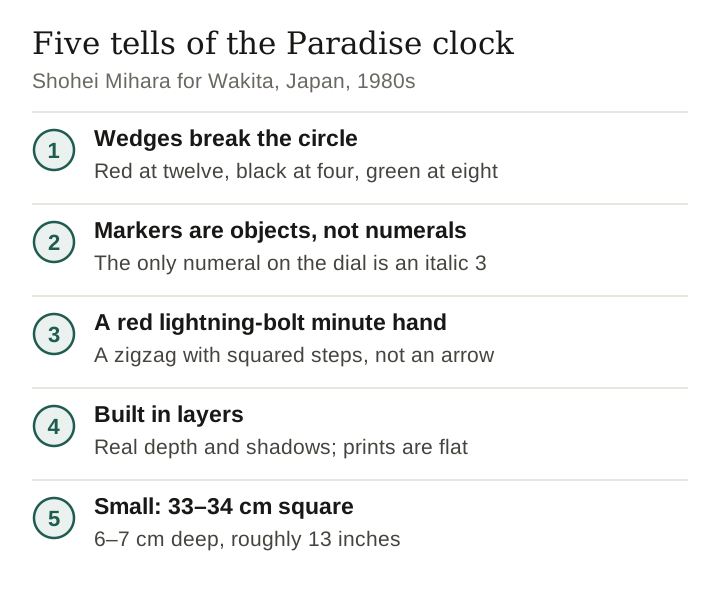
- The wedges break the circle. Red at twelve, black at four, green at eight — each one projects past the purple ring rather than sitting inside it. Printed homage clocks keep everything inside the bezel because they are flat discs.
- The markers are objects, not marks. A stipple cloud, a staircase zigzag, a safety pin, a comma, a semicolon, three stacked triangles. Only one numeral appears on the whole dial, an italic 3 at the right.
- The minute hand is a red zigzag. Not an arrow, not a baton — a lightning bolt with squared steps.
- It is built in layers. The dial sits below the ring, the wedges sit on a third plane, and the whole thing casts real internal shadows. A photograph of a genuine one always shows depth.
- Size. Documented at 33–34 cm square, 6–7 cm deep. Roughly 13 inches, which is smaller than most photographs suggest.

Why the credit line keeps changing
Three names orbit this object and sellers pick whichever they inherited.
- Shohei Mihara (b. 1947) is the designer. Dealers describe him as a leading Japanese postmodernist little known outside Japan, working in the same decade and idiom as the Memphis group.
- Wakita is the manufacturer, and the clocks were marketed under a Super Present line — that phrase turns up on related pieces and is a useful secondary search term.
- Canetti Design Group distributed related postmodern clocks in the American market. That is why perfectly honest US listings say "Wakita Canetti Paradise".
The judgement worth signing: pay for the Mihara attribution, ignore the Canetti one. Canetti alone gets you into the same visual family at a third of the price, and there is nothing dishonest about wanting the look. But a seller who cannot say Mihara probably does not know what they have, which sometimes means a bargain and sometimes means it is not the Paradise at all.
What it costs, and where the market actually is
Prices checked September 6, 2026These five asks were checked against live listings on 31 August 2026:
| Retailer | Ask | Note |
|---|---|---|
| Etsy | $240 | "Wakita Canetti Paradise 80s Postmodern…" |
| Tenon Design | $300 | attributed, clean example |
| 1stDibs | $300 | Memphis-listed |
| Bidsquare | $450 | auction listing |
| eBay | $895 | top-of-market ask |
A 3.7× spread between the cheapest and dearest verified ask, for the same clock. That is normal for an object with no reference price and one recognisable photograph — the ceiling is set by whoever is most confident, not by the market.
Two live checks, 1 September 2026. The Pamono dealer listing for a Paradise wall clock (30 cm dial, 33 cm overall, 6 cm deep) reads sold out today. A 1stDibs wall-clock listing for the same model is still live and describes an original metal example at 34 × 34 × 7 cm, battery movement, full working, with patina. So supply at the dealer tier is thin and moves: if you find one at the Etsy end of the range, it will not sit.
How to hunt one
- Search "Shohei Mihara" before you search "Memphis clock". The designer name returns dozens of results; the style name returns thousands of reproductions.
- Add Wakita, then try "Super Present" as a separate search — different sellers, different inventory.
- Mihara's Paradise exists as a table and alarm clock too, in the same palette. If you are shopping the wall version, say so, or you will end up bidding on a desk piece.
- Ask for a raking-light photograph. Flat shadows mean a print; layered shadows mean the real construction.
Frequently asked
Who designed the Memphis-style wall clock with the coloured wedges?
Shohei Mihara, born 1947, a Japanese postmodern designer. The clock is called Paradise and was produced by Wakita, marketed under the Super Present line, in the 1980s in Japan.
How big is the Paradise wall clock?
Two documented examples: a dealer listing gives 33 cm square with a 30 cm dial and 6 cm depth; another gives 34 cm by 34 cm by 7 cm. So roughly 13 inches square and under 3 inches deep. Anything much larger is not this clock.
Is the Paradise clock by Wakita or by Canetti?
Both names appear in listings and both are defensible. Wakita produced it in Japan; Canetti Design Group distributed related postmodern clocks in the United States, so American sellers often credit Canetti. The Mihara attribution is the one that carries the premium.
Is Memphis-style the same as Memphis Milano?
No, and the difference matters when you buy. Memphis Milano was Ettore Sottsass's Italian collective. The Paradise clock is Japanese work in conversation with it. Mass-market wall clocks sold today as Memphis are printed reproductions of the pattern language, not vintage design objects, and they ask $60 to $176 new.
Last verified 6 September 2026, when the absence of this clock from US affiliate feeds was re-confirmed against the CJ product feed and the 22 Memphis-pattern reproductions were re-priced. The five retailer asks were checked against live listings on 31 August 2026, and the Pamono sold-out status and the 1stDibs dimensions and condition were re-read directly from those listings on 1 September 2026; none of those dealer listings is in an affiliate feed, so they stand as of those dates. All figures are asking prices, not completed sales.
Sources
- Pamono dealer listing, Wakita Paradise wall clock by Shohei Mihara, Japan 1980s — dimensions and current sold-out status, read 1 September 2026.
- 1stDibs listing, Postmodern Memphis Wall Clock "Paradise", Shohei Mihara x Wakita — metal construction, 34x34x7 cm, battery movement, read 1 September 2026.
- CJ Affiliate product feeds, US advertisers, queried 6 September 2026 — the reproduction-only result for Memphis wall clocks.
How this page was made. Drafted with AI (Claude); not yet independently re-checked. How we work