LinkToLooks · Guides · Reference Desk
Reference Desk
Quartz or automatic: what does the catalogue actually charge?
A dearer median, a far wider spread — and a position on which one is worth it at the cheap end.
In a live catalogue pull on 3 September 2026, quartz watches ran to a median of $20.00 across 174 listings and automatic watches to $89.00 across 45. The automatic median is 4.5 times the quartz one.
The gap is not a quality measurement and we will not present it as one. It is what the two words attract in one catalogue on one morning, and the automatic sample is only 45 listings — small enough that you should treat the exact figure as indicative and the direction as solid.
Last verified 3 September 2026 against 174 quartz and 45 automatic watch listings pulled live
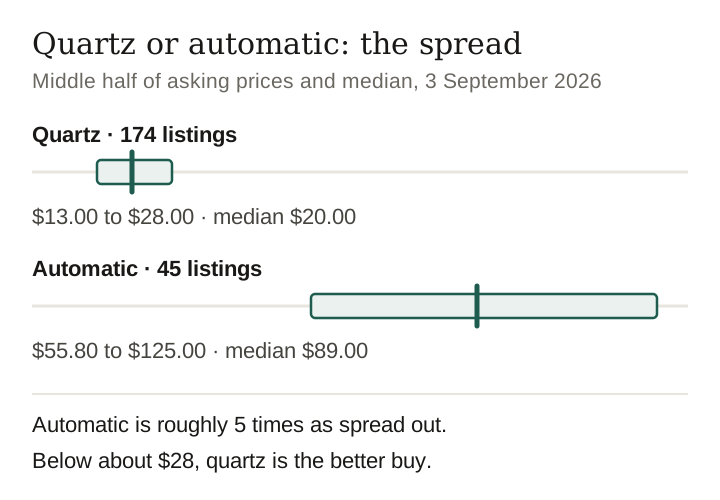
The two distributions
| Quartz | Automatic / mechanical | |
|---|---|---|
| Listings | 174 | 45 |
| Median price | $20.00 | $89.00 |
| 25th percentile | $13.00 | $55.80 |
| 75th percentile | $28.00 | $125.00 |
| Distinct retailers | 2 | 3 |
| Marketplace share | 99.4% | 100.0% |
| Carrying a markdown | 91 (52.3%) | 26 (57.8%) |
Placeholder prices — $999, $7,777, $999,999 and similar feed sentinels — are excluded from every median on this page. They are not offers.
Read the percentiles rather than the medians and the comparison sharpens. The quartz middle half spans $13.00 to $28.00 — a range of about $15. The automatic middle half spans $55.80 to $125.00, about $69. The automatic category is not just dearer, it is roughly 5 times as spread out, which means the word tells you much less about what you are about to pay.
Both figures are effective prices — the sale price where a listing carries one. On list prices alone the two medians would read $34.50 and $110.00, which is what most price round-ups quote and is not what anybody pays.
What the words actually describe
Both words name a timekeeping mechanism, not a quality tier, and that is where most of the confusion starts.
Quartz
A battery drives a quartz crystal oscillator, and electronics count its vibrations. The visible tell is the second hand: one discrete step per second.
Automatic
A mainspring drives a mechanical movement, wound by a rotor that turns as the wrist moves. No battery. The second hand appears to sweep, because it advances several times per second rather than once.
Mechanical, hand-wound
The same mechanical movement without the self-winding rotor. Catalogue titles often use “mechanical” and “automatic” interchangeably, which is one reason a title-based sample like ours mixes them — and we have not tried to separate them.
Where the money goes in each
At the quartz median you are paying for a case, a dial, a strap and a movement that costs very little. At the automatic median you are paying for a movement with a few hundred parts in it, and the case and dial that go with something built to that cost.
Two things follow that are worth more than the price comparison:
- A quartz movement keeps better time than a mechanical one. That is not a controversial claim; it is why quartz displaced mechanical movements at the volume end of the market. Nobody buys an automatic for accuracy.
- An automatic needs servicing and a quartz needs a battery. Those are different orders of cost and effort, and the difference compounds over the life of the watch rather than appearing in the purchase price.
Which is better value, honestly
We will take a position, because a page that lists both and shrugs is not worth reading.
Below about $28, quartz is the better buy. At that price an automatic movement is the cheapest part of the watch, and the money that would have gone into a decent case and dial has gone into a mechanism you cannot see working properly anyway.
Above the automatic 25th percentile of $56, the choice stops being about value and becomes about whether you want the mechanism. That is a preference, and preferences are not something a price table can settle.
The one thing the data does settle: the word “automatic” in a listing title is not evidence of quality. 45 listings carrying it ranged from $12.58 to $634.00 in this pull. It describes how the watch is wound and nothing else.
Frequently asked
Is an automatic watch more expensive than a quartz one?
In this pull, about 4.5 times: a median of $89.00 against $20.00 on 3 September 2026. The automatic sample was small at 45 listings.
How can I tell quartz from automatic in a photograph?
You usually cannot from a still. In motion, a quartz second hand steps once per second and a mechanical one appears to sweep. A transparent caseback showing a rotor is the other giveaway.
Which keeps better time?
Quartz, comfortably. Mechanical watches are not bought for accuracy.
Is a cheap automatic watch worth it?
Below roughly $28 the movement is the cheapest part of the watch and the money is better spent on the case, dial and strap. That is our judgement from the price distribution, not a test — we have not handled any of these watches.
Do automatic watches need servicing?
Yes, periodically, where a quartz watch needs a battery. That difference sits outside the purchase price and compounds over the life of the watch.
Method and limits
- 174 quartz and 45 automatic or mechanical US-priced in-stock listings, pulled 3 September 2026 through the CJ shopping-product API and filtered strictly on the listing title.
- Title-based classification. A watch is counted as automatic because its title says so. Titles are unreliable, and “automatic” and “mechanical” are used interchangeably in them.
- The automatic sample is small at 45 listings. The direction is clear; the exact median is not robust and we are not going to pretend it is.
- Mostly resale. 99.4% and 100.0% of the two samples respectively came from marketplace sellers, so these are asking prices.
- Not verified: movement type, servicing history or accuracy of any individual watch. We have not handled or worn any of them.
How this page was made. Drafted with AI (Claude); not yet independently re-checked. How we work