LinkToLooks · Guides · Reference Desk
Reference Desk
What is a NATO watch strap, and how do you spot one?
The tell is a second layer under the case — plus the lug-width number that nine of ten listings we checked left out.
A NATO strap is a one-piece nylon band that passes through both spring bars and behind the watch case, then folds back through a keeper to hold the loose end. It came from a UK Ministry of Defence specification — DefStan 66-47 Issue 2, which sets a 20 mm wide nylon ribbon in a colour it names Admiralty Grey — and the style is also called a G10 strap.
The striped versions everyone recognises are not the original. They came later, after 1973, when military personnel began making them up in the colours of their regimental ties and stable belts.
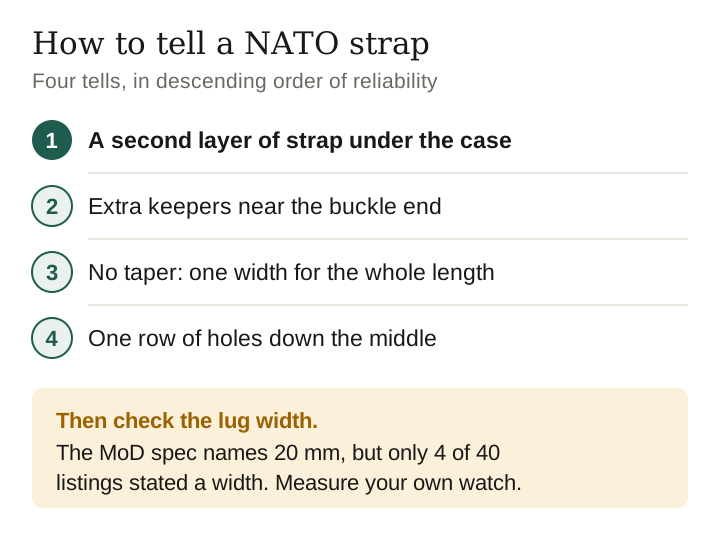
How to identify one in a photograph
Four things are visible in almost any listing photograph, in descending order of reliability.
- A second layer of strap under the watch case. This is the definitive tell and it is the one people miss. The strap goes through both spring bars and continues behind the caseback, so on a side-on photograph you can see the case sitting slightly proud of the wrist.
- Extra keepers. A NATO has a short second piece sewn near the buckle end with one or two additional loops, whose only job is to secure the folded-back excess.
- No taper. The band is the same width for its whole length, because it is a length of ribbon rather than two shaped halves.
- A row of holes down the middle. Only one set, and they run the whole length, because there is only one piece.
If the strap is two separate pieces that end at the case, it is a conventional two-piece strap however it is styled — and by the sourced description, that is a different object, not a variant.
NATO, Zulu, Marine Nationale: telling them apart
| Strap | Construction | Hardware | Origin |
|---|---|---|---|
| NATO / G10 | One piece of nylon ribbon through both spring bars, folded back into a keeper | Flat rectangular loops and buckle | UK MoD specification; DefStan 66-47 Issue 2 sets a 20 mm nylon ribbon in Admiralty Grey |
| Zulu | The same one-piece arrangement | Thicker weave, heavier hardware, rounded loops, an oval buckle | An adaptation of the NATO, typically nylon |
| Marine Nationale (MN) | Elastic, passing around the wrist, with an adjustable buckle | Adjustable buckle | Originally for dive watches, designed to come off a wetsuit wrist easily |
| Perlon | Also passes completely around the wrist including behind the case | Varies | — |
| Conventional two-piece | Two separate halves, each ending at a spring bar | Varies | The caseback contacts the skin directly |
The quickest discriminator between the first two, from a photograph, is the buckle: rectangular and flat is a NATO, oval and chunky is a Zulu. If it stretches, it is an MN and not either.
Why the construction matters
Two consequences follow directly from the sourced description, and they are the reasons the design outlived the specification.
The case rides on the strap rather than hanging between two halves. Because one continuous ribbon runs through both spring bars and behind the caseback, the watch is threaded onto the strap. That is a description of the construction, not a claim about failure rates — the standard specifies a ribbon and a folding method, not a purpose — but the mechanical difference from a two-piece strap is real and visible.
The caseback does not touch the skin. NATO, Zulu, Marine Nationale and Perlon straps all pass completely around the wrist; other styles let the back of the case contact skin directly. That is why a NATO-style strap is among the options named for people who get contact dermatitis from watch metal — it puts a layer of fabric between the case and the wrist.
The cost of the same construction is height: the watch sits a strap’s thickness further off the wrist, which on a thick case is noticeable. We have not worn one and are not going to tell you how it feels; the geometry is simply a consequence of where the extra layer goes.
The number you need, and why the listing omits it
The one measurement that decides whether a strap fits is the lug width: the gap between the two lugs, measured in millimetres, where the spring bar sits. Strap attachment points are largely standardised around a spring bar — a spring-loaded double-ended pin anchoring into holes in a bracket integral to the case — which is exactly why a strap from one maker fits a watch from another, provided the number matches.
The MoD specification names 20 mm, which is why so many NATO straps are 20 mm and why it is a reasonable first guess and a bad assumption.
Here is the problem, measured. Of 40 live watch strap listings we examined on 3 September 2026, 4 stated a lug width anywhere in the title. The single number that determines whether the product fits the buyer’s watch was absent from nine listings in ten.
Measure your own watch before you buy anything: close the calipers on the gap between the lugs, or lay a ruler across it. A 19 mm lug takes a 19 mm strap, and a 20 mm strap will not go in.
What the catalogue looks like
A live pull on 3 September 2026 returned 93 US-priced watch strap listings from 2 retailers, at a median of $19.00 and a middle half spanning $4.63 to $48.00.
| Measure | Value |
|---|---|
| Listings | 93 |
| Distinct retailers | 2 |
| Marketplace share | 100.0% |
| Median price | $19.00 |
| Middle half | $4.63 – $48.00 |
| Carrying a markdown | 56 (60.2%) |
| Stated a lug width | 4 of 40 examined |
Two retailers is not a market. One is a resale marketplace and the other, on inspection, was returning phone-watch bands rather than traditional straps at all — which is itself worth knowing before you shop a category by search results. If you want a specific NATO in a specific width, the affiliate catalogue is not where it is.
Frequently asked
What is a NATO watch strap?
A one-piece nylon strap that passes through both spring bars and behind the watch case, with the loose end folded back through a keeper. It originates in a UK Ministry of Defence specification and is also called a G10 strap.
What is the difference between a NATO and a Zulu strap?
Construction is the same; the hardware differs. A Zulu uses a thicker weave with heavier metal fittings, rounded loops and an oval buckle, where a NATO uses flat rectangular hardware.
Are NATO straps always 20 mm?
No. The MoD specification describes a 20 mm nylon ribbon, which is why the size is so common, but the strap has to match your watch’s lug width. Measure it rather than assuming.
Why do NATO straps have an extra layer under the watch?
Because the strap is a single continuous piece that runs through both spring bars and behind the caseback. That construction also keeps the metal case off the skin, which is why NATO-style straps are among the options named for people with metal contact dermatitis.
Where does the striped pattern come from?
Not from the specification. After the style was introduced in 1973 military personnel began making straps in the colours of their regimental ties and stable belts, and the striped patterns followed from that.
Sources and method
- Construction, the DefStan 66-47 reference, the 1973 date, Zulu and Marine Nationale differences, and the dermatitis note: Watch strap on Wikipedia, sections on NATO straps and on strap attachment.
- The catalogue figures: 93 US-priced watch strap listings pulled live on 3 September 2026 through the CJ shopping-product API, filtered strictly on the listing title, with title inspection on a 40-listing subset.
- Not verified: any claim about how a NATO strap performs in use. The specification describes a ribbon and a folding method; it does not state a purpose, and we have not handled or worn one.
- A floor, not a census. Two retailers returned these listings. A wider affiliate catalogue would certainly show more.
Keep identifying
Last verified 3 September 2026 against 93 live watch strap listings and the cited specification references
How this page was made. Drafted with AI (Claude); not yet independently re-checked. How we work