LinkToLooks · Guides · Creator Desk
Creator Desk
EPC, AOV and reversals: how to read an affiliate dashboard
Three of the four numbers that decide what you earn are not yours to move. The fourth is what you choose to link, and it varies 35-fold.
Part of: For creators
Four numbers do the work: clicks, order value, conversion rate and reversals. Every other figure on an affiliate dashboard is one of those four in a different costume, and three of the four are outside your control.
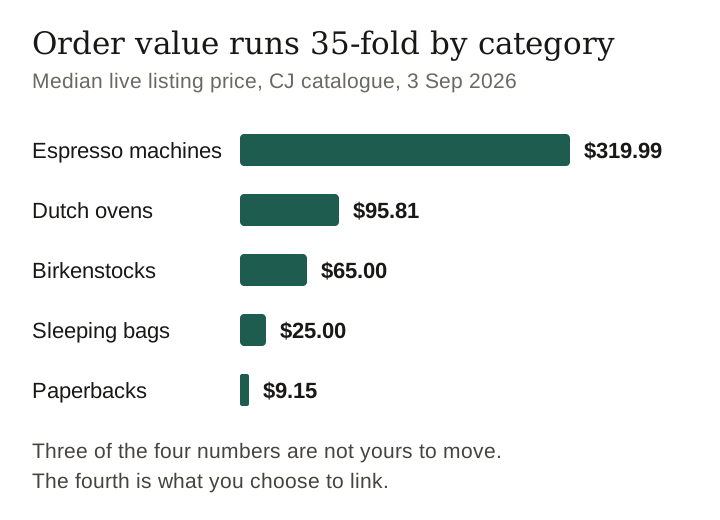
The one you can genuinely move is what you choose to link. In our own 3 September 2026 catalogue pulls, category medians ran from $9.15 for a paperback to $319.99 for an espresso machine — a thirty-five-fold spread before any commission rate is applied.
The four numbers
| Metric | What it actually measures | Can you move it? |
|---|---|---|
| Clicks | How many people followed your link | Yes — placement, context, honesty |
| AOV (average order value) | What the shopper spent at the retailer | Indirectly, by choosing categories |
| Conversion rate | Share of clicks that became orders | Barely — the retailer's site decides most of it |
| Reversal rate | Share of orders later cancelled or returned | No |
| EPC | Earnings per click; a rate, not an input | Only through the four above |
| Commission rate | The percentage the programme pays | No, except by choosing programmes |
How the standard dashboard metrics relate to each other.
EPC is the one that confuses people, because it looks like a performance metric and behaves like an average. It is earnings divided by clicks. At low click volumes it swings wildly and predicts nothing, which is why a new creator's EPC is not information yet.
Order value, measured
This is the part we can contribute rather than summarise. These are median live listing prices from our own catalogue pulls this morning — what a shopper would be spending, before any rate is applied.
| Category | Live listings priced | Median order value |
|---|---|---|
| Espresso machines | 800 | $319.99 |
| Cat trees | 493 | $106.99 |
| Camping tents | 500 | $100.49 |
| Dog beds | 441 | $99.99 |
| Dutch ovens | 797 | $95.81 |
| Cashmere knitwear | 554 | $80.00 |
| Birkenstocks | 800 | $65.00 |
| Hiking boots | 500 | $40.00 |
| Merino knitwear | 554 | $35.00 |
| Sleeping bags | 492 | $25.00 |
| Coffee gifts under $50 | 1,010 | $23.99 |
| Dog collars | 437 | $17.00 |
| Hardcover books | 500 | $15.00 |
| Paperbacks | 500 | $9.15 |
Live US in-stock listings pulled from the CJ product catalogue on 3 September 2026, strictly title-matched.
Prices checked 3 September 2026 against live US retailer listings pulled.
A single espresso machine order is worth thirty-five paperbacks in order value. Commission rates vary by category and could narrow that, but they would have to vary by thirty-five times to close it, which they do not.
We are stopping short of turning this into earnings, and we want to be explicit about why: we hold no network approvals and have earned nothing, so we have no rates to apply and no results to check against. Order value is what we can measure. Take your own rate from your own programme's terms and do the multiplication yourself — our commission calculator exists for that.
Reversals, and why pending is not paid
- A recorded sale is provisional. Returns, cancellations, duplicate orders and fraud checks all remove commission after the fact.
- Dashboards separate pending from confirmed for that reason. Reading the pending figure as income is the most common way to be disappointed a month later.
- Reversal rates vary by category in ways that follow return behaviour. Clothing and footwear return more than cookware; a sized product returns more than an unsized one.
- You cannot influence it, but you can predict it. If your niche is sized apparel, expect a gap between recorded and paid that a home-goods creator does not see.
- It compounds with payout thresholds. A reversal can push you back under a threshold you had already crossed.
Traps in the numbers
- Small samples. A conversion rate computed on forty clicks is noise. So is an EPC.
- Bot and scanner clicks. Email security tools pre-fetch links, which inflates clicks with no chance of a sale and deflates every rate computed from them.
- Attribution windows. A sale credited to you may have come from a click days earlier, and a sale you feel you caused may be credited elsewhere.
- Comparing across categories. A book creator and a furniture creator cannot compare EPC meaningfully. The order values differ by a factor of ten.
- Comparing against a published benchmark. Most circulating benchmark figures have no stated sample and no date. Treat them as folklore until they carry both.
Frequently asked
What does EPC mean?
Earnings per click, usually quoted per hundred clicks. It is a rate computed from your own results, which means it is meaningless until you have enough clicks for the number to stop moving.
What is a good conversion rate for affiliate links?
We will not give you a benchmark, because we hold no approvals and have no results of our own to compare against. Anyone quoting one universal figure is quoting a figure that varies by category, price and audience.
Why did my commission disappear?
Reversals. A return, a cancellation or a fraud check removes a sale after it was recorded, and dashboards show pending and confirmed amounts separately for exactly this reason.
What is AOV?
Average order value: what the shopper spent, not what you earned. It is the number your commission rate is applied to, and it varies enormously by category. In our 3 September 2026 pulls, category medians ran from $9.15 to $319.99.
Method and scope
- Order-value table: live US in-stock listings pulled from the CJ product catalogue on 3 September 2026, strictly title-matched, with the listing count for each category shown in the table.
- Median listing price is used as a proxy for order value. It is not the same thing — a shopper may buy more than one item, or a different item than the one linked — and it is stated as a proxy rather than presented as measured AOV.
- No commission rate, earnings figure, conversion rate or EPC of our own appears here. We hold no network approvals and have earned nothing.
- Metric definitions describe standard affiliate dashboard terminology and are not specific to any one network.
Last verified 3 September 2026 against category order values computed from live US listings pulled
How this page was made. Drafted with AI (Claude); not yet independently re-checked. How we work