LinkToLooks · Guides · Creator Desk
Creator Desk
What happens to your commission when the buyer sends it back?
The number in your dashboard today is a claim, not money. Here is what turns it into money, what takes it away, and which categories carry the most of that risk.
Part of: For creators
A commission normally moves through three states: pending while the retailer can still cancel or accept a return, approved or locked once that window closes, and paid after the network’s payment cycle. A return, a cancellation, a chargeback or a duplicated order can reverse it at any point before the second state.
We cannot tell you your reversal rate — that lives in your own statements and no public source publishes it. What we can measure is exposure: which categories send buyers to inventory where returns are hard or impossible, and which send them to ordinary restockable retail. Across 4,600 live listings on 2 September 2026, marketplace share ran from 1.2% to 95.8% depending on the product family.
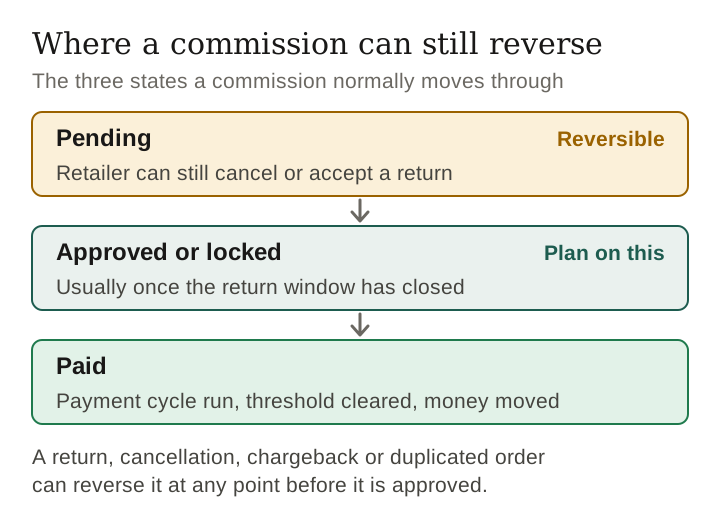
The three states, plainly
- Pending. The order exists and the commission is recorded against it. The retailer can still cancel the order, the buyer can still return the goods, and the network can still void the transaction. Nothing here is yours yet.
- Approved, locked or confirmed. The retailer has released the transaction, usually after the return window has closed. This is the number worth planning against.
- Paid. The network has run its payment cycle and cleared its threshold, and the money has actually moved.
The gap between one and three is the entire reason creator earnings feel unpredictable, and it is also why screenshots of a dashboard mean so little. A pending figure is a forecast.
Exposure, measured
What we can measure is where a link sends the buyer. A purchase from a private seller on a resale marketplace and a purchase from a national retailer sit under different return regimes, and the mix is wildly different by category.
| Product family | Listings | From resale marketplaces |
|---|---|---|
| Loungefly bags and accessories | 400 | 95.8% |
| Popcorn buckets | 321 | 93% |
| Disney ornaments | 290 | 73% |
| Tupperware | 400 | 65.0% |
| Christmas products, all brands | 400 | 29.5% |
| Carnival glass | 400 | 18.0% |
| Disney gifts, broadly | 400 | 16.5% |
| Blue Willow china | 400 | 11.8% |
| Fiesta dinnerware | 400 | 1.8% |
| Dinnerware sets | 400 | 1.2% |
Share of live US listings sold by resale marketplaces rather than conventional retailers. CJ product API, 2 September 2026. Prices checked 2 September 2026
An eighty-fold spread in exposure between the top and bottom of one page of categories. A creator covering vintage and collectibles is operating almost entirely in the top band; a creator covering home goods is operating almost entirely in the bottom one. Those are two different businesses wearing the same job title.
The second reversal risk: the price moved
Commission normally follows the price actually paid, not the price you quoted. So heavy discounting is a quiet haircut on every link into that category, and we measured that too.
| Product family | Priced listings | Already discounted | Median cut |
|---|---|---|---|
| Haunted Mansion merchandise | 282 | 82% | 20% |
| Christmas products | 169 | 66% | 28% |
| Advent calendars | 76 | 54% | 33% |
| Jim Shore figurines | 126 | 53% | 15% |
| Fiesta dinnerware | 62 | 52% | 42% |
| Disney mugs | 237 | 47% | 26% |
| Disney ornaments | 251 | 28% | 44% |
Listings whose sale price sits below their own stated list price, 2 September 2026. Prices checked 2 September 2026
A link into a category where 82% of stock is marked down at a median 20% is a link whose realised order value is systematically below its sticker. That is not a reversal, but it lands in the same place: the number you expected is not the number that arrives.
Five things a creator can actually do
- Plan on approved, never on pending. If your dashboard separates the two, the smaller number is the real one. If it does not, assume everything under the return window is provisional.
- Find the return window in your programme terms. It is the single number that tells you how long your earnings stay reversible, and it is written down in terms you have already agreed to.
- Know your category’s mix. If most of what you link is single-item resale, your exposure is structurally different from a home-goods creator’s — both to reversals and to links dying outright.
- Watch for the return-heavy shapes. Apparel with sizing, anything bought as a gift, and anything ordered in multiples to choose from are the classic return patterns. We cannot measure their rates, but we can tell you those are the shapes.
- Do not quote a price you have not re-checked. A discounted category moves under you, and a stale price in a post is a reader complaint waiting to happen.
Frequently asked
What does pending commission mean?
That the order exists but the retailer can still cancel it or accept a return, so the commission can still be reversed. It becomes yours when the programme approves or locks it, usually after the return window closes.
What is a typical affiliate reversal rate?
We do not publish one. It varies by programme and category, it lives in your own statements, and we hold no network approvals to measure it from.
Which categories carry the most risk?
On exposure, the resale-heavy ones: Loungefly at 95.8% marketplace listings, popcorn buckets at 93%, Disney ornaments at 73%. On price erosion, the heavily discounted ones: Haunted Mansion at 82% of listings marked down.
Does commission follow the list price or the sale price?
Normally the price actually paid. Check your own programme terms, because that detail is where a discounted category quietly reduces every link’s value.
Method and scope
- Marketplace share and discount share: 4,600 live listing rows from US retailer catalogues via the CJ product API, 2 September 2026.
- Marketplace share counts listings sold by resale marketplaces rather than conventional retailers, identified by advertiser name.
- The three commission states are the common structure across affiliate programmes. Specific labels, windows and rates are programme-specific and we quote none of them.
- We hold no affiliate approvals, so we have no statements of our own to measure reversals from and publish no reversal rate.
Last verified 2 September 2026 against live US retailer listings pulled
Keep reading
How this page was made. Drafted with AI (Claude); not yet independently re-checked. How we work