LinkToLooks · Guides · Reference Desk
Reference Desk
Real or reproduction carnival glass?
The honest version of this question, including the part where the published record does not give you a test — and what you can still use instead.
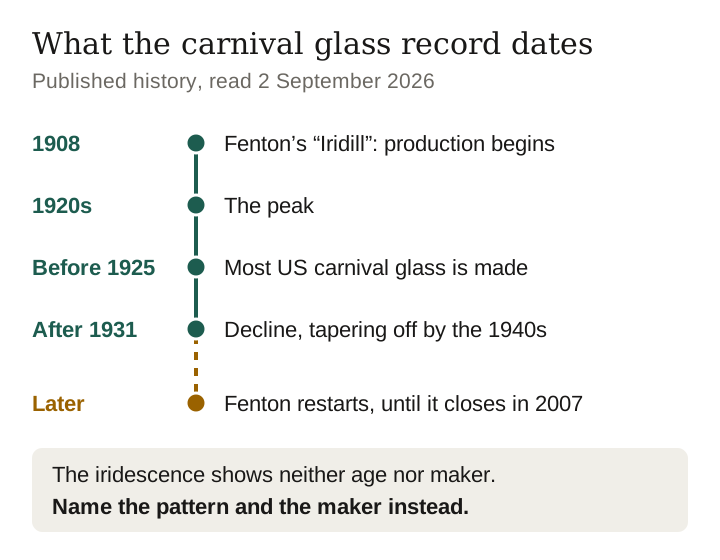
Carnival glass is pressed or moulded glass with an iridescent surface produced by applying metallic salts while the glass is still hot. Production began in 1908 with Fenton’s ‘Iridill’, peaked in the 1920s, and most US carnival glass was made before 1925, with output declining after 1931 and tapering off by the 1940s.
The complication is that Fenton — the original maker — restarted carnival glass production and continued until the company closed in 2007. So a piece can be genuine Fenton carnival glass and still be eighty years younger than the era collectors mean. Neither the age nor the maker is readable from the iridescence.
What the record actually supports
We read the published history for this page rather than recalling it, and the result is worth stating plainly: it documents the makers and the dates, and it does not give a method for telling old pieces from later ones.
That absence is the most useful thing on this page. Pages that confidently describe a foolproof test are describing something we could not source, and you should ask them where the test comes from.
| What we can date | From the record |
|---|---|
| First production | 1908, Fenton’s ‘Iridill’ |
| Peak | The 1920s |
| Most US production | Before 1925 |
| Decline | After 1931; tapering off by the 1940s |
| Later production | Fenton restarted, continuing to its closure in 2007 |
Published history read 2 September 2026.
The makers, which is what you can check
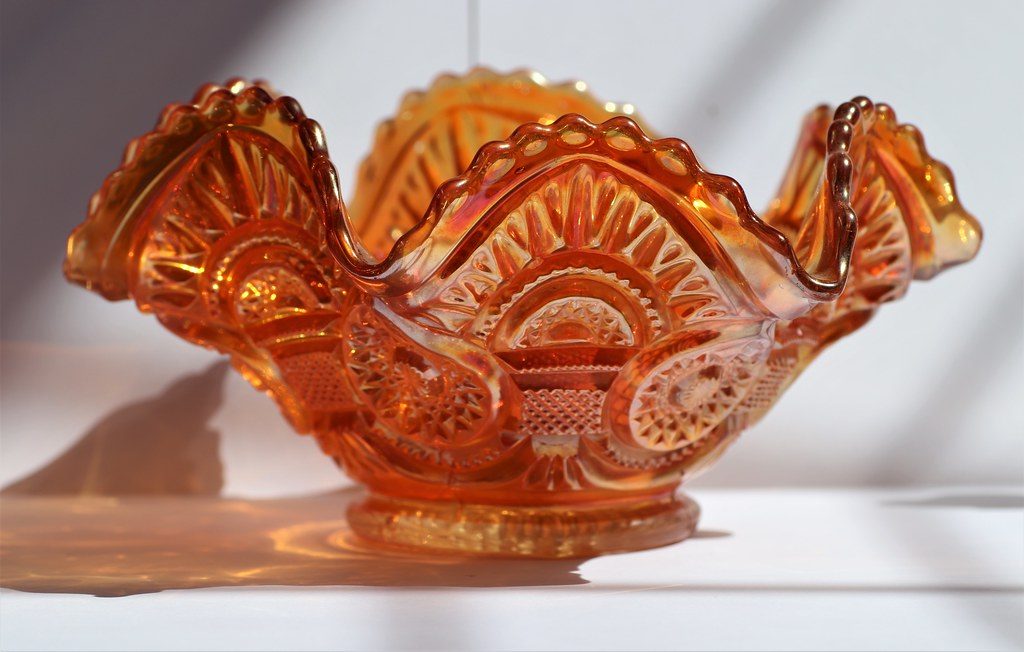
If you cannot test the glass, identify the maker. Fenton became the largest manufacturer and produced over 150 patterns. The other principal US names in the record are Northwood, Imperial, Millersburg, Westmoreland, Dugan/Diamond, Cambridge and U.S. Glass. Internationally: Sowerby in England, Brockwitz in Germany, and makers in Czechoslovakia, Sweden and Finland.
Pattern and maker together are the route to a date, because the pattern chronology is what collectors and specialist catalogues actually index. Our live pull is a small demonstration of that: the listings that name a maker — Imperial Glass-Ohio, Smith Glass — are priced and catalogued as specific objects, while the ones that say only “carnival glass” are not.
What it costs live
| Measure | 2 September 2026 |
|---|---|
| Listings measured | 326 de-duplicated, US-priced |
| Median | $39.99 |
| Middle half | $20.00 – $60.00 |
| Range | $3.99 – $420.00 |
| Distinct US retailers | 12 |
| From resale marketplaces | 17% |
CJ product API, US advertisers, in-stock filter, 2 September 2026, titles filtered to carnival glass and excluding books. Prices checked 2 September 2026
A re-read on 30 September 2026 with the same filters returned a different catalogue: 109 in-stock listings from 9 US advertisers, 78% of them from one resale marketplace, at a median of $35.00. With the seller mix that far from the one measured, the figures in this table stand as the 2 September snapshot rather than being restated.
A $39.99 median across a $3.99–$420 range, as measured on 2 September, is a category with no single price, and the reason is exactly the problem this page is about: the same two words cover 1910s Northwood and a set of new champagne flutes with an iridescent finish. A median computed over both is arithmetic, not a valuation.
Keep reading
What to do instead of a test
- Find the pattern name. It is the only identifier that ties a piece to a maker and a period, and specialist catalogues index by it.
- Prefer listings that name a maker. In our pull, the maker-named listings were the ones with real descriptions; the unnamed ones were the ones with vague titles and wide prices.
- Treat “vintage” in a title as a marketing word. It is not a date. Fenton was making carnival glass until 2007.
- Ask what the seller is dating it from. A seller who can name the pattern and the maker is telling you something checkable. One who describes only the colour is not.
Frequently asked
What is carnival glass?
Moulded or pressed glass with an iridescent surface, made by applying metallic salts while the glass is still hot. The technique imitated more expensive blown iridescent glass.
When was carnival glass made?
From 1908, peaking in the 1920s. Most US carnival glass was made before 1925, production declined after 1931 and tapered off by the 1940s. Fenton later restarted and continued to its closure in 2007.
How can I tell reproduction carnival glass from old?
The published history we read gives no test. Identify the pattern and the maker instead, and treat the iridescence itself as no evidence of age.
How much is carnival glass worth?
The median live US asking price was $39.99 on 2 September 2026, with the middle half between $20.00 and $60.00 — but that range mixes early collectible pieces with new iridescent glassware sold under the same name.
Sources and scope
- Technique, dates, makers and the Fenton restart: Carnival glass, Wikipedia, read 2 September 2026.
- Prices and counts: CJ product API, US advertisers, in-stock filter, pulled 2 September 2026; 400 raw rows, 326 usable.
- We have not handled or tested any piece described here. This page deliberately publishes the absence of an authentication test rather than filling the gap.
Last verified 2 September 2026 against the published history of the technique and live US retailer listings pulled
How this page was made. Drafted with AI (Claude); not yet independently re-checked. How we work