LinkToLooks · Guides · Creator Desk
Creator Desk
Should you write seasonal or evergreen product content?
Part of: For creators
Both, on different clocks. Evergreen earns the audience; seasonal converts it. The mistake is publishing seasonal work during its season — it is 2 September and Black Friday is 27 November, so this year's seasonal work is already late rather than early. And check that your subject even has a season: high-volume branded lines discount, one-of-one resale and replacement stock effectively never does.
Two clocks, not two categories
The common framing — seasonal content versus evergreen content — treats them as competing choices. They are not. They run on different clocks and they do different jobs.
| Evergreen | Seasonal | |
|---|---|---|
| Job | Earns the audience and the domain's credibility | Converts an audience you already have |
| Publish | Whenever it is ready | Months before the season it targets |
| Ages by | Prices and links going stale | The date passing |
| Rescued by | Refreshing prices and links | Honest year labelling and an archive |
| Fails when | It is only a link list | It is published during the season it targets |
The failure that matters is the last cell. A Black Friday page published in Black Friday week has no ranking history at the moment the traffic arrives. It is 2 September as this is written and Black Friday is 27 November: the seasonal work for this year is already late rather than early.
Which of your subjects even has a season
Not every category discounts, and writing a deal guide for one that does not is wasted work. The distinction follows inventory type rather than product type.
| Inventory type | Discounts seasonally? | Why |
|---|---|---|
| High-volume branded lines | Yes, meaningfully | Many retailers carry the identical item and compete on it |
| General-retailer own brand | Sometimes | Discounted at the retailer's discretion, not the market's |
| Small-brand open stock | Rarely | Low volume, no promotional calendar |
| One-of-one resale and replacement stock | Effectively never | Price reflects scarcity, not margin |
For example, a branded pan stocked by several retailers is a legitimate subject for a November deal page. A single mug in a discontinued pattern from the one specialist that carries it is not: there is no deal coming, and writing ‘wait for Black Friday’ about it would cost the reader the mug.
Both example listings were pulled live from US affiliate catalogues on 2 September 2026. More seasonal timing work in when creators should post Black Friday deals.
Last verified 2 September 2026 against live CJ product-feed pulls of branded cookware and replacement-china listings used for the pan and mug examples above
A ratio worth defending
We are not going to give you a rule that pretends to be derived from performance data we do not have. What we can give you is the reasoning behind a ratio, so you can set your own.
- Evergreen is the base because it compounds. A dating guide published today is still answering the same question in two years, and every seasonal page you publish links into it.
- Seasonal is the spike because it converts. People searching seasonal queries are closer to buying than people searching identification queries.
- Seasonal work needs lead time, so it needs to be scheduled rather than felt. If you decide in November, you have decided too late.
- The ratio should follow your traffic shape, not a blog post. If your evergreen pages are already ranking, more seasonal work pays. If they are not, seasonal pages have nothing to link out of.
Lead times, written as dates
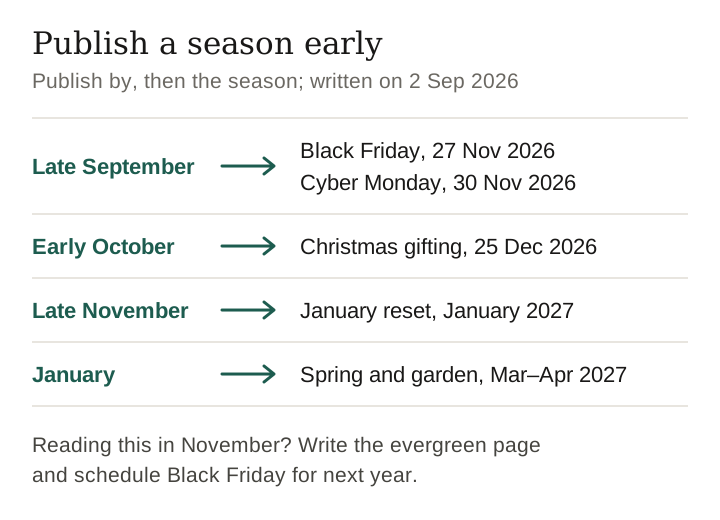
The single most common seasonal mistake is a timing error, so here it is as a calendar rather than as advice. Today is 2 September 2026.
| Season | Date | Publish by | Why that early |
|---|---|---|---|
| Black Friday | 27 November 2026 | Late September | Demand research starts weeks ahead and a new page needs time to be found |
| Cyber Monday | 30 November 2026 | Late September | Same audience, same lead time; usually the same page |
| Christmas gifting | 25 December 2026 | Early October | Gift-guide searching begins well before the shopping does |
| January reset and sales | January 2027 | Late November | Written while you are already in seasonal mode |
| Spring and garden | March–April 2027 | January | Weather-led categories move earlier than people expect |
Two consequences worth taking seriously. First, seasonal work is written out of season, which is why it has to be scheduled rather than felt. Second, if you are reading this in November wondering whether to write a Black Friday page, the honest answer is to write the evergreen mechanism page instead and schedule the seasonal one for next year.
How to make one piece do both jobs
The best structural trick here is not choosing. A seasonal page built on an evergreen spine keeps working after its season.
- Write the mechanism, then the moment. Explain why cookware discounts and one-of-one stock does not; then apply it to this November. The first half never expires.
- Date the prices in the body text. A dated price becomes a data point when it ages, rather than becoming a lie.
- Label the year honestly in the title and the text. An archive page that says which year it is remains useful; one that implies it is current becomes wrong.
- Link seasonal pages into an evergreen hub so the traffic they earn has somewhere to go once the season passes.
- Keep a comparison against last year. This is the part almost nobody does, and it is the only thing that turns a seasonal page into a genuine reference.
The same goes for a page that sets a seasonal pattern that will discount hard after its season, worth saying in both directions, beside ordinary year-round stock: a single piece of writing can cover both, and it is more useful than either alone.
Frequently asked
Should creators make seasonal or evergreen product content?
Both, in a fixed ratio, and published on different clocks. Evergreen content earns the audience that makes seasonal content work; seasonal content has to be published months before the season it targets.
When should Black Friday content be published?
Well before November. Search demand for a season arrives before the season, and a page published in the week itself has no ranking history when the traffic comes.
Which product categories discount seasonally?
High-volume lines carried by many retailers competing on the same item — cookware, electronics, toys. One-of-one inventory such as discontinued china barely discounts at all, because its price reflects scarcity rather than margin.
Does seasonal content hurt an evergreen site?
Not if it is dated and kept. A seasonal page that is honestly labelled with its year becomes a useful archive; one that quietly claims to be current becomes wrong.
What is the safest evergreen format?
Identification, dating and mechanism explanations. They stay true when listings die, which is exactly when a link-list page stops working.
Keep reading
How this page was made. Drafted with AI (Claude); not yet independently re-checked. How we work