LinkToLooks · Guides · Creator Desk
Creator Desk
How should a product roundup actually be structured?
Part of: For creators
Readers scan roundups, so build for scanning: one heading per item, one image per item, two to four specific bullets under each, with a comparison table and your actual pick above them. Add the section almost nobody writes — how the list was built, when you checked, and what you left out. Never make the reader scroll to a countdown number one.
Readers do not read roundups
They scan for the item that matches their situation, read that one block, and leave. Every structural decision below follows from that.
The failure mode is a roundup written as prose: fifteen paragraphs with the product names buried inside them. It reads fine to the writer, who reads it linearly, and it is unusable for the reader, who does not.
- One item, one heading. The heading is the item's name, not a joke about the item.
- One image per item. Scanning is visual. A single hero image at the top and a wall of text below is the layout of an essay.
- Two to four bullets per item. Enough to make a decision, few enough to take in at a glance.
- Price in the heading or the first bullet. It is the first thing they are looking for.
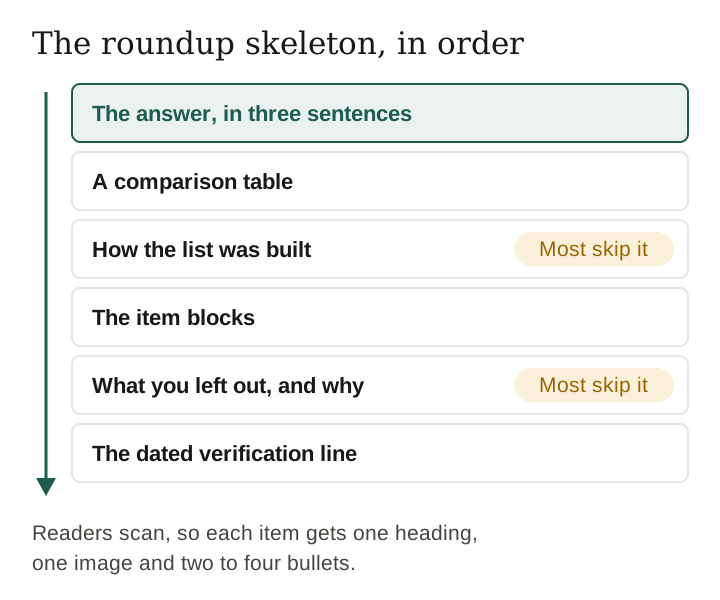
The skeleton, in order
- The answer, in three sentences. Which one you would buy and why, plus the runner-up for a different situation. Put it above everything.
- A comparison table. Only the columns that actually differ, with hard values in them: price, size, material, retailer.
- How the list was built. Two or three sentences on where the items came from, when you checked, and what you excluded. This is the section most roundups skip and the one that separates a researched list from a scraped one.
- The item blocks. Heading, image, bullets, repeat.
- A section on what you did not include and why. Cheap, useful, and almost nobody writes it.
- The dated verification line. Near the first price table, with the date you actually checked.
Ordering that helps rather than teases
Three orderings work. One does not.
| Ordering | When to use it | Risk |
|---|---|---|
| By price, ascending | Budget is the reader's main constraint | Implies the dearest is best; say if it is not |
| By use case | Items are genuinely different tools | Needs headings that name the use case, not the product |
| By your preference, best first | You have a real opinion and can defend it | You must actually explain the ranking |
| Countdown to a ‘number one’ | Never | Makes the reader scroll for information you already have |
Whichever you choose, say which ordering you used in one sentence. An unexplained order reads as arbitrary, and an arbitrary order reads as commercially motivated.
Last verified 30 September 2026 against live CJ product-feed listings for the skillet prices quoted on this page; the availability figures are from pulls run on 2 September 2026
What a good item block contains
Here is the pattern, using a real listing from a pull on 2 September 2026.
Branded cast iron skillet, 8-inch — $20.99
- Under $21 for a pan that will outlast everyone reading this.
- The 8-inch is the size that gets used daily; the 12-inch is the size that gets photographed.
- Pre-seasoned means it will not rust in the box, not that it is non-stick yet.
- The same pan was $24.90 at a farm retailer on 30 September 2026, so check two shops.
Four bullets: value, a use judgement, a correction of a common misunderstanding, and a price check. None of them would read the same for a different pan. That is the standard.
Which columns earn their place in the table
A comparison table is the most-lifted element of a roundup, by readers and by answer engines alike, and most of them are padded. The rule is simple: a column earns its place only if the values in it actually differ and a reader could act on the difference.
| Column | Keep it when | Drop it when |
|---|---|---|
| Price | Always | Never — a table without prices is a list |
| Size or capacity | Items come in different sizes | Everything is the same size |
| Material | Material changes how the thing behaves | It is a spec sheet detail nobody acts on |
| Retailer | The same item is stocked at different prices | Everything is from one shop — say so in prose instead |
| Rating out of five | You have a defensible scoring method | You do not — which is most of the time |
| “Best for” | The items genuinely do different jobs | It is a way of giving everything a prize |
Two more habits worth having. Put the units in the header rather than repeating them in every cell, and let the table scroll sideways on a phone rather than shrinking the type — a table nobody can read is a decorative element.
Building a roundup that ages well
- Prefer repeatable stock to one-of-one listings. In our 2 September 2026 pulls, 55.6% of catalogued Corelle listings were already unavailable, against 14.3% for skillets. A roundup built on the first kind of inventory is half-dead on arrival.
- Date every price in the body text, not only in a footer. Quotes and screenshots travel; footers do not.
- Put a dated verification line near the first table. It is what tells a returning reader whether to trust the numbers.
- Write the reasoning, not just the pick. If a listing dies, a block that explains why the 8-inch is the right size still helps. A block that only says ‘buy this one’ does not.
- Re-check on a schedule and say when you last did. An updated date only means something if the content changed.
Ordinary retail stock is deep and restocked, so its link lasts; one-of-one replacement stock in a discontinued pattern is not. Both can be good recommendations, but only the first belongs in a roundup you expect to still be useful in six months.
Frequently asked
How should a product roundup be structured?
One heading per item, one image per item, two to four bullets under each, and a comparison table above them. Readers scan roundups; they do not read them top to bottom.
How many items should a roundup have?
As many as you can say something specific about. Ten items with real differences beats twenty-five where fifteen are filler, and the filler is visible.
Should the best item go first?
Say which one you would buy, early and explicitly. Making the reader infer your pick from ordering is a game they will not play.
Do I need a comparison table?
If the items compete on measurable values — price, size, material, availability — then yes. A table is the format readers and answer engines both lift from.
How do I keep a roundup from going stale?
Date the prices in the text, put the checked date near the first table, and prefer items from retailers with repeatable stock over one-of-one listings.
Keep reading
How this page was made. Drafted with AI (Claude); not yet independently re-checked. How we work