LinkToLooks · Guides · Creator Desk
Creator Desk
How do you build a holiday gift guide as a creator?
Part of: Black Friday and Cyber MondayFor creators
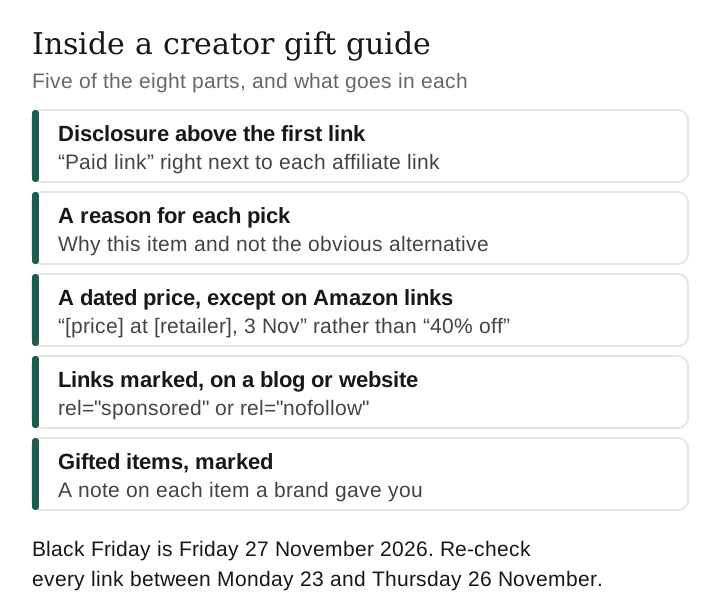
Group your picks by who the gift is for or by budget, give every pick a one-line reason and, except on Amazon links, a price with the date you saw it, and put a plain disclosure next to the links rather than only at the bottom. Publish it before the November sales, then re-check every link in the days before Black Friday, which falls on Friday 27 November 2026.
Most guides to building a gift guide are written for shops selling their own stock. A creator who links to other retailers has a different set of rules to meet: the FTC's disclosure guidance, the terms of each affiliate programme, and, on a blog, how search engines want paid links marked. This page puts each part of a gift guide next to the rule it has to meet, with the date we checked that rule.
The parts of a creator gift guide, and the rule behind each
| Part | What goes in it | The rule it has to meet (checked 1 Oct 2026) |
|---|---|---|
| 1. Disclosure, at the top and beside the links | One plain sentence, such as the FTC's own example: “I get commissions for purchases made through links in this post.” | FTC: “The closer the disclosure is to your recommendation, the better.” A disclosure only on an About page, at the end of a post or behind a “more” click is likely to be missed. Amazon Associates: the Operating Agreement (updated 15 October 2025, checked 12 Oct 2026) also requires its own statement, given below. |
| 2. Groups by recipient or budget | Who it is for, or a price band, with each group short enough to read in one scroll | No platform rule. This is an editorial choice. |
| 3. A reason for each pick | One sentence on why this item and not the obvious alternative. A wireless mic gift for a creator shows one stated pick rule; a phone gimbal gift for a creator shows another, a 4K webcam gift for a creator a third, and a key light gift for a creator’s desk a fourth. | No platform rule. If a brand sent you the item, that sentence sits next to a disclosure (row 6). |
| 4. A price and the date you saw it | “[price] at [retailer], 3 Nov” rather than “40% off” | Amazon Associates: a site may show Amazon prices only in a link Amazon serves that displays them, or with data from Amazon's Creators API or PA API (policies updated 14 April 2026). |
| 5. The links themselves | One link per pick, to the exact item you mean | On a website or blog, Google’s spam policies expect affiliate links to be “treated appropriately”, which its link-spam rules define as carrying rel="nofollow" or rel="sponsored"; its link guidance prefers sponsored for paid links. |
| 6. Gifted items, marked | A note on each item a brand gave you | FTC: if a brand gives you free or discounted products and you then mention one of its products, disclose it even if you were not asked to mention that product. |
| 7. Video and Stories versions | The disclosure inside the video or on the image, not only in the caption | FTC: in a video the disclosure belongs in the video, not just the description; on Stories, superimpose it over the picture long enough to read. |
| 8. A re-check date | The day you last clicked every link | No platform rule. Prices and stock can change between the day you write and the day a reader clicks. |

Disclosure wording you can copy
The FTC's guidance for creators, checked on 1 October 2026, accepts plain words placed where people will see them:
- On a gift guide post or page: “I get commissions for purchases made through links in this post.” This is the FTC's own example sentence. Put it above the first link, not in the footer.
- Next to an individual link: “Paid link”. The FTC says “paid link” right next to an affiliate link should be an adequate disclosure of what the link is.
- In a social post: “ad”, “advertisement” or “sponsored”, or a sentence such as “Thanks to [brand] for the free product”. A hashtag such as #ad is fine but not required.
What the FTC says does not work on its own: “affiliate link” by itself (readers may not know it means you are paid), a “buy now” button, shorthand such as “sp”, “spon” or “collab”, and a disclosure buried in a group of hashtags or links. A platform's own paid-partnership label can be used in addition to your own disclosure, but the FTC advises against assuming it is enough. For more on the wording, see affiliate disclosure rules for creators and whether gifted products need a disclosure.
A video gift guide needs it twice. The FTC's answer to a creator who puts affiliate links under product videos is to disclose the relationship both in the video and in the description near the links.
If you link Amazon through your own Associates account, add Amazon's own statement as well. Its Associates Program Operating Agreement (updated 15 October 2025, checked 12 October 2026) requires you to state, clearly and prominently on your site: “As an Amazon Associate I earn from qualifying purchases.” A substantially similar statement that the agreement allowed in the past also counts. The agreement's “site” covers your social media content as well as a website.
Prices: publish the price and the date, and check Amazon's rule
A percentage off is worked out from a list price the seller sets, so it says little on its own. A price with the date you saw it (“[price] at [retailer] on 3 November”) is a fact a reader can check, and it stays honest when the price moves.
Amazon sets its own rule. Its Associates Program Policies (updated 14 April 2026, checked 1 October 2026) let a site show Amazon prices and availability only if Amazon serves the link that displays them, or if the data comes from Amazon's Creators API or PA API under the licence terms. A price typed by hand into a gift guide meets neither condition. If you link Amazon, either leave the price out or use one of those two routes.
Where you share it
- A blog or website: mark the affiliate links
rel="sponsored"orrel="nofollow". Google’s spam policies point affiliate links to its link-spam rules, which accept paid links qualified with either value; its link guidance preferssponsored. - Email: Amazon's policies allow its links in emails, SMS and direct messages only when the reader opted in to receive them. Other programmes set their own email terms; read each one.
- Print and PDF: Amazon's policies bar its links in connection with printed material, an ebook or a mailing. If you planned a printable or downloadable guide, read that clause before you put Amazon links in it.
- Video and Stories: the disclosure goes in the video itself, and on a Stories image it is laid over the picture, per the FTC.
The 2026 dates to plan around
| Day | Date in 2026 | Source |
|---|---|---|
| Thanksgiving | Thursday 26 November | US Office of Personnel Management, federal holidays list |
| Black Friday | Friday 27 November | The day after Thanksgiving |
| Cyber Monday | Monday 30 November | The Monday after Thanksgiving |
Carrier and retailer shipping cut-offs are not on this page; the carrier dates, each with its source, are in the Q4 link calendar. Check each carrier's and retailer's own holiday page before you write “arrives by Christmas” next to a link. For when to post, see a Black Friday content calendar for creators, when to post Black Friday deals and whether it is too early to build a Q4 gift guide.
Before you publish: a short check
- The disclosure sentence sits above the first link, in plain words. If you link Amazon through your own Associates account, the guide also carries Amazon's required Associate statement.
- Every gifted item is marked as gifted.
- Every price carries a date, and no Amazon price is typed by hand.
- Every link opens the exact item you describe. Click each one; see how to audit 500 links in an afternoon.
- On a blog, affiliate links carry
rel="sponsored"orrel="nofollow". - The video or Stories version has the disclosure on screen.
- You have put a re-check date in your calendar between Monday 23 and Thursday 26 November, the days before Black Friday. The Black Friday link check lists what to look at on each link.
Frequently asked
Where should the disclosure go in a gift guide?
Next to the links and the recommendation, not only at the bottom of the post or on an About page. The FTC says the closer the disclosure is to the recommendation, the better, and that “paid link” right next to an affiliate link should be adequate (checked 1 October 2026).
Can I show Amazon prices in my gift guide?
Only in the two ways Amazon's Associates Program Policies allow: in a link Amazon serves that displays the price, or with data from Amazon's Creators API or PA API under its licence terms (policies updated 14 April 2026, checked 1 October 2026).
When is Black Friday 2026?
Friday 27 November 2026, the day after Thanksgiving, which the US Office of Personnel Management lists as Thursday 26 November 2026. Cyber Monday is Monday 30 November.
Sources
- FTC, Disclosures 101 for Social Media Influencers, fetched 1 October 2026: disclosure placement, wording (“ad”, “sponsored”, terms to avoid), gifted products, video and Stories, platform tools
- FTC, FTC's Endorsement Guides: What People Are Asking, fetched 1 October 2026: the example commission sentence, “the closer the disclosure is to your recommendation, the better”, “affiliate link” and “buy now” not adequate alone, “paid link” adequate, video plus description
- Amazon Associates Program Policies (updated 14 April 2026), fetched 1 October 2026: the price and availability rule, email and SMS links, and the offline clause on printed material, ebooks and mailings
- Amazon Associates Program Operating Agreement (updated 15 October 2025), fetched 12 October 2026: the statement an Associate must make on their site (section 5), and the definition of that site as including social media content (section 1)
- Google Search Central, Qualify your outbound links to Google, fetched 1 October 2026:
rel="sponsored"for paid links,nofollowstill acceptable - Google Search Central, Spam policies for Google web search, fetched 1 October 2026: affiliate links “with links treated appropriately”, and the link-spam rule that paid links are acceptable when qualified with
rel="nofollow"orrel="sponsored" - US Office of Personnel Management, Federal Holidays, fetched 1 October 2026: Thanksgiving Day 2026 is Thursday 26 November
Read next
Affiliate disclosure rules for creators · Amazon Associates vs a creator storefront · A Black Friday content calendar for creators
How this page was made. Researched and drafted with AI (Claude); checked by a separate automated pass on 12 October 2026. How we work