LinkToLooks · Guides · Creator Desk
Creator Desk
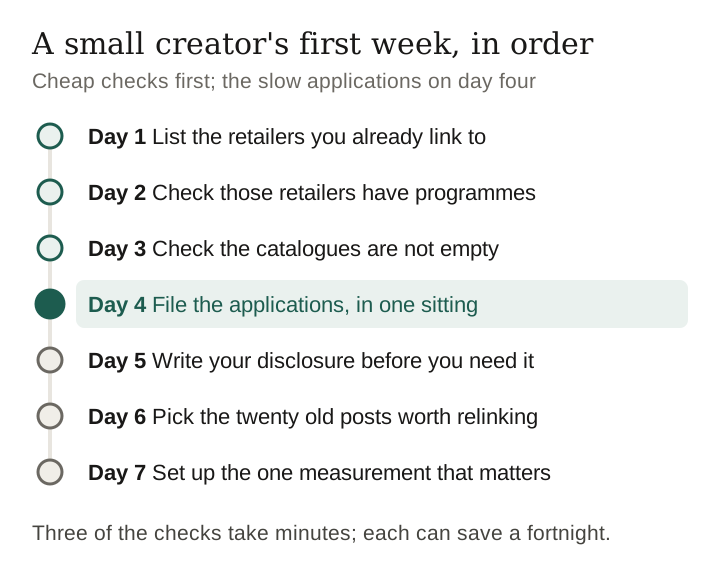
A small creator’s first week, in the right order
The tasks are not the hard part; the order is. Doing day four before days one to three is how a month disappears into an application queue.
Part of: For creators
What to do first. Not sign up for anything. The first week of monetising a small account is almost entirely research, and doing it in the wrong order is how creators lose a month waiting on an application they should never have filed. Seven days below, sequenced so that each one is only worth doing after the one before it. None of it costs money and none of it requires you to pick any particular platform, including ours.
Last verified 8 September 2026 against one affiliate network’s 2,041 US advertisers and five marketplaces’ own programme pages, read during this batch
Why the order matters more than the tasks
Most first-week advice is a list of platforms to join. The reason that fails is timing: applications are free but slow, and every one you file blindly is a week or two of waiting attached to a decision you had not made yet.
The sequence below front-loads the cheap, reversible work — counting, checking, reading — and puts the slow, irreversible work on day four, once you know which applications are worth filing. Three of the checks take minutes and each of them can save a fortnight.
Day 1 — list what you already point people at
Open your last fifty posts and write down every retailer you have mentioned or linked. Not the ones you would like to work with — the ones you have actually sent people to. Then count them and sort by frequency.
Two things usually come out of this, and both change the rest of the week:
- The list is shorter than you think. A handful of retailers usually carries most of your links.
- The tail is mostly single mentions. Most of the rest are retailers you mentioned once. Those are not worth an application each, and knowing that on day one stops you filing a stack of them.
Done when: you have a sorted list and you know which five names carry most of it.
Day 2 — check those retailers have programmes
Take the top five to ten names only and find out, for each, whether a creator programme exists and where. Start with the retailer’s own site — an affiliate or partners page is a first-party answer — and then check the affiliate network directories.
Expect this to be messier than it sounds. Directory search misleads in both directions: on 8 September 2026 the only match for “target” in one network’s US directory was Target Optical, and an exact search for Wayfair returned nothing while the directory held a Wayfair catalogue of over fourteen million products under a qualified name.
The check that settles it takes a minute: pull a few products from the candidate and look at where the links actually go. A name can be ambiguous; a hostname cannot.
Done when: each of your top names is marked with a route, or marked as having none.
Day 3 — check the catalogues are not empty
This is the step that does not appear on other checklists and it is the highest-value hour of the week.
An advertiser can be listed in a network, be unmistakably the company you meant, accept your application, and have nothing behind it. In the US directory we read on 8 September 2026, 604 of 2,041 advertisers — 29.6% — had a largest feed carrying zero products. Nearly one in three.
Where a network shows a product count, read it. Where it does not, look at whether the programme page mentions a current catalogue at all. An empty programme is not a scam, it is usually a feed that has lapsed, but the application still costs you the same fortnight.
Done when: your shortlist has been cut to programmes that exist, are the right company, and have stock.
Day 4 — file the applications, in one sitting
Now, and not before. Do them all on the same day so the waiting happens in parallel rather than in series — this is the single largest time saving in the week and it costs nothing.
Before you start, have ready: the URL of the place your audience actually reads you, an honest audience size, a one-line description of what you cover, and your tax details if you are outside the country the programme pays from. Applications that stall usually stall on the last one.
Check eligibility before you fill anything in. Some creator programmes are geographically restricted — eBay’s creator-facing route is described on its own homepage as being for US and UK based users only — and finding that out at the end of a form is avoidable.
Done when: every shortlisted application is filed and dated, so you know when to chase.
Keep reading
Day 5 — write your disclosure before you need it
You have no approvals yet, which makes this the ideal day to do it. Writing a disclosure while nothing is riding on it produces a better one than writing it the morning your first link goes live.
Two decisions to make now: the wording, and where it sits. Put it above the content rather than at the bottom, and link it to a page that explains the arrangement in plain language. A disclosure a reader has to hunt for is doing the legal job and none of the trust one.
While you are there, decide how you will mark individual links, because you will have a mix. Some of what you recommend will not be monetisable at all, and a reader who can see which links earn you nothing has been given a reason to believe the ones that do.
Done when: the wording exists, it is placed, and you know your per-link convention.
Day 6 — pick the twenty old posts worth relinking
Your back catalogue is the fastest thing to monetise because the work is already done. It is also where most of the wasted effort happens, because the obvious ordering — newest first, or best-performing first — is not the right one.
Order by whether the product is still buyable. A post about something discontinued earns nothing however well it performed, and availability varies enormously by category. Take twenty posts, check the products are still in stock somewhere, and do those first.
Twenty is a deliberate number: enough to tell you whether this is worth continuing, small enough to finish in a sitting.
Done when: you have twenty specific posts in a list, in order, with the product confirmed available for each.
Day 7 — set up the one measurement that matters
Not analytics. One thing: a way of telling which post a click came from, before you have any clicks to attribute.
Most programmes let you attach an identifier of your own to a link. Decide the naming scheme now — something that will still make sense in a year and does not depend on remembering what you posted in March — and apply it from your first link. Retrofitting it later means either relinking everything or accepting that the early months are unattributable.
This is the whole of week one’s measurement work. Anything more elaborate is premature: you have no data yet, and a dashboard with nothing in it is a way of feeling busy.
Done when: the scheme is written down somewhere you will find it.
Four things not to do this week
- Do not join everything. Applications are free and slow, and a programme you never link is a dashboard you have to check forever.
- Do not buy a tool yet. Nothing in this week needs one. Paid tiers are worth considering once you know what your links actually do, and not before.
- Do not rebuild your posting strategy around commissions. You have no data. Changing what you cover on the basis of no evidence is the most expensive mistake available in week one.
- Do not benchmark against anyone’s screenshot. Published earnings figures are self-selected by definition, and nobody posts the flat months.
And one thing we will not tell you: what any of this will earn. We have earned nothing ourselves, the terms that would determine it are set per programme, and the honest answer is that the number depends on four things nobody publishes. A checklist that ended with a projection would be a worse checklist.
Frequently asked
What should a small creator do first to start earning from links?
List the retailers you already send people to and sort them by frequency, before joining anything. The list is usually short and concentrated, and it decides which applications are worth filing.
How many affiliate programmes should I apply to in week one?
Only the ones covering the retailers at the top of your own list, and only after checking each is the right company and has a live catalogue. Filing them all on one day means the waiting happens in parallel.
Do I need followers before applying to affiliate programmes?
Requirements are set per programme and many state none publicly. We hold zero approvals, so we are not going to quote a threshold we have not verified — check each programme’s own page.
Should I disclose affiliate links before I have any?
Write the disclosure in week one, while nothing depends on it. Place it above the content and link it to a plain-language explanation.
What should I link first from my back catalogue?
The posts whose products are still buyable, not the newest or best-performing ones. Availability varies sharply by category, and a post about a discontinued product earns nothing however well it did.
Where these steps come from
The directory and empty-catalogue figures come from the 2,041 distinct US advertisers visible to our own affiliate publisher token. The eligibility example was read on eBay Partner Network’s own homepage the same day.
What this cannot show. We have no approvals and no earnings, so nothing here is a report of what worked — it is an ordering derived from where the delays and the dead ends demonstrably are. Programme requirements, approval times and rates are set per advertiser and we quote none of them. And a creator whose audience buys from retailers with no programmes at all will find days two and three end differently, which is itself worth knowing on day three rather than in month two.
Keep reading
How this page was made. Drafted with AI (Claude); not yet independently re-checked. How we work