LinkToLooks · Guides · Creator Desk
Creator Desk
The questions to ask before joining any affiliate program
Joining costs nothing, which is why nobody reads the terms. Twelve questions with the reason each matters — and four we would find awkward ourselves.
Part of: For creators
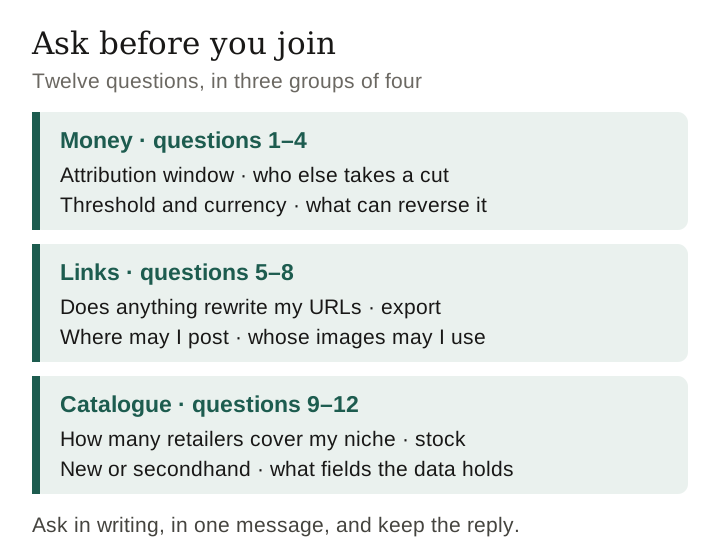
Why a checklist at all. Joining a programme is free, so the decision feels like it has no downside. The cost is not the joining; it is the months of posts you build on top of it before you find out what the terms say. Twelve questions, each with the reason it matters and what a real answer looks like — and four at the end that we would find uncomfortable if you turned them on us.
Last verified 8 September 2026 against 6,953 live US affiliate listings and four creator-tool pricing pages
Four questions about the money
1. What is the attribution model and the window?
Why it matters: almost every creator assumes last click and a long cookie. Both are set per programme, and neither is a law of nature. A short window and a first-click model produce a completely different outcome for someone whose audience researches before buying.
A real answer names the model, the window in hours or days, and what happens when a shopper touches two creators’ links. “Standard” is not an answer.
2. Who else takes a cut before I see it?
Why it matters: the programme rate is not the only deduction. Tools in the middle take one too, and this is the number the industry is quietest about. We read four creator-tool pricing pages on 8 September 2026: two of them advertise keeping 100% of affiliate commissions as a paid upgrade — at $25 and $30 a month billed annually — and neither page states what the tier below deducts. The benefit is published; the deduction is not.
A real answer is a percentage, in writing, and the tier it applies to.
3. What is the threshold, the schedule and the currency?
Why it matters: a balance that has not reached a threshold is not money. Neither is a balance in a currency your bank will convert at its own rate. For a creator outside the United States both apply at once.
A real answer gives a number, a payment day, a method, and what happens to a balance that never reaches the threshold.
4. What can reverse a commission, and how long can it stay reversible?
Why it matters: returns, cancellations and fraud screening all claw earnings back, sometimes months later. The locking period is the honest version of “how much have I earned”.
A real answer names the locking period and the reversal reasons. If the answer is that reversals are rare, ask for the rate.
Keep reading
Four questions about the links
5. Will anything in the chain rewrite my URLs?
Why it matters: this is more common than it sounds. In tonight’s pull of 6,953 live US listings, 4,905 destination URLs — 70.5% — already carried a query string before anyone added tracking, with a median URL length of 87 characters and a longest of 658. Any link tool, email service or shortener that rewrites, truncates or reorders parameters is operating on a URL that already has parameters that matter.
A real answer is a yes or no plus a test: send one live link through the whole chain and confirm the click appears in the dashboard.
6. Can I get my link list out, and in what format?
Why it matters: of four creator-tool pricing pages we read on 8 September 2026, exactly one named data export, and it sat on the top consumer tier. The others do not mention it. An export you cannot get is a migration you cannot do.
A real answer is a file format and a list of the columns, including whether the unwrapped destination URL is one of them.
7. Am I allowed to link where I actually post?
Why it matters: programme terms and platform rules are two separate permission systems, and both can forbid what the other allows.
A real answer names the surfaces — email, video descriptions, forums, closed groups, paid ads on the brand’s own terms — rather than saying “anywhere you have an audience”.
8. Whose images am I allowed to use?
Why it matters: product feeds exist to be republished by publishers, which is why we use retailer packshots and credit them. That is not the same as a licence to use a brand’s lifestyle photography, and the two arrive through the same integration.
A real answer distinguishes feed imagery from press and campaign imagery.
Four questions about the catalogue
9. How many retailers actually cover my niche?
Why it matters: a network directory of thousands of brands can still be one supplier in your category. Tonight, seven sustainable-fashion keywords returned 1,890 US rows from 17 advertisers — and one of them held 1,750 of the rows. Three of the seven searches returned exactly one retailer.
A real answer is a count of live advertisers in your categories, not a total for the network.
10. Does the feed tell me when something is gone?
Why it matters: of 31 advertisers supplying ten or more rows tonight, 19 never marked a single row out of stock. For those retailers the availability field is a constant, so any tool promising to keep your links fresh has nothing to read.
A real answer is candid that the field is populated by the retailer, and says which of them populate it.
11. Is the inventory new or secondhand?
Why it matters: 3,106 of tonight’s 6,953 rows (44.7%) are marked used. A secondhand listing is one of one; when it sells there is no equivalent to swap in, and your post stops pointing at anything. That is a content-planning fact before it is a revenue one.
A real answer is a share, per category.
12. What does the data actually contain?
Why it matters: sizes, colours, barcodes and variant groupings decide whether you can link the right thing rather than something adjacent. Missing fields are invisible until you need them.
A real answer is a field list with fill rates. Nobody will have that to hand, which is itself worth knowing.
The four we would find awkward
A checklist that only points outward is marketing. These are the ones we would rather you did not ask us, which is exactly why they belong here, with our own answers.
- “How much have you actually paid creators?” Nothing. We hold no affiliate approvals, so we have paid out nothing to anyone. Any platform that answers this with a testimonial rather than a number is answering a different question.
- “Can I sign up right now?” Not with us. There is no self-serve account; we build a storefront only when a creator asks for one, and it is published only with that creator’s written OK. Every tool we compared can be started this afternoon and we cannot, and if that is what you need then one of them is the answer.
- “How many creators are on it?” Ask this of anyone, including us, and notice whether you get a number or an adjective. We have no connected creators to point at.
- “Show me the rows behind that statistic.” The best question on this page and the one almost nobody asks. Every figure above comes with its seed list, its date and its method, because a number without its scope is a rumour with a decimal point. If a platform quotes you a conversion rate, an average order value or a category size, ask what query produced it and when. Ours are in the method note below.
How to ask, and what a bad answer sounds like
Ask in writing, in one message, and keep the reply. Support answers are not contracts, but a written answer is evidence of what you were told, and the act of putting twelve questions in one email filters out programmes that will not be reachable later either.
Three answer shapes worth treating as red flags, in ascending order of seriousness:
- The link to a help page that does not contain the answer. Common, usually laziness rather than evasion. Ask again.
- The number without a scope. “Creators earn an average of X” with no denominator, period or population. This is the single most common way a true sentence is used to mislead.
- The reassurance in place of a figure. “Reversals are rare”, “most creators find”, “you keep the vast majority”. Whoever said it has the number and chose an adjective instead.
And one practical note: none of this means you should not join. Joining is cheap and reversible. The point of asking first is to know which of your assumptions is wrong before you have built two hundred posts on top of it.
Frequently asked
What should you ask before joining an affiliate program?
The attribution model and window, who else deducts a cut, the payment threshold and currency, what reverses a commission and for how long, whether anything rewrites your URLs, whether you can export your link list, where you are allowed to post, whose images you may use, how many retailers cover your niche, whether the feed reports availability, whether inventory is new or secondhand, and what fields the data actually contains.
Do affiliate tools take a percentage of your commission?
Two of the four creator-tool pricing pages we read on 8 September 2026 advertise keeping 100% of affiliate commissions as a paid upgrade, at $25 and $30 a month billed annually. Neither states what the cheaper tiers deduct, so the figure has to be requested in writing.
How do you check whether a program has inventory in your niche?
Ask for a count of live advertisers in your categories rather than the network total. In one sustainable-fashion pull on 8 September 2026, 17 advertisers appeared and a single marketplace supplied 1,750 of the 1,890 rows.
Is a long cookie window better?
Usually, but the model matters as much as the length. Ask which touch gets credited when a shopper clicks two creators' links, because a long window on a first-click model behaves nothing like a long window on last click.
What is a red flag in an affiliate program's answer?
A statistic with no scope. If a platform quotes an average earning, conversion rate or catalogue size without a date, a population and a method, the number cannot be checked and should not be relied on.
Where these came from
The catalogue figures are from this run’s own live pull; the pricing-page figures were read on 8 September 2026 from each company’s public pricing page. We have not joined the programmes discussed, we hold no network approvals, and this is a list of questions rather than a rating of anybody’s answers.
The seed list ships with the page. A method you cannot repeat is not a method. The 24 keyword seeds behind every figure here were: vintage denim jacket, leather handbag, running shoes, hiking boots, wool scarf, gold necklace, vinyl record, vhs tape, trucker hat, mini skirt, platform sandals, sunglasses, air fryer, electric kettle, cordless drill, office chair, dog bed, coffee mug, throw pillow, table lamp, yoga mat, bluetooth speaker, hardcover book, board game. Scope: root shoppingProducts, arguments keywords and advertiserCountries:["US"], four pages of 100 rows per seed, deduplicated on advertiser + title + destination URL, then post-filtered on each row’s own targetCountry. Asking price is salePrice where the row carries one and price otherwise. Peer-to-peer asks of $500 and over and repeated-digit asks are dropped as seller placeholders. No totalCount is quoted: on a keyword pull the API OR-matches the words, so the count is not coherent.
Keep reading
How this page was made. Drafted with AI (Claude); not yet independently re-checked. How we work