LinkToLooks · Guides · Reference Desk
Reference Desk
What do the numbers stamped inside a ring mean?
A three-digit number is parts per thousand of precious metal — and in a live catalogue check, the listing almost never repeated it.
The number stamped inside a ring is a fineness mark: the parts per thousand of precious metal in the alloy. 925 is sterling silver, 585 is 14 carat gold, 750 is 18 carat, 375 is 9 carat, and 950 is almost always platinum. A letter-and-number mark like 14K says the same thing in the older carat system, where the number is parts per 24.
It is worth knowing because the listing usually will not tell you. Of 40 signet ring listings we examined in a live catalogue pull on 3 September 2026 — a search whose own wording contained no metal at all — two stated a fineness in the title. The stamp inside the band is often the only place the information exists.
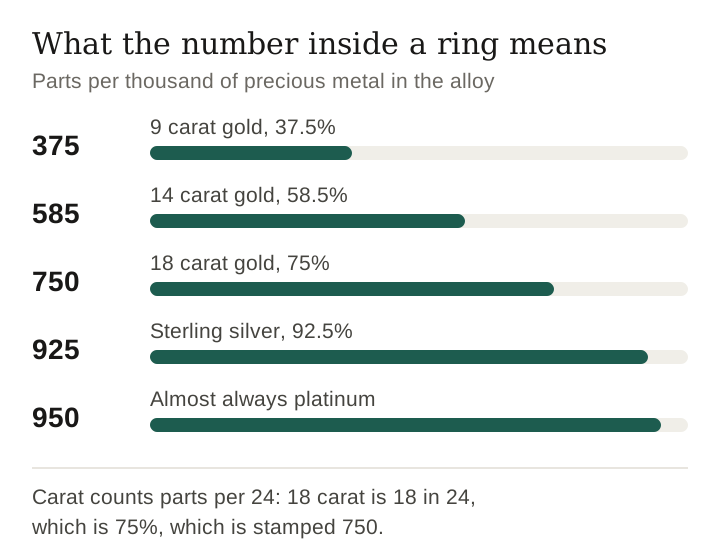
Gold numbers, and what each one means
Millesimal fineness states parts per thousand of pure metal by mass. The carat system states parts per 24, so 18 carat is 18⁄24, which is 75%, which is stamped 750. The two systems describe the same alloy in different units.
| Stamp | Carat | Gold content | Where you meet it |
|---|---|---|---|
| 999 | 24 ct | 99.9% | Bullion, not jewellery — too soft |
| 916 | 22 ct | 91.6% | Standard for jewellery in some countries including India; British sovereigns |
| 750 | 18 ct | 75% | Typical for modern jewellery in much of Europe, and the maximum used for gemstone-set pieces because the metal has to hold the stone |
| 585 | 14 ct | 58.5% | The most common fineness for jewellery in the United States |
| 417 | 10 ct | 41.7% | Historically the minimum standard for gold in the US |
| 375 | 9 ct | 37.5% | Minimum standard in the UK, Australia, Canada, New Zealand, Ireland, Austria, Portugal and France |
| 333 | 8 ct | 33.3% | Minimum in Germany since 1884, and in Denmark, Greece and Mexico |
Two details in that table repay attention.
585 is not exactly 14 carat. Fourteen twenty-fourths is 583.3, and the stamp rounds up. Fineness marks are rounded to three figures, so the number on the ring can differ slightly from the arithmetic.
The minimum that may legally be called gold varies by country, and the US minimum changed. Ten carat was historically the US floor; since the revision of the FTC Guides in August 2018, any marked carat is permissible there, down to one carat. A very low mark on a modern American piece is therefore not automatically a fake — it may be exactly what it says.
You will also see the same information written as 14K, 18K or 9ct. Decimal stamps are the European convention; carat marks are current US practice and were standard in the UK before the 1970s. Neither is more trustworthy than the other.
Silver numbers
| Stamp | Name | Silver content | Note |
|---|---|---|---|
| 999 | Fine silver | 99.9% | Bullion. Too soft for most jewellery |
| 958 | Britannia silver | 95.8% | British standard, 23⁄24 |
| 950 | French first standard | 95% | |
| 935 | Swiss watchcase standard | 93.5% | Adopted after 1887 to sit level with sterling; also Art Deco Austria and Germany, and post-war Scandinavian jewellery |
| 925 | Sterling silver | 92.5% | 92.5% silver by weight, the balance usually copper. Used in the UK since the early 12th century |
If a ring is marked 925 it is sterling. If it is marked 925 and is unmistakably gold-coloured, it is almost certainly silver-gilt — gilded silver, known in American English by the French term vermeil. The mark describes the metal underneath, not the surface.
Platinum numbers
Platinum is stamped on the same parts-per-thousand basis and the numbers sit high: 950 is the most common purity for platinum jewellery, with 900, 850 and 750 also in use, and 999 or 999.5 reserved for bullion.
The number alone is the ambiguity. A ring stamped 950 is far more likely to be platinum than French-standard silver, but the number does not say which metal it describes, and this is exactly where a word-mark next to it — PLAT, PT950, Ag — is doing the real work.
The marks that are not fineness at all
Most rings carry more than one stamp, and only one of them is the number above. Confusing the others is the commonest mistake.
- A hallmark is an official mark, or a series of them, struck to certify the noble-metal content. In countries with a compulsory assay system it is applied by an assay office rather than by the maker, which is what makes it different from everything else on the ring.
- A maker’s or sponsor’s mark is initials in a shaped surround. It identifies who submitted the piece, and says nothing about purity.
- A date letter, where the system uses one, is a single letter in a distinctive shield. It is the most useful mark for dating a piece and the easiest to mistake for a maker’s initial.
- GF, GP, RGP, and fractions like 1/20 12K GF are not fineness marks. They describe a layer of gold over a base metal, and we have a separate page on telling those apart.
- A ring size number — a bare 6, 7 or 54 with no other digits — is a size, not a metal. If the number is small and stands alone, that is what it almost always is.
A useful discipline: a fineness mark is three digits, or a number followed by K or ct. Anything else is telling you something else.
Reading a mark you cannot quite see
Marks on rings are small, curved and worn, which is why so many end up guessed at.
- Look on the inside of the band, opposite the front. On a signet ring the marks are usually near the join, where the shank meets the head.
- Use raking light. A lamp low and to one side casts shadow into the stamped depression. Light from directly in front is the worst possible angle and is the one everybody uses.
- Photograph it, then enlarge it. A phone camera close to its minimum focus distance, then pinch to zoom, beats squinting. It also gives you something to compare against a reference later.
- Expect it to be incomplete. Decades of wear rub the shallowest strokes away first, and a worn 585 can read as 585, 685 or 58S depending on the angle.
- Treat the mark as a claim, not a proof. A stamp is evidence of intent. In a compulsory-assay country a full hallmark is considerably stronger, because a third party struck it. Anything you are spending real money on should be tested, not read.
What a listing will and will not tell you
We pulled live jewellery listings on 3 September 2026 to see how often the metal is stated where a buyer would actually look.
| Pull | Listings | Retailers | Median price | Stated a fineness in the title |
|---|---|---|---|---|
| Signet rings (seed term contained no metal word) | 99 | 11 | $48.00 | 2 of 40 examined |
| Gold rings (seed term contained ‘14k’) | 412 | 5 | $530.00 | All of them — which is the search, not a finding |
The second row is in the table as a warning about our own method: search for a metal and every result mentions the metal. It measures the query, not the catalogue. The first row is the honest one, and it says that when nobody searched for a metal, almost no listing volunteered one.
The practical consequence for a buyer is small and firm: the number inside the band is frequently the only statement of what the ring is made of that you will get. Read it before you buy, not after.
Frequently asked
What does 925 mean on a ring?
Sterling silver: 92.5% silver by mass, the rest usually copper. It is a fineness mark in parts per thousand.
What does 585 mean?
14 carat gold, 58.5% gold. Fourteen twenty-fourths is precisely 583.3, and the stamp is rounded to three figures.
Is 750 better than 375?
It contains twice the gold — 75% against 37.5% — and it is softer. Higher fineness is not automatically the better choice for a ring worn daily, which is why 750 is the maximum used for gemstone-set jewellery.
What if there is no number inside the ring at all?
It means nothing conclusive on its own. Marks wear away, and not every country has required them at every date. An unmarked ring needs testing rather than reading.
Does the stamp prove the metal?
No. It is a claim by whoever struck it. A full hallmark from a compulsory assay system is far stronger evidence, because an independent office applied it.
Sources and method
- Fineness values and national minimums: Fineness on Wikipedia, including the millesimal tables for gold, silver and platinum and the August 2018 change to the US FTC Guides.
- Sterling silver: Sterling silver — 92.5% silver by weight, minimum millesimal fineness 925.
- What a hallmark is: Hallmark.
- Gilded silver: Silver-gilt, the term American English renders as vermeil.
- The catalogue measurement: 99 signet ring and 412 gold ring listings pulled live on 3 September 2026, US-priced rows only, filtered strictly on the listing title; title inspection was on a 40-listing subset of each.
- We have not handled any of these rings. We priced them and read their listings. Everything above about marks comes from the cited references, not from an object in our hands.
Last verified 3 September 2026 against 99 signet ring and 412 gold ring listings pulled live, plus the cited fineness references
How this page was made. Drafted with AI (Claude); not yet independently re-checked. How we work