LinkToLooks · Guides · Reference Desk
Reference Desk
Signet ring prices compared: $3.99 to $1,120 for one shape
The one jewellery category with real retail choice — and a price range that turns out to be tracking information, not metal.
A signet ring costs a median of $48.00 across 99 live US listings on 3 September 2026, and the range is the story: $3.99 to $1,120.00. Half the market sits between $28.00 and $125.00.
This was also the one jewellery category in our pull with real retail depth — 11 distinct retailers, where the other eight categories we measured returned one, two or three. If you want to compare sellers rather than sellers on one marketplace, this is where it is possible.
Last verified 3 September 2026 against 99 live US signet ring listings
Who sells them, compared
| Retailer | Listings | Share of the pull | Type |
|---|---|---|---|
| Poshmark | 72 | 73% | Resale marketplace |
| Sami Jewels | 6 | 6% | Retailer or brand |
| Jewlr | 6 | 6% | Retailer or brand |
| Antonioli | 5 | 5% | Retailer or brand |
| Jared The Galleria of Jewelry | 3 | 3% | Retailer or brand |
| HBX | 2 | 2% | Retailer or brand |
| Hobby Lobby | 1 | 1% | Retailer or brand |
| Christianbook.com | 1 | 1% | Retailer or brand |
Even here the marketplace is 72.7% of the rows. What makes this category different is that the remaining quarter is spread across ten named retailers rather than one, which is the first time in this batch we have been able to write the word “compared” honestly.
The retail names divide into three groups that price very differently: a mall jeweller, a personalisation specialist, and two fashion retailers whose signet rings are design objects at design prices.
The price distribution
| Measure | Value |
|---|---|
| Listings | 99 |
| Median effective price | $48.00 |
| Middle half | $28.00 – $125.00 |
| Cheapest | $3.99 |
| Dearest | $1,120.00 |
| Median list price | $56.00 |
| Under $100 | 72 of 99 |
| Carrying a markdown | 43 (43.4%) |
Every price here is the effective price — the sale price where a listing carries one, otherwise the list price. Feed placeholders ($999, $7,777, $999,999) are excluded. Prices move; this pull is dated 3 September 2026.
The interquartile range here — $28.00 to $125.00 — is unusually wide for a single product shape. A signet ring is a flat face on a band. That the middle half of the market spans four and a half times in price tells you the shape is not what you are paying for.
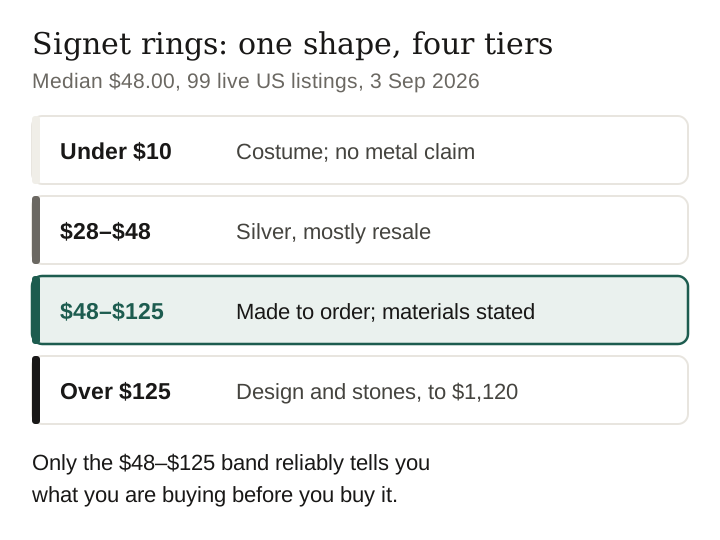
Four tiers, with what changes between them
Under $10 — costume
- Rhinestone and base-metal rings from general retailers
- No metal claim of any kind in the listing
- The cheapest listing in the whole pull sat here
- Bought for a look, not for a finger you wear it on daily
$28 to $48 — silver, mostly resale
- The largest cluster, and where the median sits
- Sterling appears in some titles; plating in others; nothing in most
- Predominantly secondhand listings from individual sellers
- The band where reading the stamp matters most, because nobody else is vouching for it
$48 to $125 — the made-to-order band
- Named jewellers and personalisation specialists appear here
- Engraving, monogramming and stone-setting become options
- Listings state materials because the seller is a business
- The first band where a returns policy comes with the ring
Over $125 — design and stones
- Fashion retailers and stone-set rings, up to four figures
- The dearest listing in the pull was $1,120.00
- Ruby, malachite and inlay listings cluster here
- You are paying for the maker and the stone, not the gold weight
Keep reading
The thing the price is really tracking
Of 40 listings we read closely, two stated a metal fineness in the title. Two. In a category where the difference between a plated brass ring and a 9-carat one is most of the price.
So the honest reading of the distribution above is not “cheaper rings are worse”. It is that price is standing in for information the listing is not giving you, and a higher price mostly buys you a seller who will answer a question.
Our editorial judgement, for what it is worth: in this category the $48–$125 band is the only one where you can reliably find out what you are buying before you buy it. Below it you are reading a stamp in a photograph; above it you are paying for a name.
Frequently asked
How much does a signet ring cost?
A median of $48.00 across 99 live US listings on 3 September 2026, with half the market between $28.00 and $125.00.
Where can you buy one?
This was the most retail-diverse jewellery category we measured: 11 distinct retailers, including a mall jeweller, a personalisation specialist and two fashion retailers, alongside a resale marketplace holding about three quarters of the listings.
Why do prices vary so much for the same shape?
Metal, stones and who made it. The shape is constant; the material is not, and only two of the forty listings we read closely stated what it was.
Are cheap signet rings solid metal?
Usually not, though the listings rarely say so either way. Below the median the metal is generally plated, and the absence of a stamp claim is itself informative.
Can signet rings be engraved?
That is what the flat face is for, and the personalisation sellers in this pull offer it. Engraving a secondhand ring is possible but is a separate job at your own cost.
Method and limits
- 99 US-priced in-stock listings pulled 3 September 2026 through the CJ shopping-product API, de-duplicated on retailer, title and destination URL, filtered on the word “signet” in the title.
- Prices are effective prices; feed placeholders are excluded.
- Title inspection was on a 40-listing subset.
- Not verified: the metal, weight or engraving options of any individual ring. We priced these listings; we have not handled one.
- One seed term, one network, one morning. Other retailers certainly sell signet rings and did not appear here.
Keep reading
How this page was made. Drafted with AI (Claude); not yet independently re-checked. How we work