LinkToLooks · Guides · Creator Desk
Creator Desk
What should you look for in a creator storefront?
Nine questions, ordered by what they cost when the answer is wrong, written so they work just as well against the company that published them.
Part of: For creators
Assess a creator storefront on nine questions, in this order: what happens when a link dies, who owns the URL, whether you control search indexing, whether you approve each product before it publishes, how deep the catalogue is in your category, how payouts actually work, whether you can export your data, how disclosure is handled, and what it costs. Everything else is presentation. The first and the seventh are the ones that cost real money when they are wrong.
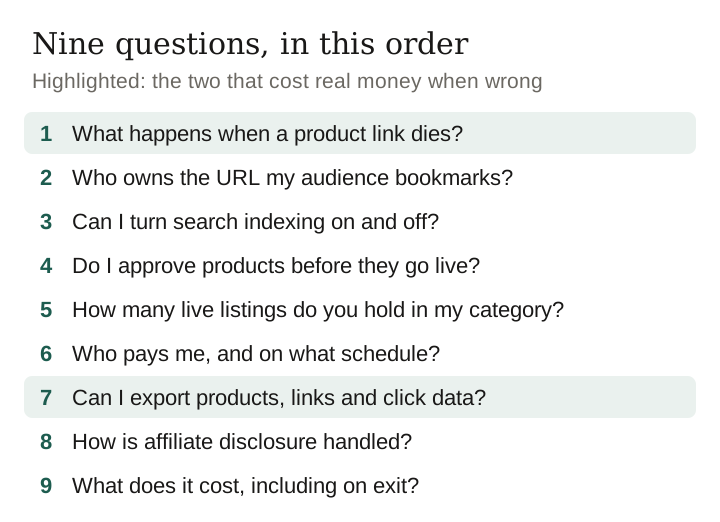
The nine questions
Written to stay useful even if you end up choosing a competitor, because a checklist that only one product can pass is an advertisement. Print it, take it to a demo, and ask for an answer you can check rather than a feature name.
| # | Question | What a good answer sounds like |
|---|---|---|
| 1 | What happens when a product link dies? | A named, automatic behaviour — detection, replacement or removal — not “you can edit it yourself”. |
| 2 | Who owns the URL my audience bookmarks? | You can point your own domain at it, or at minimum export and redirect. |
| 3 | Can I turn search indexing on and off? | A single explicit control, and a clear statement of the default. |
| 4 | Do I approve products before they go live? | Yes, item by item, with a way to reject. |
| 5 | How many live listings do you hold in my category? | A number, for your category, dated. |
| 6 | Who pays me, and on what schedule? | The network pays you, or the platform does — and which, plainly. |
| 7 | Can I export products, links and click data? | Yes, in a file format, without asking support. |
| 8 | How is affiliate disclosure handled? | Automatically and visibly on the page, not left to you. |
| 9 | What does it cost, including on exit? | A price, and what happens to your pages if you stop paying. |

1. What happens when a link dies
This is first because it is the failure that happens to every creator and is discussed the least. Products go out of stock, listings are removed, resale items sell to one buyer and vanish. A storefront that quietly keeps serving dead links converts your best-performing post into a page of disappointments, and you will not notice until someone tells you.
- Ask what detects the death: a scheduled re-check, a click-time check, or nothing.
- Ask what happens next: silent removal, replacement with a similar item, or an honest “no longer available”.
- Ask how you find out. An email is fine; nothing is not.
- Ask when it last ran on your own storefront. A feature that exists and has not run this month is not a feature.
2-4. Ownership, indexing and approval
Who owns the URL
Every follower who bookmarks your storefront is bookmarking somebody’s domain. If it is not yours and cannot become yours, every one of those bookmarks is an asset you are renting. Custom domains are the clean answer; a documented export and redirect path is an acceptable one.
Indexing control
Some creators want their storefront in search results, because it is a shopping page that answers shopping queries. Others emphatically do not, because they do not want a permanent public record of what they were paid to recommend. Both are reasonable and the platform should not decide for you: ask for a single control and ask what the default is.
Product approval
Any system that matches products to your posts will occasionally match the wrong thing. The question is whether the wrong thing publishes. Item-by-item approval before anything goes live is the only arrangement that keeps a bad match from becoming your recommendation.
Keep reading
5. Catalogue coverage in your category
Total catalogue size is the least useful number a platform can give you, and it is the one always quoted. What matters is depth in the two subcategories you actually post about, and depth varies enormously between them. From live US listings we pulled on 2 September 2026:
| Subcategory | Live listings matched | Distinct retailers |
|---|---|---|
| Webcams and microphones | 186 | 26 |
| Candles | 182 | 18 |
| Cookware | 172 | 16 |
| Dumbbells | 124 | 18 |
| Resistance bands | 15 | 4 |
| Yoga mats | 7 | 3 |
Method: CJ product API, US advertisers, keyword pulls filtered to titles naming the product type and de-duplicated by link and title, pulled 2 September 2026. Illustrative of variation between subcategories, not a measure of any platform's catalogue.
A creator whose category looks like the bottom two rows has a different problem from one whose category looks like the top two, and no storefront feature fixes it. Ask for the number in your category, with the date it was counted.
Last verified 2 September 2026 against live CJ product-feed pulls taken on that date, used here to illustrate how far catalogue depth varies between subcategories
6-7. Payouts and data export
Who actually pays you
Two arrangements exist and they are not equivalent. Either the affiliate network pays you directly and the platform is a publishing tool, or the platform collects and pays you. The second adds a party between you and your money, which is not automatically worse — it can mean one payment instead of nine — but you should know which one you are in, what the threshold is, and what happens to a pending balance if you leave.
Export, the question nobody asks
The cost of leaving a platform is decided on the day you join it. If your product list, your affiliate links and your click history cannot be exported to a file, then switching later means rebuilding your storefront by hand and losing every measurement you have made. Ask to see an export before you commit anything you would mind losing.
8-9. Disclosure and cost
- Disclosure should be automatic and visible on the page. A platform that leaves it to you has handed you a compliance obligation and called it flexibility.
- Ask what happens to your pages if you stop paying. Do they go offline, go read-only, or stay up with the links stripped? Every answer is defensible; not knowing is not.
- Ask what the free tier costs in exchange. Sometimes it is branding, sometimes it is a share of the commission, sometimes it is your audience data.
Using this against the platform that wrote it
We build creator storefronts, so the fair thing is to say where a reader should push hardest on us and where a competing approach is genuinely better.
- A manual link-in-bio page beats any storefront when you promote fewer than about ten products and want total editorial control. Fewer moving parts, nothing to go stale, no platform to leave.
- A network’s own storefront beats an independent one when you are already deep inside that network and want a single payout relationship.
- Any platform without an export is a worse deal than it looks, including ours if we ever ship one, and that is the question to ask us first.
Frequently asked
What should I look for in a creator storefront platform?
Nine things, in this order: what happens when a link dies, who owns the URL, whether you control search indexing, whether you approve products before they publish, catalogue coverage in your own category, payout mechanics, data export, disclosure handling, and cost.
Is a storefront better than a link-in-bio page?
They do different jobs. A link-in-bio page routes people to destinations; a storefront is a destination that holds products. Many creators need both, and some need neither.
What is the most overlooked question?
Data export. If you cannot export your product list, your links and your click data, then changing platform later means rebuilding from nothing, and that cost is invisible on the day you sign up.
Does a creator storefront help with search traffic?
Only if it is indexable and you want it indexed. Ask specifically whether you can turn indexing on and off, because the right answer differs by creator and the default is rarely explained.
Should the checklist favour any particular platform?
No, and this one is written so it can be used against us. LinkToLooks builds creator storefronts, so we are one of the things being assessed here.
Sources and scope
- Catalogue-depth figures: CJ product API, US advertisers, pulled 2 September 2026. They illustrate subcategory variation and are not a measurement of any platform.
- No competitor feature is described here, because we only publish competitor facts we have verified on their own public pages.
- No earnings, conversion or commission figure is asserted.
How this page was made. Drafted with AI (Claude); not yet independently re-checked. How we work