LinkToLooks · Guides · Creator Desk
Creator Desk
If two creators link the same product, who gets the commission?
The published rule, the 6.3% of products that two retailers both carry, and the blank where every other network's answer should be.
Part of: For creators
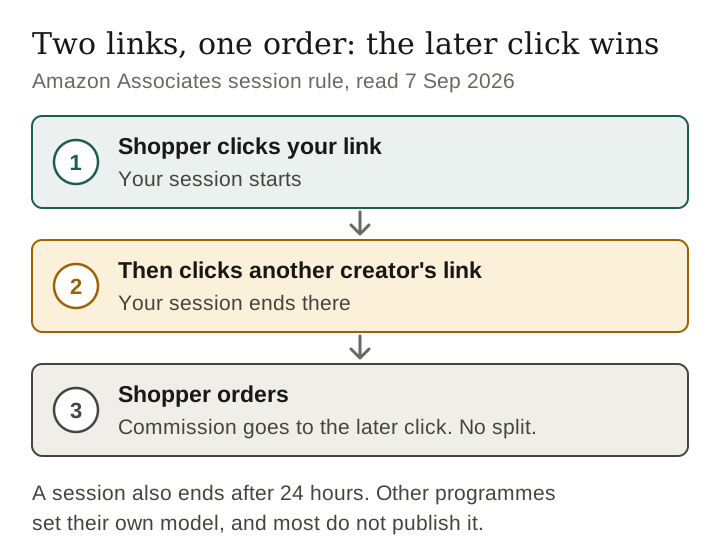
Under the one set of affiliate terms we can quote in full, the second creator wins. Amazon’s Program Policies define a session as beginning at your click and ending at the first of three things — 24 hours elapsing, the customer ordering a non-digital product, or the customer clicking through “a Special Link to an Amazon Site that is not your Special Link”. That third clause is the whole answer. A later click does not split the commission with you; it ends your session.
What we cannot tell you is whether the programme you are on works the same way, because almost nobody else publishes it.
What the published terms actually say
| Programme | What the published terms say about a competing click | Where |
|---|---|---|
| Amazon Associates | The session ends when the customer clicks through a Special Link that is not yours. Purchases after that point are not yours, and there is no split. | Associates Program Policies, Commission Income Statement §1(b)(z) |
| CJ Affiliate advertisers | Attribution model and window are configured per advertiser, so there is no single network answer and two links in one post can behave differently. | Per-advertiser programme terms |
| Creator platforms (LTK, ShopMy, Mavely) | Not published. The behaviour is inherited from whichever retailer programme sits behind the link. | Not published |
Read the middle row twice. “Last click wins” is repeated as though it were a law of affiliate marketing. It is a setting, and on a network it is the advertiser’s setting, not the network’s and certainly not the industry’s. First-click and split-attribution models exist. We cannot show you which advertisers use them, because they do not say.
How often is it the same product at all?
The question assumes two creators are pointing at one listing. We measured how often that is even possible. Across 1,711 priced US rows pulled on 7 September 2026 from eight unrelated seed searches:
| Measure | Result |
|---|---|
| Distinct product titles, normalised | 537 |
| Titles carried by more than one advertiser | 34 — 6.3% |
| Rows sitting on one of those shared titles | 613 of 1,711 — 35.8% |
| Distinct advertisers in the whole pull | 34 |
| Share held by the top three advertisers | 88% |
Method below. Titles were lowercased and stripped of punctuation before comparison, which is a loose match and therefore an over-count of true product overlap, not an under-count.
Two numbers pull in opposite directions and both matter. Only 6.3% of distinct titles appear at more than one advertiser — so most of the time, two creators covering the same category are linking two different listings and no attribution contest arises. But 35.8% of rows sit on a shared title, because the shared ones are the generic ones: “coffee mug” is the entire title of listings at three separate advertisers in this pull, and “running shoes” at two.
The real overlap risk is not the product. It is the advertiser. Three advertisers hold 88% of these rows, so two creators in the same niche are overwhelmingly likely to be sending traffic to the same retailer, through the same network, under the same attribution setting. Whether they picked the same listing barely matters.
What last click changes about what you post
- Being early is worth nothing on its own. If attribution is last click, the value of your post is not when it was published but whether it was the last thing touched before the order.
- Deal aggregators and coupon sites are the competing click. A shopper who leaves your post to look for a code, then returns through someone else’s link, has ended your session under Amazon’s definition. This is the single most common way a commission you expected does not arrive.
- Add-to-cart is the defence where the terms allow it. Under the same Amazon terms, a product added to the cart during your session stays attributable for up to 89 days from the initial click.
- Considered purchases are the exposed ones. The $385.99 office chair in this pull is going to be researched across several sessions; the $12.0 pair of earbuds is not.
- Do not build a strategy on a model you have not read. Check the attribution language for the two or three programmes you actually run, in the terms, not in a blog post.
The blank we are not filling
We also cannot tell you how often a session is actually ended by a competing click rather than by the 24-hour clock. That would need click data from a live account, and we hold none — no network has approved us.
Keep reading
Method and scope
- Terms: Amazon Associates Program Policies (the page states Updated: April 14, 2026) and Operating Agreement (Updated: October 15, 2025), both read on 7 September 2026.
- Overlap measurement: The eight seeds, published so this can be re-run: running shoes, espresso machine, leather handbag, office chair, wireless earbuds, dog bed, coffee mug, hiking boots. Root
shoppingProducts, keyword filter only, three pages of 100 rows per seed, deduplicated on advertiser plus title plus link, then post-filtered on each row’s owntargetCountry. Asking price is the sale price where a row carries one and the list price otherwise; peer-to-peer asks of $500 or more and repdigit asks are dropped as placeholders. 1,743 US rows, 1,711 of them priced, 34 advertisers, 7 September 2026. - Not measured: how often a competing click actually ends a session, conversion, or any earnings figure. We have no account data of any kind.
Frequently asked
If two creators link the same product, who gets the commission?
Under the Amazon Associates Program Policies, the later click. A session ends when the customer clicks through a Special Link that is not yours, so the purchase belongs to whoever was clicked last. There is no split. Other programmes set their own model and most do not publish it.
Is last-click attribution universal?
No, and treating it as universal is the mistake. On a network like CJ Affiliate the model and window are configured per advertiser, so two links in the same post can behave differently. We could not verify the model used by any creator platform against a public source.
Does posting first protect my commission?
Not under last-click terms. Publication order is irrelevant; what counts is the last affiliate link the shopper touched before ordering.
How often do two retailers sell the exact same listing?
In a 1,711-row US pull on 7 September 2026, 34 of 537 distinct normalised titles - 6.3% - appeared at more than one advertiser, though 35.8% of rows sat on one of those shared titles because the shared ones are generic. The larger overlap is at the advertiser level: three advertisers held 88% of the rows.
What actually protects a commission?
Where the terms allow it, getting the item into the cart during your session - under Amazon's terms that keeps the product attributable for up to 89 days. Beyond that, reading the attribution clause of the two or three programmes you really run.
Last verified 7 September 2026 against the Amazon Associates Program Policies (Commission Income Statement §1(b)) and Operating Agreement, both read that day, and against 1,711 priced US product rows pulled from eight keyword seeds. No attribution model is published here for any programme whose terms we could not read.
How this page was made. Drafted with AI (Claude); not yet independently re-checked. How we work