LinkToLooks · Guides · Creator Desk
Creator Desk
Do discount codes outperform affiliate links?
The honest answer depends on something nobody checks first: whether the retailer is already discounting the thing you are about to hand out a code for.
Part of: For creators
A code is worth most where the retailer discounts least. We measured 3,214 live US listings on 2 September 2026 and the share already carrying a sale price ranged from 22% (automatic watches) to 66% (men's watches).
In a category where two thirds of listings are already marked down, your 10% code is a discount stacked on a discount, and the reader would have got most of it anyway. In a category where almost nothing is discounted, the same code is the only price advantage in the room.
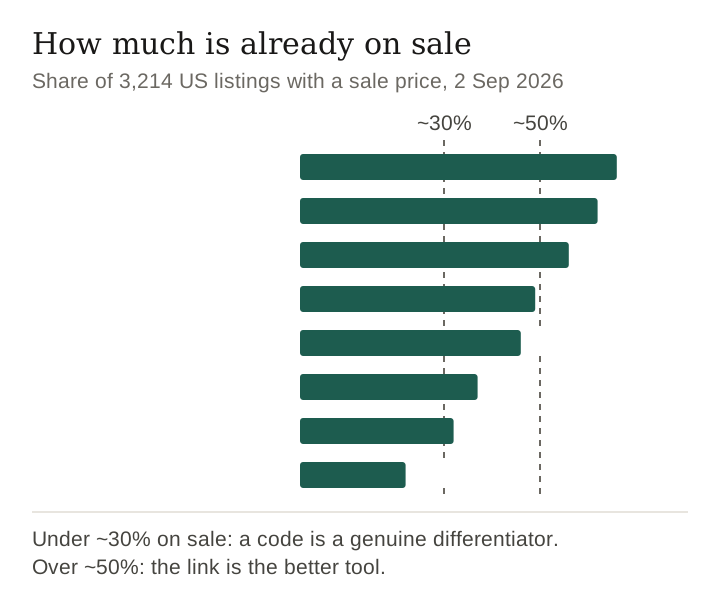
How much discounting is already there
Before comparing the two tools, it is worth measuring the ground they stand on. For each category we pulled the live US feed rows and counted how many supplied a sale price below their own list price, and by how much.
| Category | Listings | Already carrying a sale price | Median cut where discounted |
|---|---|---|---|
| Men's watches | 422 | 66% | 23.4% |
| Hoop earrings | 324 | 62% | 27.5% |
| Gold chain necklaces | 405 | 56% | 60.0% |
| Signet rings | 127 | 46% | 28.9% |
| Track pants | 158 | 37% | 44.9% |
| Varsity jackets | 182 | 49% | 37.9% |
| Air Jordan 1 | 222 | 32% | 31.5% |
| Automatic watches | 374 | 22% | 25.0% |
3,214 US listings pulled from CJ product feeds on 2 September 2026. 'Already carrying a sale price' means the feed supplied a sale price below the row's own list price. It is not proof the list price was ever charged.
Two things jump out. First, discounting is the norm in most of these categories, not the exception. Second, the spread is enormous: automatic watches at 22% and men's watches at 66% are the same shelf in most shops, and they behave completely differently.
The gold chain row is the one to sit with. 56% discounted at a median 60% cut is not a sale, it is a pricing convention — and it is the clearest single argument for reading a 'was' price with suspicion before you build content around it.
They are not two versions of the same thing
Creators talk about codes and links as alternatives. They are not. They fail differently, they pay differently, and they ask different things of the reader.
An affiliate link
- Pays you a percentage of an order that would have happened anyway at the same price.
- Costs the reader nothing and gives them nothing.
- Breaks silently: the product sells out, the URL changes, the program ends.
- Works only inside the cookie window, and only if the click actually registered.
A discount code
- Gives the reader a real reason to act now, which is the whole point.
- Survives a screenshot, a repost and a friend's WhatsApp. A link does not.
- Is trackable without a click at all, which matters on platforms that suppress or strip links.
- Trains an audience to wait for a code before buying anything from you.
That last bullet is the cost nobody prices in. A code is a habit you are teaching. Hand one out every week and you have converted your recommendations into a discount channel, and the weeks you have no code become weeks you sell nothing.
Keep reading
Which to reach for, by situation
- Category rarely discounted (under ~30% on sale)? A code is a genuine differentiator. Automatic watches were the clearest case in our data.
- Category discounted most of the time (over ~50%)? The link is the better tool, and your value is helping the reader tell a real markdown from a decorative one. That is editorial work and it is worth more than 10% off.
- Platform strips or suppresses links? A code, obviously. It is the only mechanism that survives a caption with no clickable URL.
- Evergreen content you want earning in a year? Links. Codes expire, and an expired code in an old post reads as neglect in a way a dead link does not.
- Both available? Use both, and put the link on the product name rather than on the code, so the reader who ignores the discount still routes through you.
What we cannot tell you, and will not estimate
The question in the title has a numerical answer — conversion rate with a code versus without — and we do not have it. We hold no affiliate network approvals and we have never run a code. Any percentage we printed here would be invented.
We are also not going to quote someone else's conversion-lift statistic, because the ones circulating on this query are almost all from companies selling code management, are undated, and describe a sample nobody can inspect.
What we can give you is the part we did measure, which happens to be the part that changes the decision: how much of the discount your reader was going to get without you. Check that for your own category before you go asking a brand for a code.
How to check it yourself, in about ten minutes: open the retailer's category page, sort by bestselling, and count how many of the first fifty products show a struck-through price. If it is more than half, your code is not the offer. Your judgment is.
Frequently asked
Do discount codes convert better than affiliate links?
We do not have that number and will not invent one. What we measured is the context that decides it: the share of listings already discounted ranged from 22% to 66% across eight categories on 2 September 2026.
When is a creator code actually worth having?
When the retailer rarely discounts. In our pull, automatic watches were on sale on only 22% of listings, so a code there is a genuine price advantage. Men's watches were on sale 66% of the time.
Can I use a code and an affiliate link together?
Usually yes, though some programs will not pay commission on orders that used a code. Put the link on the product name so a reader who skips the code still routes through you.
What is the downside of always having a code?
You teach your audience to wait for one. Weeks without a code become weeks without sales, and the discount stops being an event.
Method and scope
- Source: CJ product feeds, queried live on 2 September 2026 with advertiser country set to the United States.
- 3,214 listings across eight categories after filtering out rows with no usable price and rows from CJ's demo advertiser.
- 'Already carrying a sale price' counts feed rows whose supplied sale price is below their own list price. Feed list prices are not evidence of a transacted price.
- No conversion-rate figures appear on this page. We hold no network approvals and have never run a discount code.
- We do not quote third-party conversion-lift statistics here because the ones available on this query are undated and come from vendors selling code management.
Last verified 2 September 2026 against 3,214 live US listings and their sale-price flags, pulled from CJ product feeds
Keep reading
How this page was made. Drafted with AI (Claude); not yet independently re-checked. How we work