LinkToLooks · Guides · Creator Desk
Creator Desk
Affiliate disclosure on a storefront page
A storefront has no caption to bury it in and no narrator to say it out loud, which makes the placement question unusually simple — and unusually easy to get wrong.
Part of: For creators
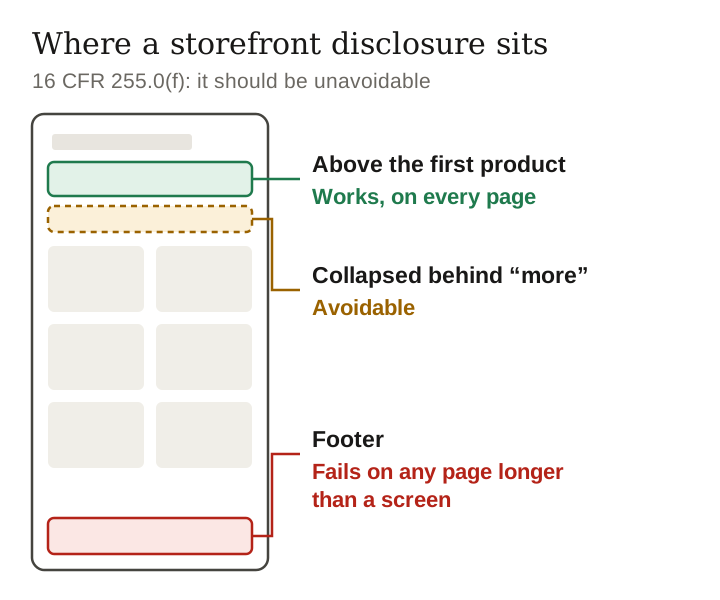
On a storefront there is no caption to bury it in and no voice-over to say it over, so the disclosure has one job: be above the first link, on every page, without the reader doing anything. 16 CFR 255.0(f) asks that disclosures in interactive media be “unavoidable”. A storefront is the easiest surface in a creator’s stack to get this right on, because you control the template — and the easiest to get wrong, because a footer feels like the natural home for a legal line.
Our own site is the simpler case: no link here pays us, so there is no commission to disclose above the first link. What every page carries instead is a line at the end saying that LinkToLooks holds no affiliate approvals and that no link on the page pays us, with the date that was checked. The build adds it to every page, so it is a template decision, made once.
Why a storefront is a harder case than a post
A post has a moment. The recommendation happens at a point in time and the disclosure can sit next to it. A storefront has no moment: it is a standing list, entered from search, from a link in a bio, from a DM, from a share, on any of its pages, in any order.
That changes the problem in three ways.
- There is no reliable entry point. You cannot put the disclosure on the home page and assume it was seen, because a shopper arriving from search lands on a product page directly.
- There is no narration. Nothing on the page is explaining anything to anyone; it is a grid of products. The disclosure has to carry the entire explanation on its own.
- It is long-lived. A post is read in a week. A storefront page is read for as long as it ranks, which means the disclosure has to keep being true.

What the rule asks for
“In any communication using an interactive electronic medium … the disclosure should be unavoidable.”
16 CFR § 255.0(f), retrieved 4 September 2026
The section’s next sentence adds that nothing else in the communication may contradict the disclosure, water it down or sit at odds with it.
“Unavoidable” on a web page has a fairly literal reading: the reader should not have to scroll, tap, expand or navigate to reach it. That is a layout requirement, and layout is the one thing a storefront owner completely controls.
That next sentence is doing quiet work too. A page that discloses commission at the top and then describes every product as a personal favourite it has tested is inconsistent with its own disclosure. This is our own constraint as much as anyone’s: we have never handled any product on this site and our pages say so.
Top of page, and why the footer fails
| Placement | Reaches the reader who... | Verdict |
|---|---|---|
| Above the first product, every page | arrives anywhere, scrolls nothing | Works |
| Under the page heading, collapsed behind “more” | chooses to expand it | Avoidable |
| Footer | reaches the bottom of a long grid | Fails on any page longer than a screen |
| Bio link page only | came in through the bio, not from search | Fails for organic arrivals |
| Separate /disclosure page | goes looking for it | Useful as the explainer, not as the disclosure |
| Per-product, next to each link | reads any single item | Works, at the cost of repetition |
The last row is worth a note. Repeating a short disclosure next to every product is not wrong — it is arguably the most robust option because it survives being screenshotted or embedded. It reads as noise if the wording is long, which is an argument for short wording rather than for fewer placements.
Put it in the template, not in the content
The single most useful thing in this page is also the least interesting: a disclosure written into the page template cannot be forgotten, and a disclosure typed per page eventually will be. If your storefront is built on a tool, find the header or layout setting once. If it is a page you maintain by hand, put it in the include that every page shares.
This also solves the update problem. When the wording needs to change — you join a second network, you start accepting gifted product — a template disclosure changes in one place across every page you have ever published. A hand-typed one changes on whichever pages you remember.
Link it to a page that explains the arrangement
A one-line disclosure tells a shopper that a commercial relationship exists. It does not tell them what it is, and 255.5(a) asks that the disclosure “clearly communicate the nature of the connection sufficiently for consumers to evaluate its significance”. A short line plus a link to a fuller explanation does that better than either alone.
What belongs on the explainer page, in rough priority order:
- Which relationships exist — commission, gifted product, paid placements, or all three.
- Whether the price the shopper pays changes. Usually it does not, and saying so is the single most reassuring sentence on the page.
- How products get chosen, honestly. If they are chosen because they are in a feed you have access to, say that.
- What you have not done. We have not worn, tested or handled anything, and our explainer says it in those words.
- How to contact you about it.
What we do on this site, exactly
Because it would be poor form to write this page and be vague about our own implementation:
- The affiliate line is injected by the build at the end of every page: LinkToLooks holds no affiliate approvals, and no link on the page pays us, with the date that was checked. It is not typed per page and cannot be omitted by whoever wrote the page.
- It sits at the end, not above the first link, because it reports that there is no connection rather than disclosing one. The day a link on this site pays us, the placement rule on this page applies to us too, and a line at the end will not be enough.
- A separate page, /how-we-work/, explains the arrangement in full, including that we hold no affiliate approvals.
- Every priced page carries a dated verification line so a reader can see when the numbers were last checked, rather than inferring freshness from a published date.
- Our pages state that we have not handled the products. That is a consistency requirement under the second sentence of 255.0(f), not modesty.
None of that is clever. All of it is a template decision made once and then not thought about again, which is exactly the property you want from a compliance control.
Frequently asked
Last verified 4 September 2026 against 16 CFR 255 fetched in full from the eCFR renderer API
Method, sources and limits
The quotations are from 16 CFR 255.0(f) and 255.5(a), fetched from the eCFR renderer API on 4 September 2026. The description of our own site is a description of the build we ship, checkable on any guide page.
Limits. This is not legal advice and we are not lawyers. We have no data on how any particular placement is treated in enforcement, and we are not aware of a public dataset that would let anyone produce one. Storefront tools differ in what they let you edit; where a tool gives you no template control, the per-product placement in the table above is the fallback that does not depend on it.
Keep reading
How this page was made. Drafted with AI (Claude); not yet independently re-checked. How we work