LinkToLooks · Guides · Creator Desk
Creator Desk
Keeping a disclosure record that survives an audit
The regulation governs the disclosure, not the evidence — and the platform deletes the evidence on its own schedule, not yours.
Part of: For creators
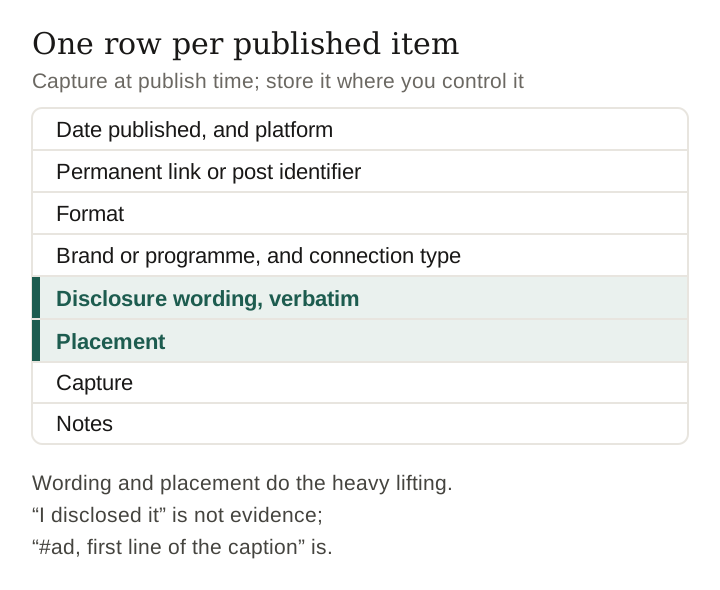
Keep a row per published item recording what you disclosed, where in the piece it sat, when it went live, and a copy of the piece itself — because the platform will delete the evidence and you will not get it back. The regulation is specific about what has to happen and silent about proving it happened, which is exactly the gap a record fills.
16 CFR 255.5(a) states that where a connection between endorser and seller might materially affect the weight or credibility of the endorsement and is not reasonably expected by the audience, “such connection must be disclosed clearly and conspicuously”. Nothing in the part tells you to keep records. The reason to keep them is practical: a Story expires in a day, a platform can remove a post without notice, and a disclosure nobody can produce is indistinguishable from one that never existed.
What the regulation actually says
Read section 255.5 rather than a summary of it, because the scope is wider than most creators assume. Material connections, in the regulation’s own words, can include a business, family or personal relationship; monetary payment; free or discounted products, including products unrelated to the endorsed product, whether or not an endorsement was required in return; and other benefits such as early access, the possibility of being paid, of winning a prize, or of appearing in media promotions.
The same section adds a threshold worth quoting because it is more demanding than the usual paraphrase: a material connection needs to be disclosed when a significant minority of the audience does not understand or expect it. Not a majority. And a disclosure does not require the complete details of the connection, but it must communicate the nature of it sufficiently for consumers to evaluate its significance.
Section 255.1 puts an obligation on the other side too: advertisers should provide guidance to endorsers, monitor compliance, and take action to remedy non-compliance. That matters to your record for a practical reason — a brand asking you to evidence a disclosure two years later is a brand meeting its own obligation, and your answer is either a spreadsheet row or a shrug.

The gap: a rule about conduct, not about evidence
The part governs what must be disclosed and how prominently. It does not require you to keep proof, and we are not going to pretend it does. The case for a record is entirely practical, and it rests on three facts about the platforms rather than on the law:
- Ephemeral formats delete themselves by design. A Story is gone in 24 hours, and with it the disclosure it carried.
- Platforms remove content without notice. Accounts get restricted, posts get taken down, and archives are not guaranteed.
- You may leave a platform, or it may leave you. Anything held only in an account you do not own is held at somebody else’s discretion.
So the question a record answers is not whether you are required to keep it, but this: if a brand, a network or a regulator asks you in 2028 what you disclosed on a post from 2026, can you show them?
The record, field by field
| Field | Why it is there |
|---|---|
| Date published, and platform | the anchor for everything else, and the thing you will search on |
| Permanent link or post identifier | may be dead later; it still proves which item you mean |
| Format | Story, Reel, feed post, video, newsletter, page — decides what prominence was even possible |
| Brand or programme, and the connection type | paid, gifted, affiliate, early access, competition entry: the categories 255.5 names |
| Disclosure wording, verbatim | the exact words, not a description of them |
| Placement | where in the piece it sat and whether it was visible without expanding, scrolling or tapping |
| Capture | screenshot or file, stored somewhere you control |
| Notes | anything unusual: a platform label used, a late edit, a brand-supplied wording you were asked to use |
Two of those fields do the heavy lifting. Verbatim wording matters because “I disclosed it” is not evidence and “#ad, first line of the caption” is. Placement matters because the regulation is about prominence, and a disclosure below a fold or behind a “more” link is the specific thing that fails.
Keep reading on disclosure
Capturing formats that delete themselves
Stories and other 24-hour formats
- Screenshot at the moment of posting. There is no later.
- Capture the whole frame, including the disclosure and any sticker or label, not a crop of the product.
- Where the platform offers an archive, use it, and still keep your own copy: an archive is a feature that can be removed.
Video
- Note the timestamp of the spoken disclosure as well as the written one.
- Keep the description text as text, not only as a screenshot, so it is searchable.
- If the disclosure is on screen, capture that frame specifically.
Live
- Hardest to evidence and worth deciding in advance. Note when you said it and how often.
- If a recording is retained, download it yourself.
- Repeating the disclosure through a live session is both better practice and easier to evidence.
Feed posts and pages
- Easiest case: capture the post as published and store the caption text.
- Record any later edit, with its date. An edited caption overwrites the version a regulator might ask about.
A routine that survives contact with reality
- Capture at publish time. One screenshot, one row, thirty seconds, while you are already there. Every retrospective version of this fails.
- Store outside the platform. A folder in your own cloud storage, named by year and month.
- Use one wording per connection type so the record is consistent and you are not reinventing the sentence each time.
- Review monthly, briefly. Anything with an empty wording or placement field is either an oversight in the record or a real gap in the disclosure. Both are worth ten minutes.
- Keep it as long as the relationship could matter. Longer than the campaign, and longer than the contract term.
- Export before you leave a platform. Deciding to stop using one is exactly when the archive stops being available.
What we do, since the same rule would apply to us
We hold no affiliate approvals today and no link on this site pays us, so the obligation has nothing to attach to yet. It would apply the day a link paid us, and it is fair to say what we already do rather than only what we recommend.
- The disclosure is one line in the footer of every guide, printed by the build rather than written into each page separately, so it cannot be forgotten and cannot vary in wording. Today it says that we hold no affiliate approvals and that no link on the page pays us, with the date that was last checked.
- Every guide also links to a page explaining how the site works, including that we hold no affiliate approvals, so no link here pays us.
- Every page keeps a dated verification line naming what was checked, so a reader can see when a claim was last true.
- Our pages are files in a repository, so the published version of any page on any date is recoverable without depending on a platform.
That last point is the whole argument in miniature. Our record survives because it lives somewhere we control. A creator’s record can too, and it costs a screenshot.
Frequently asked
Am I legally required to keep disclosure records?
Part 255 does not impose a record-keeping requirement on endorsers, and we are not going to imply otherwise. The reason to keep them is that the evidence disappears on the platform’s schedule rather than yours, and a brand or network contract may separately require them.
Is the platform’s paid partnership label enough on its own?
Treat it as one element rather than as the whole disclosure. It is a platform feature whose prominence the platform controls and can change; the regulation asks whether the connection was disclosed clearly and conspicuously to the audience.
What if a brand asked me to use their wording?
Record the wording and the request. Section 255.1 puts guidance and monitoring duties on advertisers, so who asked for what is relevant context, and it is the kind of detail nobody remembers two years later.
Does this apply outside the United States?
Part 255 is US. Other jurisdictions have their own rules and some are stricter. The record-keeping habit is jurisdiction-neutral; the legal standard is not.
Method and scope
Quotations are from 16 CFR part 255, retrieved from the eCFR renderer on 4 September 2026, sections 255.1 and 255.5. We quote the text and link the section rather than paraphrasing a summary of it. The record structure is a practice we describe, not a legal requirement, and this page is not legal advice. We hold no creator-supplied disclosure data of any kind; the account of our own practice describes this site.
Keep reading
How this page was made. Drafted with AI (Claude); not yet independently re-checked. How we work