LinkToLooks · Guides · Creator Desk
Creator Desk
Can you put affiliate links on Substack? We checked 804 free posts
Substack permits affiliate links while building nothing for them, and among the top shopping-adjacent newsletters on 27 September 2026, 68 of 128 used them, mostly through ShopMy, and most of those posts carried no disclosure in the text.
Part of: For creators
Yes, Substack allows affiliate links. Its help centre says Substack builds no functionality for affiliate links or advertising, and its Content Guidelines ban only publications whose primary purpose is advertising external products, driving traffic to third-party sites or distributing offers. A newsletter that sometimes links products is not that.
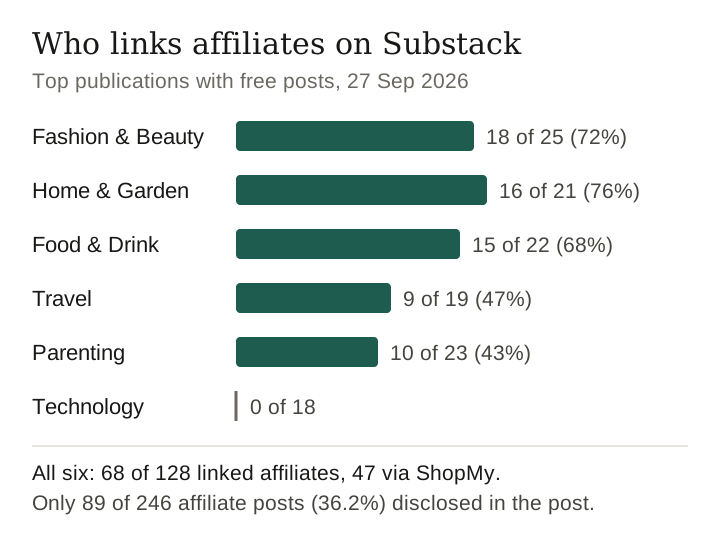
We then measured what Substack writers do. From the top 25 publications in six categories, 68 of the 128 with free posts linked affiliates in their newest posts, 47 of those through ShopMy, and only 89 of the 246 affiliate posts (36.2%) used a disclosure phrase in the post.
What Substack’s own documents say
| Where | What it says, in short | What it means for you |
|---|---|---|
| Help centre: “Can I use affiliate links or advertising in my emails?” | Substack is focused on subscriptions and builds no functionality for affiliate links or advertising; publications set up with the sole purpose of advertising are not permitted | You may add links yourself; expect no tools for them |
| Content Guidelines, “Marketing and Promotion” | No publications whose primary purpose is to advertise external products or services, drive traffic to third-party sites, distribute offers and promotions, or boost SEO | A deals-only newsletter is out; a newsletter with links is not |
| Help centre: “Can my publication host sponsored ads?” | Substack has no policy prohibiting sponsored content, and recommends reviewing the Publisher Agreement and Content Guidelines | Paid brand placements are allowed |
| Help centre: Creator Kits | A media kit for Substack’s native sponsorships programme, open to Bestsellers or publications with at least 100 paid subscribers | Substack itself now brokers brand deals |
Sources: affiliate article (body last edited 26 January 2023), Content Guidelines (“Last Updated: July 20, 2026”), sponsored ads article (edited 17 December 2025), Creator Kit article (edited 16 June 2026), all read 27 September 2026.
The Content Guidelines also say they apply to comments, Notes and other community surfaces, and ban spam in comments and replies. A Note that is only a product link sits closer to that line than a post that discusses the product.

What 128 top newsletters actually do
On 27 September 2026 at 15:32 we took the first page of Substack’s public leaderboard in six categories (25 publications each, 150 in all), and read the newest ten posts of each through Substack’s public posts API. 138 publications answered. Of 1,373 posts, 569 were for paid subscribers only and came back without a body, which leaves 804 free posts from 128 publications. We counted a post as carrying an affiliate link if any link pointed at one of 11 affiliate networks or tagged Amazon links (list in the method).
| Category | Publications with free posts | Linking affiliates | Free posts | Posts with an affiliate link |
|---|---|---|---|---|
| Fashion & Beauty | 25 | 18 (72%) | 170 | 93 (54.7%) |
| Home & Garden | 21 | 16 (76%) | 94 | 39 (41.5%) |
| Food & Drink | 22 | 15 (68%) | 117 | 48 (41.0%) |
| Travel | 19 | 9 (47%) | 128 | 23 (18.0%) |
| Parenting | 23 | 10 (43%) | 177 | 43 (24.3%) |
| Technology | 18 | 0 (0%) | 118 | 0 (0.0%) |
| All six | 128 | 68 (53%) | 804 | 246 (30.6%) |
Leaderboard page 1 per category; newest 10 posts per publication (published October 2025 to 27 September 2026); free posts only.
Two readings. In fashion and beauty, affiliate links are the norm, not the exception: 18 of 25 top publications carry them and more than half of their free posts do. In technology, none of 18 did in the posts we read, which says the top of that leaderboard earns from subscriptions and sponsors, not product links.
Keep reading
Which networks they use
One network dominates. Counted by publication (a publication counts once per network however many posts use it):
| Network or link type | Publications (of 68) | Posts (of 246) |
|---|---|---|
| ShopMy | 47 | 186 |
| Amazon short links (amzn.to) | 31 | 56 |
| Bookshop.org affiliate | 6 | 11 |
| Amazon with a tag | 5 | 12 |
| Impact | 4 | 5 |
| Rakuten | 3 | 16 |
| LTK | 2 | 8 |
| CJ | 2 | 2 |
| geni.us | 2 | 9 |
| Skimlinks | 1 | 10 |
| Awin | 1 | 3 |
ShopMy appears in 47 of the 68 linking publications and in 186 of the 246 posts. Amazon, through short links or tagged URLs, is second. Everything else is small. The traditional networks that dominate blogs (CJ, Rakuten, Awin, Impact) together reach fewer than ten of these newsletters.
Why that matters to you: ShopMy links are built for creators to paste anywhere, and they are what the top of the Substack shopping leaderboard has settled on. We are not recommending a network; we have no approvals with any. We are reporting what the leaderboard uses.
How often they disclose
We searched each affiliate post’s text for an affiliate disclosure: the words affiliate or commission, “may earn”, “I earn”, “paid link”, “at no extra cost to you” and similar. We then read two random samples of 16 posts the test called undisclosed. The first found two misses (“[Publication] may earn some money”), so we widened the test; the second found none.
- 89 of 246 affiliate posts (36.2%) carried a disclosure phrase in the post body.
- 30 of the 68 linking publications disclosed in at least one sampled post; 38 never did; 15 disclosed in every affiliate post.
- Five posts, from five publications, disclosed a paid sponsorship (“this section is in paid partnership with…”) on the same page as undisclosed affiliate links. A sponsorship label does not cover the commission links.
Our position: in a newsletter, put the disclosure in the post, near the first link. A reader meets a Substack post in an inbox, in the app or forwarded, and none of those shows your About page. The clearest pattern in our sample, used by two fashion newsletters, marks each affiliate link with an asterisk and explains the asterisk in the same issue.
Substack against Medium
The two long-form platforms draw opposite lines, which matters if you cross-post:
| Substack | Medium | |
|---|---|---|
| Affiliate links | Allowed; no tools | Allowed; disclose, footer sentence is enough |
| Brand-paid sponsorships | Allowed; Substack runs a sponsorships programme | Not allowed |
| Banned purpose | Publications mainly for advertising, traffic, offers or SEO | Posts mainly to drive traffic; affiliate marketing dressed as reviews |
So a sponsored newsletter issue can live on Substack and cannot be cross-posted to Medium as it stands.
What the data cannot show
- Paid posts. 569 of 1,373 posts were paywalled and unreadable to us; paid issues may link more or less.
- The whole platform. This is the top of six leaderboards on one day, not a random sample of Substack.
- Links we could not recognise. Direct brand programmes, plain Amazon links without a tag, and links rewritten at click time (as some networks do) are not counted, so 68 is a floor.
- Disclosures outside the post. About pages, welcome emails and image text were not read.
- Earnings or clicks. Nothing here says what any link earns.
We name no publication. The point is the pattern, not any one writer.
What to do this week
- Add a one-line disclosure at the top of any issue with affiliate links, and mark the links themselves.
- If you take a Substack sponsorship, label it separately from your affiliate links.
- Do not cross-post a sponsored issue to Medium.
- Keep link roundups inside a newsletter that has a reason to exist without them; the Content Guidelines target publications whose purpose is the links.
Frequently asked
Are affiliate links allowed on Substack?
Yes. Substack's help centre says it builds no functionality for affiliate links or advertising, and its Content Guidelines ban only publications whose primary purpose is to advertise external products, drive traffic to third-party sites or distribute offers. An ordinary newsletter with affiliate links is not that.
How many Substack newsletters use affiliate links?
In our 27 September 2026 sample of the top 25 publications in six shopping-adjacent categories, 68 of the 128 with free posts had at least one affiliate link in their newest free posts, and 246 of 804 free posts carried one. ShopMy was the most common network, used by 47 of the 68.
Can I run sponsored posts on Substack?
Yes. Substack's help article on sponsored ads says it has no policy prohibiting sponsored content, and it runs its own sponsorships programme through Creator Kits for Bestsellers and publications with at least 100 paid subscribers.
Do Substack writers disclose affiliate links?
Often not in the post. Of 246 free posts with an affiliate link, 89 (36.2%) used an affiliate disclosure phrase in the post body, and 38 of the 68 linking publications used none in any sampled post. Some may disclose on an About page, which we did not read.
Method and sources
- Publications:
substack.com/api/v1/category/public/<id>/all?page=0for Fashion & Beauty, Home & Garden, Food & Drink, Travel, Parenting and Technology, 27 September 2026, 15:32 local time. - Posts:
<publication>/api/v1/posts?limit=10; free posts return their full HTML. Links were read from thehrefattributes. - Affiliate hosts counted: shopmy.us / shop-links.co; amzn.to; amazon with a
tagparameter; liketk.it / shopltk.com / rstyle.me; Skimlinks; Sovrn; Rakuten (linksynergy); CJ click domains; Awin; Impact click domains; ShareASale; Howl; Bookshop.org affiliate paths; Partnerize; geni.us. - Substack’s Content Guidelines and four help-centre articles read on 27 September 2026, with each article’s own edit date. We did not sign in, subscribe or post. This page is not legal advice.
Last verified 27 September 2026 against Substack’s Content Guidelines, four help-centre articles and 804 free posts from 128 publications
Keep reading
How this page was made. Drafted with AI (Claude); not yet independently re-checked. How we work