LinkToLooks · Guides · Creator Desk
Creator Desk
Can you put affiliate links on Tumblr, and does Tumblr add its own?
Tumblr allows affiliate links in posts but bans blogs whose primary purpose is affiliate marketing, and its Terms of Service have let Tumblr add its own affiliate code to links you post since 2016, unless your link already carries yours or you opt out.
Part of: For creators
Yes, you can post affiliate links on Tumblr, with two limits written into Tumblr’s own documents. The Community Guidelines say not to create blogs with the primary purpose of affiliate marketing, under the heading on spam. And the Terms of Service say Tumblr may add its own affiliate code to links posted on Tumblr, provided you have not already included your own, with an opt-out in blog settings.
So: an ordinary blog that sometimes links products is fine; a blog that exists to push affiliate links is the thing the rule names. Read on tumblr.com and in Tumblr’s public policy history on 27 September 2026.
The four rules that apply
We read Tumblr’s Community Guidelines, Terms of Service and Global Advertising Policy in full on 27 September 2026. Four passages decide what an affiliate creator may do:
| Where | What it says, in short | What it means for affiliate links |
|---|---|---|
| Community Guidelines, “Spam” | Don’t use deceptive means to generate revenue or traffic, or create blogs with the primary purpose of affiliate marketing | A blog built to push links is banned; links in an ordinary blog are not mentioned |
| Community Guidelines, “Deceptive or Fraudulent Links” | No misleading link descriptions, wrong source fields, misleading click-through links on images, or links to pop-up ads | Say where a link goes. A product image that clicks through to an unrelated page is named as a violation |
| Terms of Service, content licence | Tumblr may add its own affiliate code to links at its discretion, unless you already included yours; you can opt out | Your plain product links may earn Tumblr a commission |
| Terms of Service, section 8 | If you post or buy advertisements or sponsored content, comply with the Global Advertising Policy | Applies to sponsored posts; whether it covers affiliate links is not defined |
Sources: Tumblr Community Guidelines, Terms of Service, Global Advertising Policy (“Last Modified: 2026-08-20”), all read 27 September 2026.
The guidelines also forbid misleading tags (their example is tagging a cat photo with a TV show) and posting automatically or programmatically. Both matter to anyone tempted to schedule the same link post across many tags.
Keep reading

‘Primary purpose’: where the line sits
Among the rulebooks we have read for this series (Reddit, Facebook groups, Discord, WhatsApp, Snapchat, Threads, Bluesky), Tumblr’s is the only one that puts affiliate marketing itself under spam. It does not say how it judges “primary purpose”, so the line is a judgement Tumblr makes. From the text, these are the patterns it describes:
- Likely inside the rule: a blog whose posts are mostly product links with little else, a blog created only to hold links, or several such blogs run together.
- Likely outside it: a fashion, art or fandom blog that sometimes links the products it posts about. The rule is about the blog’s purpose, not about any one post.
- Named separately: deceptive means of generating revenue. A post that hides where its link goes breaks the deceptive-links rule whatever the blog’s purpose.
Our position, from the text: on Tumblr, an affiliate link should be a footnote to a post that would be worth reblogging without it. That is also what gets reblogged, which is how Tumblr posts travel.
Tumblr’s own affiliate code on your links
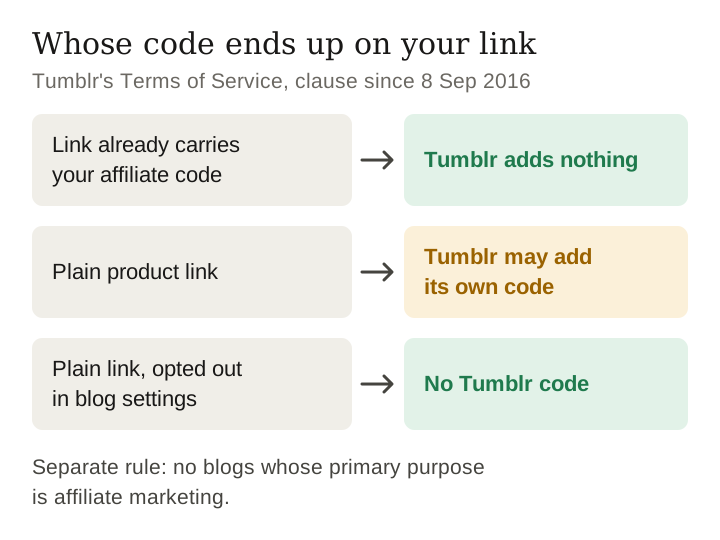
This is the clause most creators have not read. The Terms of Service content licence says Tumblr may add its own affiliate code to links posted on Tumblr, at its discretion, as long as the user has not already included their own affiliate code in that link, and that users may opt out. The opt-out link in the terms points to your blog settings.
What it means in practice:
- If your link already carries your affiliate tag, the terms say Tumblr will not add its own. Your commission is not displaced.
- If you post a plain product link, Tumblr may turn it into an affiliate link that pays Tumblr.
- If you want no one’s code on your plain links, the opt-out is in blog settings, per the terms.
When these rules were written
Tumblr publishes the history of its policies in a public GitHub repository and links to it from the bottom of both pages. We checked every version:
- The affiliate-code clause first appears in the Terms of Service on 8 September 2016 (commit “Update terms-of-service.txt”). The 20 earlier versions, back to March 2012, do not contain it. The newest version in the repository is dated 27 January 2025, and the clause is still there.
- The affiliate-marketing sentence is in every version of the user guidelines file in the repository, whose history there starts on 20 June 2024; the newest is dated 14 October 2025. The live Community Guidelines page carries the same sentence.
So neither rule is new. The affiliate-code clause is nine years old, which is part of why so few creators have heard of it.
Disclosure on Tumblr
Tumblr’s guidelines do not set a wording for disclosing an affiliate link, and we found no paid-partnership label for ordinary posts in the documents we read. The Terms send sponsored content to the Global Advertising Policy, which is written for advertisers and asks that offers be clear and not misleading.
Your own duty does not depend on Tumblr. In the US the FTC expects a clear disclosure of a material connection, and a commission is one. On Tumblr that means a line in the post itself, above or next to the link, not only a note in your blog description, because most readers meet your post as a reblog on someone else’s dashboard.
What we could not verify
- How Tumblr enforces “primary purpose”. No threshold is published.
- Whether Tumblr currently adds its own code, and to which retailers. The terms say it may; we did not log in, post links or inspect rewritten links.
- The opt-out control. The terms link it to blog settings; we did not sign in to see its name or default.
- Reach. Tumblr publishes nothing about links and distribution, and we did not test it.
What to do this week
- Look at your Tumblr blog settings for the affiliate-link option the terms describe, and decide whether you want it on.
- Use your own tagged links where you have them, so the terms’ own condition keeps Tumblr’s code off.
- Keep link posts a minority, write the disclosure into each one, and never tag a link post with an unrelated popular tag.
- If you run a separate “shop my finds” blog, read it against the primary-purpose sentence honestly.
Frequently asked
Are affiliate links allowed on Tumblr?
Yes, in posts. Tumblr’s Community Guidelines ban creating blogs whose primary purpose is affiliate marketing, and deceptive links, but not affiliate links as such.
Does Tumblr add affiliate codes to links?
Its Terms of Service say it may, at its discretion, unless the link already carries the user’s own affiliate code, and users may opt out in blog settings. The clause has been in the terms since 8 September 2016.
How do I disclose an affiliate link on Tumblr?
Tumblr sets no wording. Write it in the post, next to the link, for example “Affiliate link: I earn a commission”, so it survives reblogs.
Sources and method
- Tumblr Community Guidelines, Terms of Service and Global Advertising Policy, read in full on tumblr.com on 27 September 2026.
- Policy history: github.com/tumblr/policy. We downloaded every listed version of
terms-of-service.txt(38, from 2 March 2012 to 27 January 2025) anduser-guidelines.txt(4, from 20 June 2024 to 14 October 2025) and searched each for the two sentences, with line breaks normalised. - We did not post on Tumblr or sign in. This page is not legal advice.
Last verified 27 September 2026 against Tumblr’s Community Guidelines, Terms of Service, Global Advertising Policy and 42 archived policy versions
Keep reading
How this page was made. Drafted with AI (Claude); not yet independently re-checked. How we work