LinkToLooks · Guides · Creator Desk
Creator Desk
Where affiliate links belong in an email newsletter
Email is the one format you cannot fix after publishing, and that single fact should decide both your disclosure and your destinations.
Part of: For creators
Put the disclosure above the first link, and point most of your links at pages you control. A newsletter is the one format you cannot edit after publishing, which changes both of those decisions.
The durability problem is measurable. We re-requested 108 live retailer image URLs and 8 failed the same day the feed supplied them; a larger check of 665 URLs the previous day saw 246 fail. Retail infrastructure moves constantly. Your sent email does not.
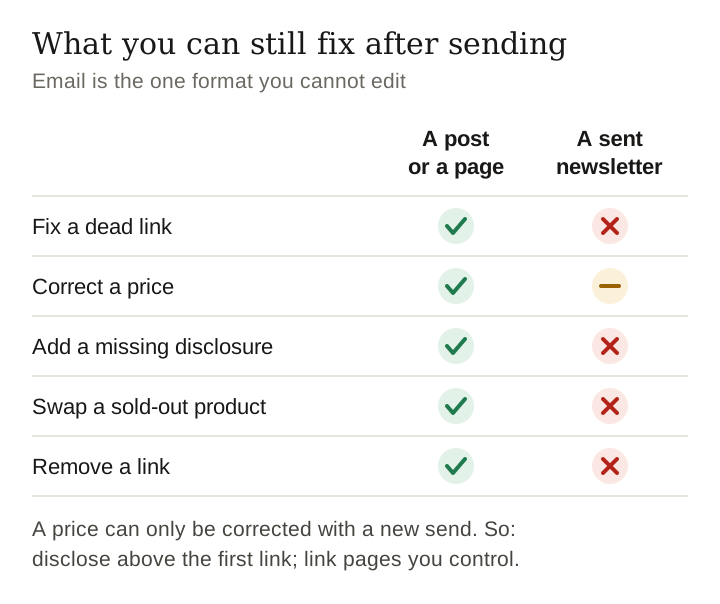
The one thing email does differently
Every other placement is editable. A caption can be fixed, a page can be updated, a storefront can be repointed. An email that has arrived is final, and that single fact should drive how you build one.
| A post or a page | A sent newsletter | |
|---|---|---|
| Fix a dead link | Edit it | Cannot |
| Correct a price | Edit it | Send a correction |
| Add a missing disclosure | Edit it | Cannot |
| Swap a sold-out product | Edit it | Cannot |
| Remove a link entirely | Edit it | Cannot |
The practical difference that governs everything below.
Which yields the rule this whole page rests on: the more durable the destination, the better it suits email. A link to your own page can be repaired forever. A link to a specific marketplace listing dies when one item sells, and takes a piece of your newsletter with it.

Where the disclosure goes
The requirement is that a disclosure be clear and hard to miss, placed so a reader encounters it before acting on the endorsement. The FTC's endorsement guidance is the authority worth reading directly rather than through summaries.
- Above the first affiliate link, in the body. Not the footer, not the preheader, not the postscript.
- In ordinary body type. Grey six-point text under a divider is a disclosure that has been designed not to be read.
- In plain words. ‘Some links below are affiliate links, which means I may earn a commission if you buy’ is complete and takes one line.
- Again, if the email is long. A reader who scrolls past a lot of content may not connect a disclosure at the top to a link nine sections down.
- Not in an image. Many clients block images by default, and a disclosure that does not load has not been made.
Keep reading
Where the links go
- One link per recommendation, near the recommendation. A block of links at the end separates the endorsement from the action, which is bad for the reader and bad for the disclosure.
- Prefer a page you control for anything you will repeat. An evergreen recommendation belongs on a page that you can fix; the newsletter links to the page.
- Prefer product pages to search or marketplace pages. A search URL changes results under you; a marketplace listing dies when the item sells.
- Keep the count low. Every link is a maintenance job you cannot do after sending.
- Name what you could not link. ‘I could not find this one anywhere reliable’ is a real sentence and readers trust it.
Mechanics that break email links
- Link tracking rewriting. Some email platforms wrap outbound links in their own redirect. Check whether that survives your affiliate parameters before a send, not after.
- Corporate mail scanners. Security tools pre-fetch links, which can produce clicks that never came from a human. This affects what your dashboard shows you.
- Blocked images. Design as though images will not load, because for a meaningful share of readers they will not.
- Very long URLs. Some clients break them across lines in plain-text versions, which turns a link into text.
- Redirect chains. Each hop is a chance to lose a parameter. The fewer hops between your reader and the retailer, the fewer things can fail silently.
None of these are exotic. They are the ordinary friction of a format that has to survive dozens of mail clients, and the reason a newsletter link deserves a test send to yourself before it deserves a subscriber.
Frequently asked
Can you put affiliate links in an email newsletter?
Yes. The disclosure obligation is the same as anywhere else: it must be clear, and it must sit where the reader will see it before they click, not at the bottom.
Where should the affiliate disclosure go in an email?
Above the first affiliate link, in the body, in ordinary type. A footer disclosure sits below the click and is the most common way to get this wrong.
Do broken links matter more in email?
Yes, because you cannot edit a sent email. We re-requested 108 live retailer image URLs on 3 September 2026 and 8 failed the same day; an earlier check of 665 URLs saw 246 fail. Anything you send is frozen at the moment you send it.
Should I use an affiliate link or a link to my own page?
For a newsletter, linking your own page is usually the more durable choice: you can fix a dead product link on a page you control, and you cannot fix one inside an email that has already gone out.
Method and scope
- Link durability: 108 live retailer image URLs re-requested with an ordinary browser user agent on 3 September 2026, of which 8 failed. The 665-URL figure is from the same check run the previous day on a different and larger sample.
- Disclosure placement follows the FTC's published endorsement guidance, linked above. This page is not legal advice.
- Email client behaviour described here is long-standing and general; we have not tested any specific email platform's link rewriting.
- We hold no affiliate approvals and quote no earnings, click-through or conversion figures of our own.
Last verified 3 September 2026 against 108 live retailer URLs re-requested and the FTC's published endorsement guidance
Keep reading
How this page was made. Drafted with AI (Claude); not yet independently re-checked. How we work