LinkToLooks · Guides · Creator Desk
Creator Desk
Can you use a retailer's product photo in your post?
Nobody can tell you your use is permitted, but the mechanical half is measurable — and it is where most people actually get hurt.
Part of: For creators
Direct answer. A retailer’s product photograph is the retailer’s (or a brand’s) copyrighted work. Whether you may republish it depends on the terms of the specific programme or feed you got it from, and those terms differ per advertiser — there is no blanket permission and nobody can give you one in an article. What we can tell you is the mechanical part, which is where most people get hurt anyway: in a sample of feed image URLs we requested on 8 September 2026, some did not load, some URLs were malformed, some were served over plain http, and some listings shared their photograph with another listing at a different price. A picture that is legal to use can still be wrong, broken, or of something else.
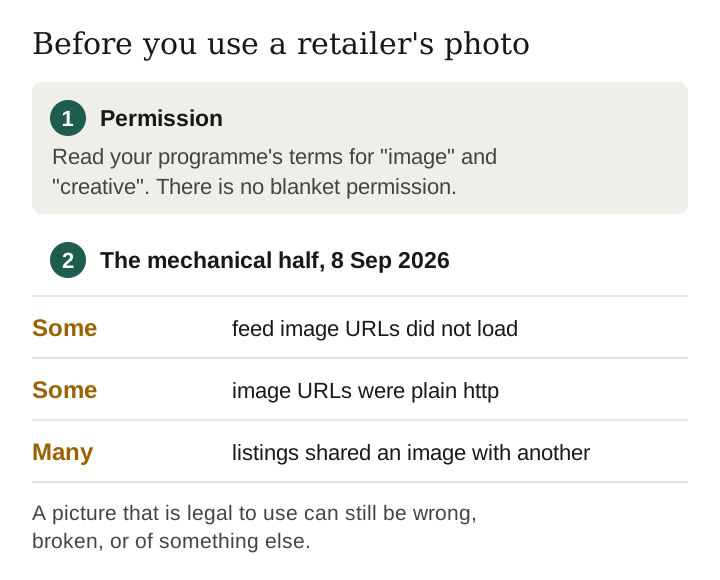
Last verified 8 September 2026 against a sample of live feed image URLs requested with a browser user agent, and every image link in the pull inspected, during this batch
The permission question, answered honestly
Product photographs are creative works with owners. The owner is usually the retailer or the brand, and sometimes a third-party studio that licensed the image to them for their own use only. None of those parties has given you anything by putting the picture on a public page.
What does grant permission, when it exists, is the agreement attached to whatever you are pulling the image from. A product feed is published precisely so that approved publishers can republish its contents; the terms of the programme you joined say what that covers, and they are not identical across advertisers. Some allow feed imagery in editorial content and not in advertising. Some require the linked destination to be the advertiser. Some say nothing about images at all, which is not the same as saying yes.
We are not going to tell you that your use is fine, and you should be wary of any page that does. We hold zero programme approvals ourselves, so we have never signed one of these agreements and cannot summarise yours. The one useful, checkable instruction is this: open the terms of the specific programme, search them for “image”, “creative” and “content”, and read what comes back. That takes four minutes and it is the only thing on this subject that is actually about your situation.
Two things are true regardless of the terms. Taking a photograph from a retailer you have no relationship with is a straightforward copyright question with no agreement to fall back on. And a photograph that contains an identifiable person carries a second set of considerations on top of the copyright one.
Keep reading on imagery
The photograph is not as stable as it looks
If you hotlink — put the retailer’s URL straight into your img tag — your page inherits every problem their image hosting has. We requested a random sample of image URLs from this catalogue with a browser user agent, one request each. Most returned an image; the rest were malformed URLs with unescaped spaces, 404 not found, or 403 forbidden to an ordinary client.
Two of those failures deserve naming. The malformed URLs are a defect in the feed itself: the file name contains a literal space, so the string is not a valid URL and a browser or script has to guess. Across the whole pull, every one of them came from a single retailer. If your tooling silently drops those, you lose part of one retailer’s catalogue and never see why.
The 403s are the retailer refusing an automated client. The same image often loads fine in a browser on the retailer’s own page. That is a deliberate defence, it is theirs to set, and it means a hotlinked image can work when you test it by eye and fail for a crawler.
Two more mechanical facts from the same inspection:
- Some image URLs are plain
http. Embedded in anhttpspage they are mixed content, and most browsers will simply not display them. A small number of retailers account for nearly all of it. - Some rows point at a placeholder — files literally named
no_imaged.gifandimage_1.jpgin aplaceholderdirectory. The feed reports an image; the image is a grey box. Nothing in the record says so.
None of that argues against using retailer photography. It argues for not building on a URL you do not control.
The photograph may not be the product
This is the failure that damages trust rather than layout, and it is much more common than the broken-image one.
Many rows use an image URL that also belongs to at least one other listing. Among the shared images, some are attached to listings with different titles and some to listings at different prices. One tent photograph in our pull served several listings at different prices.
Usually that is a variant family: one photograph standing in for every colour or size. Sometimes it is a genuine mismatch. Either way, if you publish the photograph next to one of those prices, you have implicitly told a reader that the picture is the thing at that price, and you have no evidence that it is.
The related trap is quantity. A photograph of a five-piece set sits happily above a price for one item, and the feed carries no quantity field to contradict it — a problem we measured separately: whether multi-item listings say how many you get.
What changes per platform
| Where you are publishing | What is technically possible | The thing to watch |
|---|---|---|
| Your own site or blog | You can hotlink or host a copy. | Hotlinking inherits the 403s, the 404s and the mixed-content problem above; hosting a copy makes the permission question sharper, because you now hold the file. |
| Instagram, TikTok, Pinterest | You must upload a file. There is no hotlink. | Every image you post is a copy you made. Whatever the programme terms say about republishing applies squarely. |
| Email newsletter | Either, but most senders proxy or rewrite image URLs. | Hotlinked retailer images frequently break in email clients, and image blocking is on by default for many readers. |
| A storefront or link-in-bio tool | The tool usually pulls the feed image itself. | Then the tool's agreement governs it, not yours. Worth knowing which of you is the publisher in that arrangement. |
What we do, and why
Since 11 October 2026 this site uses no retailer product photographs. Our pages carry figures we draw ourselves and free-licence photos, each credited under the image, and we never use a photograph taken by a creator without that creator’s written consent. That rule is ours rather than the law’s: a creator’s photograph is their work and their likeness decision.
Until then we hotlinked feed photos, and some feed image URLs fail, as the sample above shows. If you hotlink, check the image URLs before you publish and again later: a page that quietly loses its pictures three months later is worse than one you fix today. Our link audit method covers running the same check at scale.
What we do not do is present our practice as advice about yours: a site that shows no retailer images has a simpler position than a creator inside a programme, and yours will not be as simple.
A checklist before you use one
- Do you have a relationship with this retailer? If not, there is no agreement in play and the question is plain copyright.
- Have you read the programme terms for the words “image” and “creative”? Four minutes, and it is the only step that is about your actual situation.
- Does the URL start with
https? Some in this catalogue do not, and those will not display on a secure page. - Does the URL contain a space or an odd character? One retailer here shipped such URLs. They are not requestable as written.
- Does the image actually load from a plain request? Some hosts refuse anything that is not a browser.
- Is this photograph attached to more than one listing? If so, it is a family shot, and the price you put beside it should be described as a range or tied to the named variant.
- Have you credited it? Naming the source costs one line, and it is the difference between using someone’s photograph and passing it off.
What this page cannot tell you
- Whether your use is permitted. That is in your programme’s terms. We hold none, so we have not read one.
- This is not legal advice and copyright is jurisdictional. Where the answer turns on your country, we do not have it.
- Our load test is one sample on one evening, one request per URL. A different sample or a different hour gives a different result, and this network has a documented DNS flake that can read as a dead image.
- We did not check whether shared images are wrong. We measured that they are shared. Most are probably variant families, which is a reason to describe the variant rather than a reason to panic.
- Twenty outdoor and fitness search terms. Image hygiene almost certainly varies by category and by retailer type.
Frequently asked
Can I use a retailer's product photo in my post?
Only if something gives you permission - normally the terms of the affiliate programme or feed you are approved for. There is no general permission, and terms differ per advertiser. Read the programme terms for the words image and creative.
Is hotlinking safer than copying the file?
It is different, not safer. Hotlinking means you never hold a copy, but you inherit the host's failures: in our sample, some URLs did not return an image, and some URLs in the catalogue were plain http, which browsers block on a secure page.
Why do some feed images not load?
Three reasons in our sample: the URL was malformed with unescaped spaces, the file was gone, or the host refused a non-browser client with a 403.
Can I assume the photo shows the product I linked?
No. In our pull many listings shared an image with another listing, and some shared images were attached to listings at different prices. Treat a shared photograph as a family shot.
Do I have to credit the image?
Whether you must depends on the terms. Whether you should is easier: it costs one line, it tells your reader where the picture came from, and every image on this site carries one.
Method and scope
US listings pulled from the CJ product catalogue on 8 September 2026 across twenty outdoor and home-fitness search terms, de-duplicated on advertiser plus title plus destination URL and filtered on each row’s own targetCountry; network demo advertisers excluded. Every row carried an image link — none were blank.
The load test is a sample of rows drawn at random with a fixed seed, one GET each with a desktop Chrome user agent and a 25-second timeout, reading the first four kilobytes. The malformed-URL, scheme and placeholder checks cover every row in the pull. Shared images are grouped by exact image URL.
Keep reading
How this page was made. Drafted with AI (Claude); not yet independently re-checked. How we work