LinkToLooks · Guides · Creator Desk
Creator Desk
The claims you cannot make about a product you have not handled
We screened 5,040 retailer descriptions for claim language, read the matches, and halved our own number. What is left is the copy you should not paste.
Part of: For creators
Every one of the 5,040 live listings we read on 7 September 2026 shipped a description, and 372 of them — 7.4% — contained a claim a creator would be repeating rather than reporting.
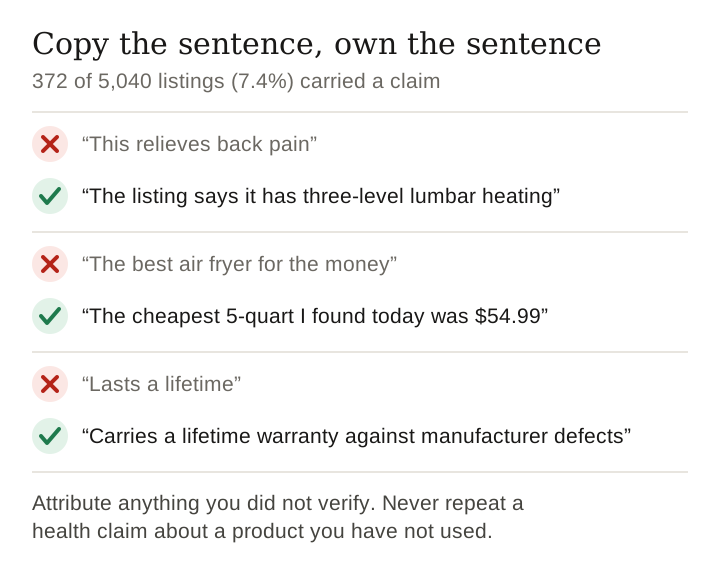
The regulation is short about what happens next. Under 16 CFR 255.1, an endorsement may not carry any express or implied claim “that would be deceptive if made directly by the advertiser”. Copy the sentence, own the sentence.
This matters more to us than to most people writing about it, because we have never handled any of these products. Neither has any tool that generates a caption from a feed.
What the descriptions actually contain
The first surprise is how little marketing copy there is. The median description in this pull is 134 characters, and 56.9% are under 200 — a spec line, a colour, a capacity. The long persuasive paragraphs that a creator might be tempted to lift are a minority of the catalogue.
| Description length | Share of 5,040 listings |
|---|---|
| Under 200 characters | 56.9% |
| 10th percentile | 30 characters |
| Median | 134 characters |
| 90th percentile | 899 characters |
Every row in this pull carried a description; none was empty.
So most listings give you nothing to copy. The risk is concentrated in the long ones, which are also the ones that read well enough to be tempting.
The four kinds of claim we found
| Claim class | Listings | Share of all 5,040 |
|---|---|---|
| Safety and materials (BPA-free, food-grade, non-slip) | 175 | 3.5% |
| Absolute superlatives (the best, the ultimate, flawless) | 142 | 2.8% |
| Environmental (eco-friendly, non-toxic, biodegradable) | 47 | 0.9% |
| Health and therapeutic (relieves, medical-grade, antibacterial) | 46 | 0.9% |
| Durability (lasts a lifetime, indestructible) | 0 | 0.0% |
A listing can appear in more than one class; 372 distinct listings carried at least one.
The health ones are the ones to be careful with
Forty-six is a small number and it is the number that matters most. An office chair listing in this pull states that the chair “helps relieve back pain from extended sitting”. A kettle is described as “100% medical-grade titanium”.
A retailer making those statements is making them as the seller, with whatever substantiation it holds. A creator who repeats them is making a health claim about a product they have not used, on the strength of a feed field. There is no version of that which is safe, and it is the single easiest thing on this page to simply not do.
Durability was the surprise
Eighteen listings matched the word lifetime. Reading them, every single one was a lifetime warranty — a commercial term, not a claim that the object lasts forever. The tightened count is zero. A warranty is a fact you can repeat, provided you repeat it accurately and name who is offering it.
Why the honest number is half the obvious one
We ran this twice. A first, obvious set of patterns flagged 945 listings — 18.8%. Reading the matches, most were not claims at all:
- “treat your friends to a cup of tea” matched a health pattern.
- “the perfect way to bring colour to your kitchen” matched a superlative pattern. “Perfect for” is a preposition, not a boast.
- “Carbon Neutral Certification: No” — a spec field answering no — matched an environmental pattern.
- “90 Day Warranty” matched a performance pattern.
| Loose patterns | After reading the matches | |
|---|---|---|
| Listings with any claim | 945 (18.8%) | 372 (7.4%) |
| Superlatives | 778 | 142 |
| Environmental | 123 | 47 |
| Durability | 18 | 0 |
We are publishing both numbers because the gap is the practical lesson. If you use a tool that scores listings or captions for “risky language”, expect it to be wrong by roughly this much in this direction, and expect the errors to be words like perfect, green and treat. A screen is a way to find sentences to read, not a verdict.
Whose copy is riskiest to reuse
| Retailer | Listings with a description | Carrying a claim |
|---|---|---|
| Perigold | 115 | 40 (34.8%) |
| Wayfair North America | 1,550 | 223 (14.4%) |
| Macy’s | 54 | 4 (7.4%) |
| UnbeatableSale.com | 64 | 4 (6.2%) |
| Zoro | 207 | 9 (4.3%) |
| AllModern | 62 | 2 (3.2%) |
| Poshmark (resale) | 1,404 | 27 (1.9%) |
| Woot! | 912 | 0 (0.0%) |
| TikTok Shop US – Marketplaces | 59 | 0 (0.0%) |
Advertisers with 50 or more described listings.
Two of these retailers published 912 and 59 descriptions with no claim language at all, because their copy is specifications. Two others write lifestyle prose and land at 14% and 35%. Where you source your products changes how much editing their words need — which is not a reason to avoid a retailer, only a reason to read before you paste.
What the regulation says
The FTC’s Endorsement Guides are 16 CFR Part 255. Three sentences from them do most of the work here, with their key words quoted:
- “Endorsements must reflect the honest opinions, findings, beliefs, or experience of the endorser.” (§ 255.1)
- An endorsement may not carry any express or implied claim “that would be deceptive if made directly by the advertiser.” (§ 255.1)
- Advertisers can be held liable for “misleading or unsubstantiated statements made through endorsements”, and for not disclosing unexpected material connections with their endorsers. (§ 255.1)
Read the second one twice. It does not ask whether you believed the claim or where you got it. It asks whether the representation would be deceptive coming from the seller. A sentence copied out of a product feed arrives with that property already attached.
We are not lawyers and this is not legal advice. The regulation is public and short, and the link is below; where it is genuinely silent about a format we will say so rather than guess.
What you can say instead
The useful move is not to write less. It is to change what your sentence is about — from the product’s effect, which you cannot vouch for, to something observable, which you can.
| Instead of | Say |
|---|---|
| “This relieves back pain” | “The listing says it has three-level lumbar heating” |
| “Non-toxic and eco-friendly” | “The retailer describes it as PFAS-free; I have not tested that” |
| “The best air fryer for the money” | “The cheapest 5-quart I found today was $54.99” |
| “Lasts a lifetime” | “Carries a lifetime warranty against manufacturer defects” |
| “I love this one” (about an item you have not used) | “This is the one I would buy, and here is why” |
Four rules that follow from the sample:
- Attribute anything you did not verify. “The listing says” is four words and it changes who is making the claim.
- Never repeat a health claim about a product you have not used. 46 listings here carried one; none of them is worth it.
- Prefer numbers you can check — capacity, price, dimensions, warranty term — over adjectives you cannot.
- Say plainly when you have not handled it. Readers forgive that instantly. They do not forgive discovering it later.
What we cannot tell you
- Whether any specific claim is substantiated. We checked language, not evidence. A retailer may hold perfectly good support for every sentence we flagged.
- What a regulator would do. Nothing here is an enforcement prediction, and we cite no enforcement action.
- Anything outside the United States. 16 CFR 255 is US federal law. Other jurisdictions differ and we did not read them for this piece.
- Whether our classifier caught everything. It was tuned by reading its own false positives, which lowers over-counting and says nothing about what it misses. Treat 7.4% as a floor.
Sources fetched, with what each one returned:
- eCFR, 16 CFR Part 255 (Endorsement Guides) — HTTP 200, 106,357 bytes, fetched 7 September 2026
- FTC, The FTC's Endorsement Guides: What People Are Asking — HTTP 200, 1,082,699 bytes, fetched 7 September 2026
Method and sources
Scope, so this can be repeated rather than believed: root shoppingProducts on the CJ product API, filtered on keywords and advertiserCountries: ["US"], four pages of 100 rows per seed, deduplicated on advertiser plus title plus destination link, then post-filtered on each row’s own targetCountry. Asking price is salePrice where a row carries one and price otherwise; peer-to-peer asks of $500 or more and repdigit asks are dropped as seller placeholders. 5,040 US rows, 81 advertisers, 7 September 2026.
The eighteen seeds, published so the pull can be re-run: electric kettle, air fryer, office chair, standing desk, mechanical keyboard, backpack, sunglasses, leather boots, wool coat, area rug, duvet cover, coffee table, humidifier, robot vacuum, cordless drill, sleeping bag, electric toothbrush, espresso machine.
Descriptions were screened with two sets of regular expressions, a loose set and a tightened set, and both counts are published above. The tightening was done by reading matches, not by guessing: every exclusion in the second pass removes a class of false positive we could name. The script is scratch/aft_claims2_0907.py in our repository.
More on getting it right
Frequently asked
How much affiliate product copy contains a claim?
372 of 5,040 live listings, or 7.4%, after reading the matches. A looser automated screen flagged 945, or 18.8%, and most of the difference was phrases like 'the perfect way' and '90 Day Warranty'.
What kinds of claims appear in product feeds?
In this sample: safety and materials claims on 175 listings, absolute superlatives on 142, environmental claims on 47 and health or therapeutic claims on 46.
Is a creator responsible for a claim copied from the retailer?
16 CFR 255.1 says an endorsement may not carry any express or implied claim “that would be deceptive if made directly by the advertiser”. This is not legal advice; the regulation is linked on the page.
What should a creator write instead?
Attribute anything you did not verify, prefer checkable numbers like price, capacity and warranty term over adjectives, never repeat a health claim about a product you have not used, and say plainly when you have not handled the item.
Do all retailers write risky copy?
No. Two retailers in this sample published 912 and 59 descriptions with no claim language at all because their copy is specifications, while two others reached 14.4% and 34.8%.
Last verified 7 September 2026 against 5,040 live US listing descriptions and against 16 CFR Part 255 as served by eCFR that day.
How this page was made. Drafted with AI (Claude); not yet independently re-checked. How we work