LinkToLooks · Guides · Creator Desk
Creator Desk
Do affiliate links hurt Instagram reach?
Part of: Instagram for creatorsFor creators
Nobody outside Meta can answer this with evidence, because Instagram does not publish per-post distribution data and has never stated that outbound or affiliate links reduce reach.
What can be said with confidence: Instagram spent March 2026 adding affiliate product tagging to Reels, which is a strange thing to build if commercial links were being suppressed.
On this page
What the claim actually is
The folk claim comes in three versions, and they are not equally plausible:
- Strong version: Instagram detects an affiliate link and demotes the post. No evidence, no platform statement, no mechanism anyone has demonstrated.
- Medium version: posts that send people off-platform get less distribution because time-on-app is what the ranking optimises. Plausible in principle for any recommendation system, unconfirmed in fact.
- Weak version: posts that read as advertising get less engagement from humans, and lower engagement means lower distribution. Almost certainly true, and it has nothing to do with links.
What evidence exists, and what it is worth
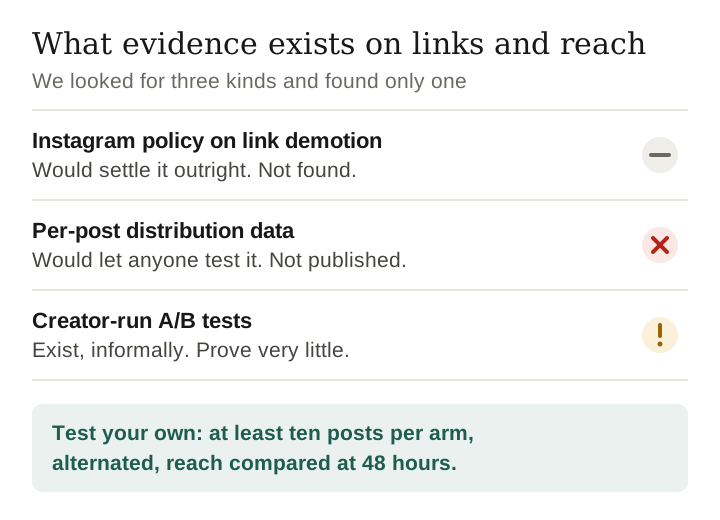
We went looking for three kinds of evidence and found only one of them.
| Kind of evidence | Does it exist? | What it would prove |
|---|---|---|
| A published Instagram policy on link demotion | not that we could find | would settle it outright |
| Platform-published per-post distribution data | no | would let anyone test it properly |
| Creator-run A/B tests shared publicly | yes, informally | very little — see below |
Creator-run tests are the only widely circulated evidence, and they are almost always confounded. A creator posts a linked Reel and an unlinked Reel, sees different reach, and reports a penalty. But the two Reels had different content, different hooks, went out at different times, to an audience whose composition shifts weekly. A sample of two posts cannot separate a link effect from every other difference between them.
The strongest argument against the claim
It is a behavioural argument rather than a data one, and it is the most persuasive thing on this page. In late March 2026 Instagram launched affiliate product tagging in Reels, letting creators tag up to 30 products in a single Reel, with commissions paid by brands through Meta's Commerce Manager or through connected affiliate programmes. Meta added retail partners on the Facebook side and said publicly that it expects the link-in-bio era to end.
A platform building commerce tooling of that size is not simultaneously running a quiet penalty on commercial posts. It might well prefer that the commerce happen through its own tagging surface rather than through a link out to somebody else's page — that is a real and reasonable suspicion — but that is a different claim from "affiliate links hurt reach", and it deserves to be stated as the different claim it is.
What creators are probably measuring
Four things that will move your reach far more than a URL:
- The post reads as an ad. People scroll past advertising. Lower early engagement means lower distribution, and that is a human effect, not an algorithmic punishment.
- Product posts are narrower. A post about one specific object interests fewer people than a post about a feeling. Narrow content earns narrower reach.
- Posting cadence changed. Creators tend to add links during pushes, and pushes change frequency, format and timing all at once.
- Seasonality. Reach on any account swings with the calendar. Comparing a September post to a July one measures the month.
How to test it on your own account
If you want a real answer for your account rather than a general one, this is the minimum that would tell you anything:
- Same format, same length, same posting time. Vary only whether a link is present.
- At least ten posts per arm. Two is noise. Ten is a weak signal. Twenty is a finding.
- Compare reach at a fixed age — 48 hours, say — not lifetime totals, which favour older posts.
- Alternate them. Do not run linked posts for a fortnight and then unlinked ones; that measures the fortnight.
Almost nobody does this, which is why the question has been argued about for years without resolving. If you do run it, your result will be about your account and your audience, and it will still be more evidence than anything currently circulating.
Platform features checked 1 September 2026. Instagram and TikTok both change creator rules several times a year; anything on this page describing a platform feature is true as of that date and should be re-checked against the platform's own pages before you rely on it.
Links and reach, asked plainly
Do affiliate links reduce Instagram reach?
There is no published Instagram policy saying so and no platform data that would let anyone test it. The widely shared creator experiments are confounded by content, timing and audience differences.
Why do people believe it?
Because product posts often do get less reach. The likely cause is that a post reading as an ad earns less early engagement from humans, and narrow product content interests fewer people.
What is the best argument against the claim?
In late March 2026 Instagram launched affiliate product tagging in Reels, allowing up to 30 tagged products per Reel. A platform investing in commerce tooling at that scale is unlikely to be penalising commercial posts.
How would I test it myself?
Same format, same length, same posting time; at least ten posts per arm, alternated; compare reach at a fixed post age rather than lifetime totals.
Sources
- NetInfluencer and Affiverse on Instagram's March 2026 affiliate product tagging in Reels, the 30-product limit, and Meta's public comments on the link-in-bio era. Trade press, not platform documentation.
- Digiday on the 2022 closure of Instagram's earlier native affiliate programme, which is the last time the platform's commerce priorities changed abruptly.
- We searched for a published Instagram policy on link-related distribution effects on 1 September 2026 and did not find one. Absence of a policy page is not proof of absence of an effect, and the page says so.
More on distribution →
Read next
Tagging vs affiliate links · How to add affiliate links · Making money on TikTok
How this page was made. Drafted with AI (Claude); not yet independently re-checked. How we work