LinkToLooks · Guides · Creator Desk
Creator Desk
Product tagging or affiliate links: who gets paid?
Part of: Instagram for creatorsFor creators
Product tagging and affiliate linking answer different questions. A product tag makes an item tappable inside a post and requires a connected catalogue. An affiliate link is a tracked URL that pays you a share of the sale wherever you put it.
Since late March 2026 the two overlap: Instagram lets creators tag affiliate products in Reels, including by pasting an affiliate link they already hold.
On this page
Who each is available to
Product tags
- Require a product catalogue connected through Meta's Commerce Manager, either the brand's or one you are tagging from.
- Available to creators in Instagram's commerce markets. The March 2026 affiliate tagging launch was reported in the United States, Brazil, India, Indonesia and Thailand, with expansion planned.
- Reported capacity: up to 30 products in a single Reel.
Affiliate links
- Require approval by an affiliate network or a retailer's own programme — not by Instagram.
- Work anywhere a URL works: bio, Stories, DMs, your own site, a newsletter, another platform entirely.
- No capacity limit, and no dependence on any one platform's commerce roadmap.
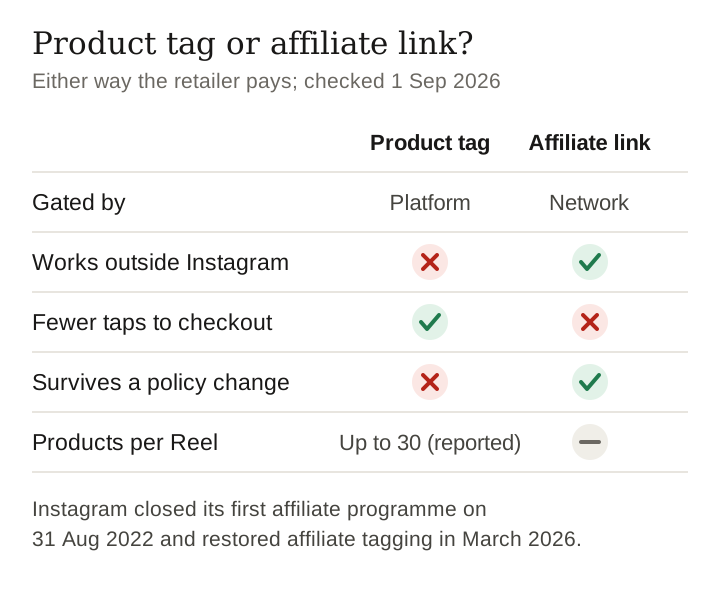
The structural difference worth internalising: a product tag is a permission granted by a platform, and an affiliate link is a relationship with a retailer. Permissions get revoked when priorities change — Instagram shut its first native affiliate programme on 31 August 2022 and did not restore affiliate tagging until March 2026. Relationships with retailers survived that entire gap.
Who actually gets paid
In both cases the money comes out of a retailer's margin, not out of Instagram. With affiliate tagging in Reels, brands set the commission rate through Commerce Manager or by connecting an affiliate programme they already run. With a plain affiliate link, the rate is whatever your network or programme agreed with you.
What that means practically: tagging does not create a new revenue source. It removes a hop between the post and the checkout. Whether it earns you more depends entirely on whether removing that hop converts more people than the audience you lose by tagging rather than talking.
What happens when the product sells out
This is the failure mode people do not plan for, and the two mechanisms fail differently.
- A catalogue-backed product tag is tied to a catalogue entry. When the item goes out of stock, the tag typically reflects that, and when the entry is removed the tag has nothing to point at.
- An affiliate link points at a URL. When the item sells out, that URL usually still resolves — to an out-of-stock page, a redirect, or in the worst case a 404 that still looks like a working link from the outside.
For single-item resale inventory the second case is constant rather than rare. In today's pull, 97.9% of one category's live listings were single-item resale — every one of those links has a finite life measured in days or weeks. If your niche is secondhand, link checking is not maintenance, it is part of the job.
Side by side
| Product tag | Affiliate link | |
|---|---|---|
| Gated by | the platform | the affiliate network |
| Works outside Instagram | no | yes, anywhere |
| Who sets the rate | the brand, in Commerce Manager | your network or programme |
| Taps to checkout | fewer | one more |
| Survives a platform policy change | no | yes |
| Behaviour when stock ends | tag reflects or disappears | URL may resolve to nothing |
| Capacity per Reel | reported up to 30 | not applicable |
Which to use, per post
- A Reel about one in-stock product from a brand with a catalogue: tag it. Fewer taps, and the tag carries the price.
- Anything secondhand or one-of-one: affiliate link, and check it monthly.
- A recommendation you want to still be useful in a year: affiliate link on a page you control, because it outlives both the post and the platform's current tooling.
- Expensive items: either. Above roughly $50 the extra tap stops mattering, because the purchase already involves deliberation.
Platform features checked 1 September 2026. Instagram and TikTok both change creator rules several times a year; anything on this page describing a platform feature is true as of that date and should be re-checked against the platform's own pages before you rely on it.
Tagging versus linking, asked plainly
What is the difference between product tagging and affiliate links?
A product tag makes an item tappable inside an Instagram post and depends on a connected catalogue and on Instagram's permission. An affiliate link is a tracked URL, approved by a network rather than a platform, that works anywhere.
Who pays the commission in each case?
The retailer, in both cases. With affiliate tagging in Reels, brands set the rate through Meta's Commerce Manager or by connecting an existing affiliate programme.
What happens to a product tag when the item sells out?
It is tied to a catalogue entry, so it reflects the stock state or disappears with the entry. An affiliate link keeps pointing at a URL that may resolve to nothing.
Which should I use for secondhand items?
Affiliate links, and check them regularly. In today's data 97.9% of one category's listings were single-item resale, so those links have short lives.
Sources
- NetInfluencer and Affiverse on Instagram's March 2026 affiliate tagging in Reels, the 30-product limit and the Commerce Manager rate mechanism. Trade press, not platform documentation.
- Digiday on the 31 August 2022 closure of Instagram's earlier affiliate programme.
- Single-item resale share: CJ Affiliate product feeds, US advertisers, queried 1 September 2026.
More link mechanics →
Read next
Storefront vs link in bio · Do links hurt reach? · Making money on TikTok
How this page was made. Drafted with AI (Claude); not yet independently re-checked. How we work