LinkToLooks · Guides · Creator Desk
Creator Desk
How do you choose which products to feature?
Part of: For creators
Four checks, three of them measurable before you write a word: listing durability, retailer depth and price band. Then the judgement call: can you say anything specific?
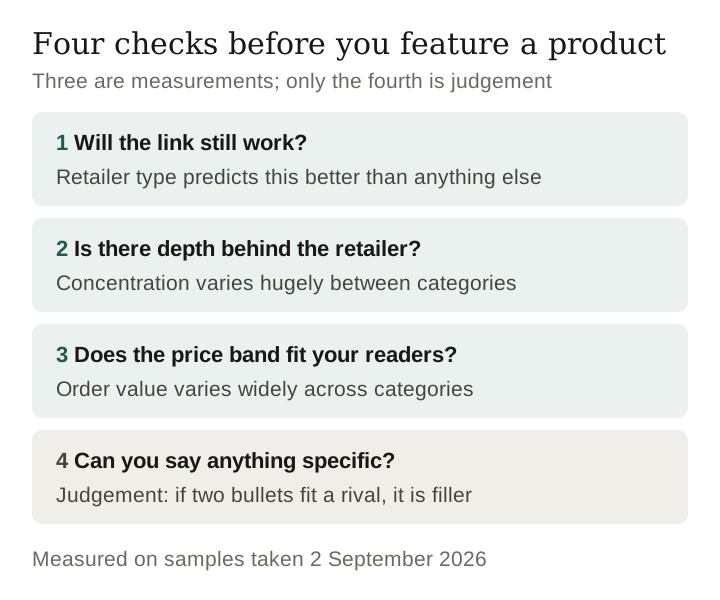
Four checks, all doable before you write
Choosing products is usually described as taste. Most of it is not. Four things can be checked in a few minutes each and they eliminate most bad candidates before you have written a word.
- Durability of the listing. Will this URL still resolve to this product in a month?
- Depth behind the retailer. Is there more where this came from, or is this retailer the whole category?
- Price band fit. Does the number make sense for the people who read you?
- Specificity. Can you say something about this item that would not be true of its competitor?
Only the fourth is judgement. The first three are measurements, and the rest of this page is how to take them.
Check one: will the link still work?
Retailer type predicts this better than anything else. We ran identical queries with and without an in-stock filter on 2 September 2026 and compared how much of each family’s catalogue was not currently purchasable.
| Product family | Inventory type |
|---|---|
| Corelle | Discontinued patterns, one-of-one |
| Enamelware | Mixed new retail and open stock |
| Pyrex | Mixed |
| Skillet | Ordinary repeatable retail |
| Tupperware | Ordinary repeatable retail |
| Jadeite | Active seller listings |
Method: CJ product API, US advertisers, paired keyword queries run with and without the in-stock filter, 2 September 2026.
Compare a branded skillet stocked by many retailers, restocked continuously, and available at $24.90 from a second retailer on 30 September 2026, with a single mug in a discontinued pattern. Both are good recommendations. Only the first belongs in something you expect people to read for a year.
Last verified 30 September 2026 for the skillet and prep-bowl prices, against the CJ product feed; the durability, retailer-depth and price-band checks come from paired queries across six product families and top-level category samples run on 2 September 2026
Check two: is there depth behind the retailer?
If one retailer is the category, your content plan is really a bet on one commercial relationship. That is fine when you know it and dangerous when you do not.
| Category | What it means |
|---|---|
| Vehicles & parts | One relationship is the category |
| Arts & entertainment | Same |
| Food, beverages & tobacco | Same |
| Home & garden | Mostly one, with a tail |
| Electronics | One large retailer and a wide spread; plan for both |
| Health & beauty | One large retailer and a wide spread |
| Toys & games | Genuinely spread |
| Apparel & accessories | Genuinely spread |
| Animals & pet supplies | Very spread; join widely |
The practical use is not to avoid concentrated categories — food and home are excellent subjects. It is to know that in those categories, a single approval decision determines most of what you can link, so it should be your first application and not your fifth.
Check three: does the price band fit your readers?
Order value varies widely across categories, and the mistake is to read that as a ranking. It is a constraint.
| Category | What that implies |
|---|---|
| Furniture | Few purchases, long consideration, high value each |
| Luggage & bags | Seasonal spikes, considered purchase |
| Electronics | Specification-driven, comparison-heavy |
| Apparel & accessories | Frequent, fit-dependent, high return rates |
| Home & garden | Broad, repeatable |
| Toys & games | Age-banded, gift-seasonal |
| Health & beauty | Repeat purchase, routine-driven |
| Baby & toddler | High trust bar, thin catalogue |
| Arts & entertainment | Impulse, volume-dependent |
A cheap category needs volume and repeat purchase to work. An expensive category needs trust and depth of explanation. Choosing products from a band that does not match how your audience actually reads you is the commonest reason a good recommendation earns nothing.
Check four: can you say anything specific?
The disqualifier. Draft two bullets about the candidate before you commit to it. If they would read identically for a competing product, the item is filler.
- Good: “$20.99 here and $24.90 at a farm retailer for the same pan.” Specific, checkable, useful.
- Good: “Enamel conducts, so the rim gets hot with the drink.” A mechanism, and a drawback.
- Filler: “A beautiful addition to any kitchen.” True of everything.
- Filler: “Built to last.” Also true of everything, and unverifiable.
Frequently asked
How do you choose which products to feature?
Score candidates on four things you can check before you write: how durable the listing is, how deep the retailer's stock is, whether the price band suits your audience, and whether you can say anything specific about the item.
Should I feature expensive products to earn more per sale?
Order value genuinely varies by category. But a product your audience will not buy converts at zero regardless of its price.
How do I know if a listing will still be live next month?
Look at the retailer type. Ordinary retail stock is repeatable; peer-to-peer and replacement listings are one-of-one.
Is it worth featuring products from small retailers?
Sometimes, and check first. Concentration varies hugely between categories.
What is the fastest disqualifier?
Not being able to say anything specific. If your bullets would read identically for a competing product, the item does not belong in the piece.
Keep reading
How this page was made. Drafted with AI (Claude); not yet independently re-checked. How we work