LinkToLooks · Guides · Creator Desk
Creator Desk
How do you recommend a product without sounding like an ad?
Part of: For creators
The tell is not enthusiasm, it is interchangeability: advertising describes a product in language that would fit any product in its category. Fix it with four things — the dated price, a mechanism rather than a benefit, one sentence on who it is wrong for, and an explicit statement of what your evidence is. Then run the swap test on every sentence.
Why the reader can tell
Readers are extremely good at spotting advertising and not very good at explaining how. The tell is almost always the same: advertising describes a product in language that would fit any product in its category.
Take a real listing from a pull we ran on 2 September 2026: an enamel-on-steel saucier at $25.99. Here are two ways to write it.
Reads as an ad: “Elevate your kitchen with this beautiful enamel saucier — the perfect addition to any home cook’s collection.”
Reads as a recommendation: “$25.99. Enamel over steel, so it heats fast and cools fast — the opposite of cast iron, and better for a sauce you have to watch. Light enough to hold one-handed. A chip on the inside will rust and there is no fixing it, so this is a hob pan, not a scouring pan.”
The second version is not better written. It contains four facts and one drawback. The first contains none and none.
Four things every honest recommendation contains
- The price, stated plainly and dated. Omitting the price is the single commonest advertising tell, because advertising wants desire to arrive before arithmetic does. Give the number and the date you checked it.
- A mechanism, not a benefit. ‘Heats fast because it is thin steel’ is a mechanism. ‘Perfect for busy weeknights’ is a benefit with nothing behind it.
- Who it is wrong for. One sentence. It costs you almost nothing and it is the fastest way to establish that you are not being paid to omit things.
- Your evidence. Used it, held it, read the spec, or pulled the listing. Say which. Readers forgive a limited basis; they do not forgive a disguised one.
The swap test
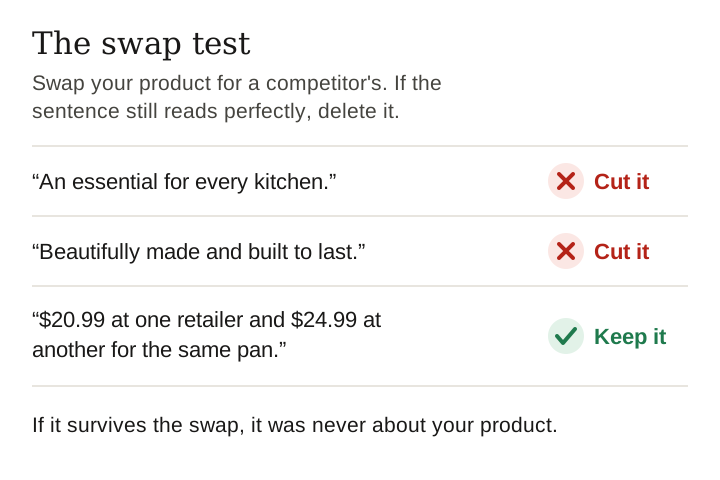
A single check that catches most of it. Take any sentence in your draft and swap the product for a competitor's. If the sentence still reads perfectly, delete it — it was never about your product.
| Sentence | Survives the swap? | Verdict |
|---|---|---|
| “An essential for every kitchen.” | Yes | Cut it |
| “Beautifully made and built to last.” | Yes | Cut it |
| “$20.99 at one retailer and $24.99 at another for the same pan.” | No | Keep it |
| “The 8-inch is the size that gets used; the 12-inch gets photographed.” | No | Keep it |
| “Enamel conducts, so the rim gets hot with the drink.” | No | Keep it |
Run it once on a finished draft. It is uncomfortable the first time and it takes about four minutes.
Structural choices that change the reading
- Lead with the object, not with yourself. A paragraph of preamble before the product is the shape of sponsored content, because sponsored content has a word count to reach.
- Link two or three things, not everything. When every noun is a link the post becomes a catalogue and the reader adjusts their trust accordingly.
- Put the drawback before the call to action, not after it. A caveat in the last line reads as legal cover; a caveat in the middle reads as advice.
- Date your prices in the text. ‘$25.99 on 2 September’ ages honestly. ‘Only $25.99’ just becomes wrong.
- Disclose where disclosure applies, clearly and near the top. Burying it does not make the post read less like an ad; it makes it read like an ad someone is hiding.
Keep reading
What honesty costs, and what it buys
Being specific has a real cost and it is worth naming rather than pretending otherwise.
- You will recommend fewer things. Four facts and a drawback per product is more work than a sentence of praise, so the volume goes down.
- Some posts will send fewer clicks. Telling a reader the pan is heavy will stop some of them buying the pan. That is the point of telling them.
- Some brands will not like it. A brand that objects to a stated drawback is telling you what kind of partner it is, which is useful information early.
What it buys is the only durable asset in this line of work: a reader who believes the next thing you say. We are not going to put a number on that — we hold no affiliate approvals and have no performance data to generalise from, so a conversion claim here would be invented. The argument stands on its own without one.
Last verified 2 September 2026 against live CJ product-feed pulls of the enamel saucier and cast iron skillet listings quoted above
Frequently asked
How do you write a product recommendation that does not read as an ad?
Say what the thing costs, say who it is wrong for, and include at least one fact you could only know from handling it or from checking a source. Adverts omit all three.
Does disclosure make a post read as an ad?
Disclosure is required where it applies and it is not what makes a post read as an ad. Vagueness does. A specific, disclosed recommendation reads better than an undisclosed vague one.
Should I recommend things I have not used?
You can write usefully about a product you have not tested if you are explicit about what your evidence is. What you cannot do is imply experience you do not have.
What words give an ad away?
Superlatives with no comparison, benefits with no mechanism, and borrowed brand language. If a sentence would read identically for a competing product, it carries no information.
Is it bad to link everything in a post?
It changes what the post is. A post where every noun is a link reads as a catalogue. Linking two or three things you actually mean is a recommendation.
How this page was made. Drafted with AI (Claude); not yet independently re-checked. How we work