LinkToLooks · Guides · Creator Desk
Creator Desk
Health and beauty claims a creator should not repeat
Honesty is not the test. The test is evidence about the product — which is why the safest thing a creator can publish about a cream is its price.
Part of: For creators
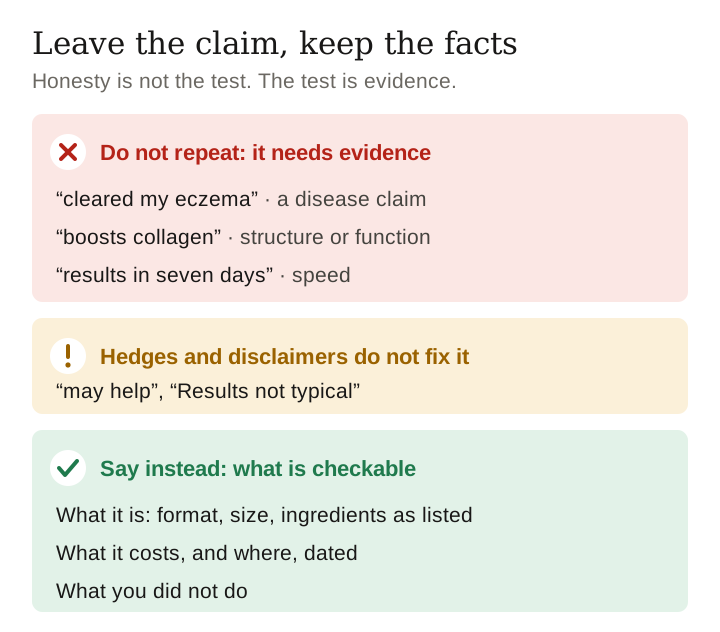
Repeating a brand’s health claim makes it your claim, and the substantiation standard does not soften because you were quoting. The FTC’s Health Products Compliance Guidance states the principle directly: advertisers should not use consumer testimonials or expert endorsements to make claims that “would be deceptive or couldn’t be substantiated if the advertiser made them directly”. And the same guidance defines advertising to include “social media and influencer marketing” explicitly.
For us this is not an abstract rule. We have never worn, tested, applied or handled any product on this site, so every claim category below is one we are structurally unable to make. Writing this page is writing down our own constraint.
The principle
The guidance gives as an overarching principle that advertisers should not use testimonials or expert endorsements for claims that would deceive, or that they could not back up, if made directly. It goes on:
“It’s not enough that a testimonial represents the honest opinion or experience of an endorser.”
FTC, Health Products Compliance Guidance, retrieved 4 September 2026
The second half is the one to sit with. Honesty is not the test. You can sincerely believe a supplement helped you and still be repeating an unsubstantiated efficacy claim, because the standard is evidence about the product, not sincerity about the experience.
The same guidance sets the evidentiary bar: claims about health benefits or safety “require substantiation in the form of competent and reliable scientific evidence”. That is a high bar deliberately, and it is a bar no creator meets by having used something.
The claim categories to leave alone
These are the shapes that turn a product description into a health claim. The rule of thumb: if the sentence implies an effect on a body or a condition, it needs evidence you do not have.
| Category | The shape it takes | Why it is a problem |
|---|---|---|
| Disease treatment or prevention | “cleared my eczema”, “stops breakouts” | A disease claim needs competent and reliable scientific evidence about the product |
| Structure or function of the body | “boosts collagen”, “repairs the skin barrier” | Still an objective efficacy claim requiring substantiation |
| Outcome with a number | “lost 16 pounds”, “80% fewer wrinkles” | A quantified result is the most substantiation-hungry claim shape there is |
| Speed | “results in seven days” | Adds a timeframe that must also be supported |
| Safety and suitability | “safe for pregnancy”, “fine for babies” | A safety claim, and the audience least able to absorb an error |
| Comparative superiority | “works better than prescription X” | Requires evidence about both products |
| Authority by association | “dermatologist approved”, “FDA approved” | Claims about approval and endorsement are themselves claims |
Beauty is where this catches people who thought they were outside it. “Reduces the appearance of” is a cosmetic claim; “repairs” is a structure-function claim; and the two sit one word apart in the same caption.
The hedge words that do not work
The guidance addresses this directly and unusually bluntly:
“Vague qualifying terms are inadequate.”
Saying that a product ‘may’ have the claimed benefit, or ‘helps’ achieve it, is not enough, it says, and consumers are likely to read modifiers such as ‘promising,’ ‘preliminary,’ ‘initial,’ or ‘pilot’ “as positive product attributes, rather than as substantial disclaimers about the state of the science.” Those are the exact hedges creators reach for.
So “may help” is not a shield. Neither is “promising early research suggests”, which reads to a consumer as there is research rather than as the research is thin. The guidance’s own worked example is a cholesterol supplement whose “promising, preliminary” framing it judges unlikely to convey the limitations at all.
“Results not typical” does not cure it
The most common attempted fix is the asterisk. The guidance is explicit that it does not work. Testimonials that “report results more dramatic than users can generally expect” are likely to deceive, it says, before adding:
“[A]ttempts to disclaim dramatic results with statements like ‘Results not typical’ don’t cure the deception.”
What the guidance asks for instead is a disclosure of “the results a typical consumer can actually expect” — which is a number, from evidence, that a creator repeating a brand’s copy does not have. That is the whole trap in one line: the cure requires exactly the substantiation whose absence created the problem.
What you can say instead, and why it is not weaker
The reflex is that removing efficacy claims leaves nothing to say. In practice it leaves most of what a shopper actually wants, and all of it is checkable.
- What it is. Format, size, quantity, ingredients as listed, materials.
- What it costs, and where. Across sellers, dated. This is the one thing almost no beauty content does well.
- What the brand says, clearly attributed as the brand’s claim rather than adopted as yours — and note that attribution reduces the problem without eliminating it.
- What it is for, in the category’s own terms: a cleanser cleanses.
- What is verifiable about availability — in stock, discontinued, sold by one retailer only.
- What you did not do. Saying you have not tried something is information, and readers treat it as credibility rather than as a gap.
A price comparison across five sellers, dated today, is more useful to a buyer than a repeated efficacy claim they have already read on the brand’s own page. It is also the only one of the two that is ours.
Our own version of this rule
Every page on this site is written under the same constraint we are describing. We have not worn, tested, applied or handled any product here. Our authority is measurement: we pull live retailer data, we count it, and we date it. So when a page says a category’s median asking price was a given figure on a given day, that is a claim we can stand behind, and when a page has nothing to say about whether a product works, it says nothing.
We think that is the right trade for anyone in the affiliate layer, not just for us. The people who can honestly make efficacy claims are the ones holding the evidence. Everyone else is passing along someone else’s copy and inheriting its liability.
Frequently asked
Last verified 4 September 2026 against the FTC Health Products Compliance Guidance and 16 CFR 255, both fetched today
Method, sources and limits
The FTC Health Products Compliance Guidance was fetched on 4 September 2026 (1,154,109 bytes, HTTP 200) and every quotation above is verbatim from it. 16 CFR 255 came from the eCFR renderer API the same day. Note for anyone repeating our method: the FTC site returned 200 to a browser user agent today, having refused scripted agents in the past, so test rather than assume.
Limits. Not legal advice, and not medical advice either. This describes advertising-substantiation principles as the Commission publishes them; it does not cover FDA labelling law, which is a separate regime with its own definitions, and it does not cover any jurisdiction outside the United States.
Keep reading
How this page was made. Drafted with AI (Claude); not yet independently re-checked. How we work