LinkToLooks · Guides · Creator Desk
Creator Desk
Children and teen audiences: what actually changes
Two rules, two different questions, and the merge between them is where most creator advice on this subject goes wrong.
Part of: For creators
Two separate things change when your audience is young, and they are governed by two different rules that people routinely merge. 16 CFR 312 — the COPPA Rule — is about collecting personal information from a child, which it defines as an individual under 13. 16 CFR 255.6 is about advertising to children, and it is two sentences long. Neither one says what most creator advice says it says.
On top of both sit the platforms’ own age rules, which are contractual rather than legal and are usually the thing that actually affects a creator’s account.
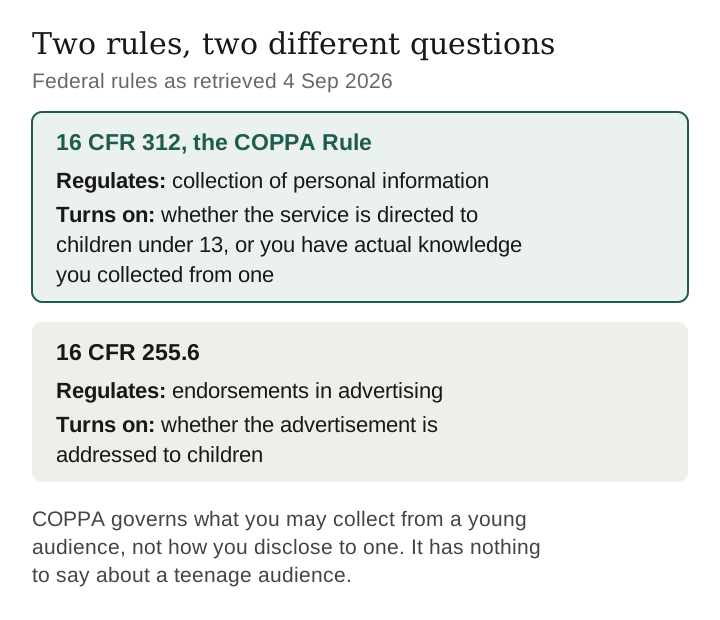
Two rules, two different questions
| 16 CFR 312 (COPPA Rule) | 16 CFR 255.6 | |
|---|---|---|
| Regulates | Collection of personal information | Endorsements in advertising |
| Turns on | Whether the service is directed to children under 13, or you have actual knowledge you collected from one | Whether the advertisement is addressed to children |
| Length | Thirteen sections, 89,649 bytes as fetched | Two sentences |
| Applies to a creator when | You operate a site or service that collects data — a storefront, a mailing list, a form — or post child-directed content on a platform where personal information is collected on your behalf, such as for targeted ads | Your content is an advertisement addressed to children |
| Says nothing about | Disclosure wording | Data, consent or age gates |
Merging the two produces the confident, wrong advice you see most often: that COPPA governs how you disclose to a young audience. It does not. COPPA governs what you may collect from one.
What COPPA actually regulates
The definition that anchors everything, quoted from the rule:
“Child means an individual under the age of 13.”
16 CFR § 312.2, retrieved 4 September 2026
That single number does a lot of work, because it means COPPA has nothing to say about a teenage audience. A creator whose viewers are fourteen is outside the rule entirely, whatever the platform’s own policies require.
312.2 also defines collection broadly enough to catch things that do not feel like data collection: “requesting, prompting, or encouraging a child to submit personal information online”, “enabling a child to make personal information publicly available in identifiable form”, and “passive tracking of a child online”. The third is the one that reaches ordinary web analytics on a site directed to children.
The obligations that follow — notice at 312.4, verifiable parental consent at 312.5, a parent’s right to review at 312.6, and retention and deletion limits at 312.10 — are operator obligations. They land on the operator. For a creator that is your own site, your own storefront and your own mailing list, and it can also be you on someone else’s platform: the FTC’s COPPA FAQ says that if content you post is directed to kids and personal information is collected by you or on your behalf, such as a persistent identifier used to serve targeted advertising, you will be deemed an operator.
16 CFR 255.6, which is two sentences long
The first sentence says that endorsements in advertisements addressed to children:
“may be of special concern because of the character of the audience.”
16 CFR § 255.6, retrieved 4 September 2026
The second says that something which would pass unremarked in an advert aimed at adults may be open to question in one aimed at children. That is the entire section. It sets no separate standard, names no specific practice, and gives no examples — unusually for part 255, which is otherwise dense with worked examples. What it does is raise the general standard: things that pass for an adult audience may not pass for a child one.
The practical reading is about comprehension. A disclosure has to be “easily understandable by ordinary consumers” under 255.0(f), and 255.0(f) adds that where an endorsement targets a specific audience, “ordinary consumers” includes members of that group. For a young audience that is a plain-language requirement with a regulatory hook, not a stylistic preference.
The platform rules that bite first
In day-to-day terms, the rule that changes a creator’s life is usually not either of the above. Platforms operate their own age minimums, their own made-for-kids designations, and their own restrictions on what monetisation features are available on content flagged that way. Those are contractual terms, enforced by the platform, sometimes by automated systems.
We are deliberately not listing per-platform thresholds here. They change often, and a stale table on this subject is worse than no table — a creator acting on a number we published in September would have no way of knowing it moved. Read the platform’s own current page before you rely on any figure, including one from us.
Keep reading
What changes in practice
Five things actually change, and they are smaller and more concrete than the topic’s reputation suggests.
- Plain words in the disclosure. 255.0(f) makes “ordinary consumers” include members of the targeted group. If the group is nine-year-olds, an abbreviation is not a disclosure.
- Your own data collection, including collection made on your behalf. If your site, list or channel could plausibly be directed to under-13s, the operator obligations in part 312 can attach to you, including where a platform collects identifiers for targeted ads on your content.
- Passive tracking counts. 312.2 names it explicitly. Analytics on a child-directed site is collection.
- Nothing changes for a teen audience under COPPA. The definition stops at 13. Platform rules and other law may not, but this rule does.
- The advertising standard rises, without becoming specific. 255.6 raises the bar and leaves the detail to the facts, which means erring wide is the only safe reading.
What we cannot tell you
Three honest gaps, because a page on this topic that admits none is not describing the topic accurately.
- Whether your audience is under 13. Platform audience reporting is self-declared age at signup, aggregated, and bucketed. It is not a reliable answer on its own: the rule asks whether your content is directed to children, weighing many factors including evidence about audience composition, or whether you have actual knowledge.
- Whether your content is “addressed to children”. That is a facts-and-circumstances judgement in both rules. Subject matter, presentation, music, characters and language all feed it, and no threshold exists.
- State law. Several states have enacted their own requirements around minors and online services. We are describing two federal rules only, and we say so rather than implying completeness.
Frequently asked
Does COPPA apply to my Instagram or TikTok posts?
COPPA's obligations fall on the operator of a site or online service that collects personal information. That can be you on someone else's platform: the FTC's COPPA FAQ says that if content you post is directed to kids and personal information is collected by you or on your behalf, such as a persistent identifier used to serve targeted advertising, you will be deemed an operator. Running your own storefront, site or mailing list can make you one too.
What age does COPPA cover?
16 CFR 312.2 defines a child as an individual under the age of 13. The rule does not reach a teenage audience.
What does 16 CFR 255.6 require?
It is two sentences and sets no separate standard. It says endorsements in advertisements addressed to children may be of special concern, and that practices unquestioned for adults might be questioned for children.
Do analytics count as collecting data from children?
16 CFR 312.2 lists 'passive tracking of a child online' inside its definition of collection, so on a child-directed service, yes.
How do I know if my audience is under 13?
You largely cannot. Platform age reporting is self-declared and aggregated. The rule is framed around whether a service is directed to children or you have actual knowledge, not around an audience percentage.
Last verified 10 October 2026 against 16 CFR 312 and 16 CFR 255 fetched in full from the eCFR renderer API
Method, sources and limits
Both parts were fetched from the eCFR renderer API on 4 September 2026 — part 312 at 89,649 bytes and part 255 at 106,357 bytes — and quoted directly. The FTC’s own COPPA compliance FAQ was fetched the same day and returned 200; we link it rather than summarising it, because it is long and it changes.
This is a description of published rules, not legal advice. We are not lawyers, we have no enforcement data, and the two judgement calls that decide most real cases — whether a service is child-directed and whether an ad is addressed to children — are exactly the ones neither rule reduces to a test.
Keep reading
How this page was made. Researched and drafted with AI (Claude); checked by a separate automated pass on 12 October 2026. How we work