LinkToLooks · Guides · Creator Desk
Creator Desk
What is a SubID, and why should a creator use one?
The label that turns an anonymous sale into a post you can point at, and the two-minute check that it arrives intact.
Part of: For creators
A SubID is a label you attach to an affiliate link so that when a sale comes back, you know which post produced it. Networks report sales with a timestamp, an amount and your SubID. Many do not report the page a click came from, though some let you pass it: Awin has a link parameter that records your page address in its transaction report. Without a SubID, a sale is anonymous.
Analytics cannot fill this gap, and the reason is structural: your analytics stops at the click, and the network only knows which post a sale came from if the link tells it. Nothing joins the two except a string you put in the link yourself.
The gap a SubID closes
| System | Sees the click | Sees the sale | Knows which post |
|---|---|---|---|
| Your site or platform analytics | Yes | No | Yes, for clicks only |
| The affiliate network's dashboard | Partly | Yes | Only if you told it |
| The retailer | Yes | Yes | No, and it does not report to you |
| A SubID | Carried through | Reported alongside the sale | Yes |
Read the last column. Every system in that table knows something, and no system except the SubID knows the thing you actually want: which piece of work earned the money.
This matters most for the creators with the least time. If you publish forty posts a quarter and eleven sales come back, the difference between knowing and not knowing which eleven posts produced them is the difference between a content plan and a guess.
A naming scheme that survives a year
The scheme matters more than people expect, because the SubID you invent in March is the SubID you have to interpret in December. Three rules:
- It must be decidable at posting time without a lookup table. If you have to open a spreadsheet to know what to type, you will eventually not type it.
- It must sort. Put the date first, in year-month-day order, so a plain alphabetical sort is also a chronological one.
- It must survive being read by a stranger — including you, later.
post12is not a label, it is a promise to remember.
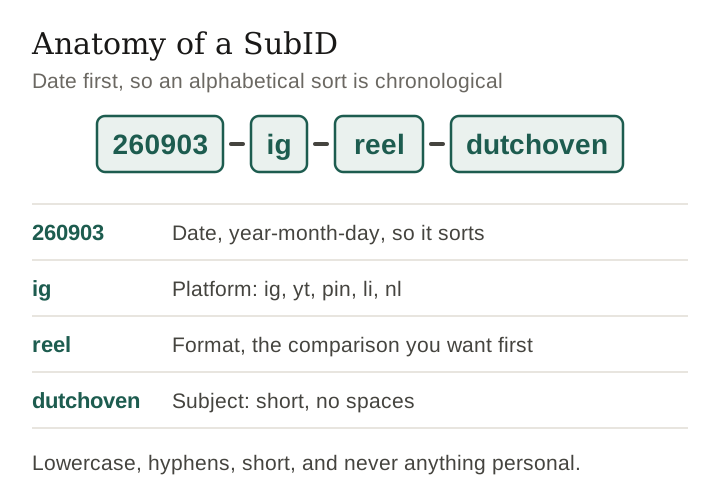
A shape that satisfies all three:
260903-ig-reel-dutchoven
260903— date, sortable, unambiguous.ig— platform. Two letters is enough: ig, yt, pin, li, nl for the newsletter.reel— format, because the format comparison is the one you will want first and cannot get any other way.dutchoven— subject, short, no spaces.
Keep it lowercase, use hyphens rather than spaces or underscores, and keep it short: networks impose their own length limits and a truncated SubID is worse than a short one because it silently collides with its neighbours. Never put anything personal in it — a SubID travels through several parties' systems and appears in reports you do not control.
Keep reading
Check that it survives the redirects
A SubID lives in a query parameter, and query parameters are not guaranteed to arrive. The failure to watch for is a quiet one: a redirect can drop a parameter and return a healthy status code, so nothing in your dashboard will ever tell you.
The check takes two minutes and is worth doing once per programme: build a link with a SubID you would recognise, open it, and look at the address bar on the page you land on. If the label is gone, you have learned it before three months of data went missing rather than after.
Four mistakes that cost you the data
- One SubID for everything. A single label across every post is the same as no label, with extra steps. If you do nothing else, separate by platform.
- A different scheme every quarter. The value of the labels is comparison over time, and a scheme change resets it. Pick something you can live with and keep it.
- Reusing a SubID on a second post. Cheap to do, impossible to unpick later. Two posts sharing a label are one row in your report forever.
- Adding it and never reading it. The label is not the point; the quarterly look at which format and which platform actually produced sales is the point.
What a SubID still will not tell you
- Why a post worked. It attributes; it does not explain. Two posts with the same SubID structure and wildly different results is where your judgement starts, not where it ends.
- Who the clickers were. Some networks count clicks per SubID (Awin’s click-reference report does), but a count is all you get; the people who clicked and did not buy remain invisible unless your own analytics saw them.
- Which of several links in one post earned. Not unless you gave each link its own suffix, which is worth doing on any post carrying more than three or four products.
- Whether the network counted it correctly. Reversals, cross-device journeys and cookie loss all happen upstream of the label.
- What any of this pays. We hold no commission data and no earnings of our own — this page is about attribution mechanics, not income.
Frequently asked
What is a SubID in affiliate marketing?
A label you add to an affiliate link, passed through to the network, which reports it back alongside any sale. It is the only reliable way to know which post produced which sale.
Is a SubID the same as a UTM parameter?
No. They are read by different parties: a UTM parameter is read by the analytics on the page the link lands on, which for an affiliate link is the retailer’s, not yours; a SubID is read by the affiliate network. Setting one does not populate the other.
What should a SubID look like?
Date first for sortability, then platform, then format, then subject — for example 260903-ig-reel-dutchoven. Lowercase, hyphenated, short, and never containing personal information.
Can a SubID get lost?
Yes. It travels in a query parameter, and a redirect can drop parameters while still returning a healthy 200.
How many SubIDs should one post have?
One per link if the post carries more than three or four products. Otherwise one per post, which is already a large improvement on none.
Method and scope
- The naming scheme is our recommendation, not a standard. Networks differ on length limits and permitted characters; check yours before committing to a format.
- Not verified: how any specific network treats SubIDs on a redirect, since those terms sit behind publisher logins we do not hold.
- We hold no affiliate approvals and no SubID reporting of our own. This page describes the mechanism, not results.
Keep reading
Last verified 10 October 2026 against Awin’s click-reference help and Google’s campaign-URL help
How this page was made. Researched and drafted with AI (Claude); checked by a separate automated pass on 10 October 2026. How we work