LinkToLooks · Guides · Creator Desk
Creator Desk
How many pages does a creator need before Google notices?
There is no page count that makes Google notice a site. Here is what Google’s own documentation says does move, and how to measure it on yours.
Part of: For creators
No number of pages makes Google notice you. Google’s documentation sets no page-count threshold: it finds pages through links and sitemaps, says crawling takes days to weeks, and guarantees nothing. Volume can get more of your pages indexed. Indexed is not the same thing as being noticed.
Being noticed means impressions: your page appearing when somebody searches. That takes a search for something you answer and a page that beats the ones already answering it. Neither of those scales with how many pages you have, and Google’s guidance on helpful content warns against publishing lots of content in the hope that some of it performs.
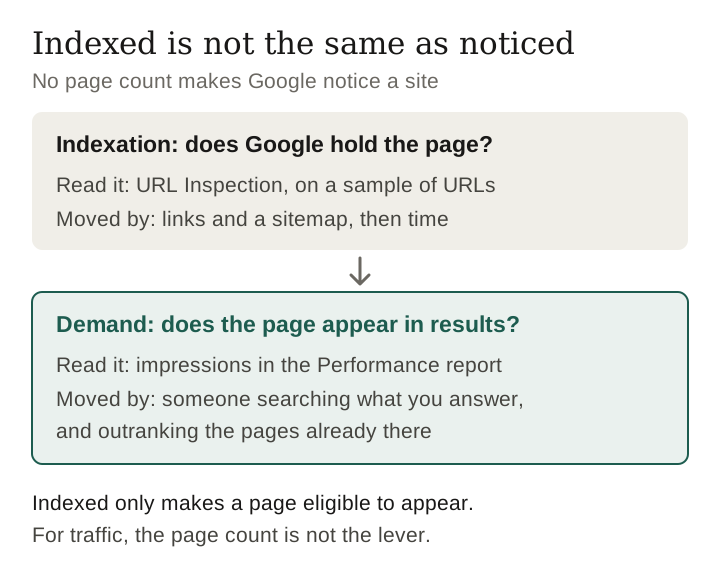
Two numbers to measure, not one
The question in the title mixes two different measurements, and they respond to different things.
| Measure | Where to find it | What moves it |
|---|---|---|
| Indexation — how many of your pages Google holds | URL Inspection on a sample of your URLs | Discovery through links and a sitemap, then time |
| Demand — how often your pages appear in results | The Search Console Performance report: impressions and clicks | Somebody searching what you answer, and your page outranking the pages already there |
Google’s own definitions make the gap plain. In the URL Inspection tool, “URL is on Google” means the page is eligible to appear, and Google says that does not guarantee it will. An impression, in the Performance report, is counted only when your site actually appears in results.
How to take an indexation reading
- Verify your site in Search Console and submit a sitemap.
- Take a sample of URLs from your sitemap — twenty to forty is enough — and run each through URL Inspection. Record the time with every reading.
- Count three states: indexed, discovered but not indexed, and unknown to Google.
- Re-take the reading a few days later before you act on it. Google says crawling takes days to weeks, so a young site’s share can change between readings, and a figure you have not re-taken is a memory.
- Say how you drew the sample. Taking every tenth URL from the sitemap is systematic, not random, and a sample of forty carries wide error bars. Quote a range with dates attached rather than one decimal place.
Keep reading on getting found
Indexed is not found
Here is the reading that actually answers the question in the title. Once your sample is mostly indexed, open the Performance report and look at impressions over the last 28 days. If most of your pages are indexed and impressions are still close to zero, you have learned something useful: volume has done its job, and the constraint is somewhere else.
The mechanism is not mysterious. Being in the index makes you eligible to appear. Appearing requires that somebody searches something you answer, and that Google ranks you above the pages already answering it. A new domain with few external links has a hard time winning that second contest, however many pages it has.
So how many pages does a creator actually need?
Taking a position, from Google’s documentation rather than from folklore:
- For indexation: fewer than you think, and it is not really about the count. Google’s sitemap guidance says a well-linked site of about 500 pages or fewer may not need a sitemap at all. Nothing in Google’s documentation says page 200 helps page 40 get indexed.
- For traffic: the page count is not the lever. Google’s helpful-content guidance lists producing lots of content on many different topics, in the hope some of it performs, as a sign of content made for search engines rather than people, and says Google has no preferred word count.
- For a creator specifically: publish for the query, not for the total. Thirty pages that each answer a question somebody actually types will beat hundreds that collectively answer none of them, and thirty is a realistic number for one person.
We are not telling you to stop publishing. We are telling you that “more pages” and “more traffic” are different projects, and that only one of them is measured by counting pages.
What to do at page one
- Submit a sitemap on day one and check it was read. Google names a new site with few external links as one that can benefit from a sitemap.
- Measure before assuming. Take the indexation reading above, and re-take it before you act on it.
- Do not read a flat traffic line as a content-quality problem until the pages are actually indexed. A page Google has not crawled is not competing and losing; it is not in the index at all. Those need opposite responses.
- Spend the effort on being worth citing rather than on page count. The constraint on a young domain is authority, and authority arrives as links from other people, which no publishing schedule manufactures.
Frequently asked
How many pages before Google indexes a new site?
Google’s documentation sets no page-count threshold. Google finds pages through links and sitemaps, says crawling can take a few days to a few weeks, and does not guarantee indexing for any page.
Does publishing more pages get the earlier ones indexed?
We cannot show that it does, and Google’s documentation does not say so. What Google describes is discovery: a page is found through a link from a page it already knows, or through a sitemap.
Why does an indexed page get no impressions?
Indexation only makes a page eligible to appear. Appearing also needs search demand for its question and enough authority to outrank the pages already answering it.
Does Google prefer sites with more pages?
Google’s helpful-content guidance lists producing lots of content on many different topics, in the hope some of it performs, as a warning sign, and says Google has no preferred word count. Publish for a question somebody asks, not for a total.
Sources and scope
- Discovery through links and sitemaps, and no guarantee of crawling, indexing or serving: Google Search Central, In-depth guide to how Google Search works.
- Crawl timing: Google Search Central, Ask Google to recrawl your URLs.
- Who benefits from a sitemap, and that a sitemap does not guarantee indexing: Google Search Central, What is a sitemap.
- Producing lots of content on many topics as a warning sign, and no preferred word count: Google Search Central, Creating helpful, reliable, people-first content.
- What “URL is on Google” and an impression mean: Search Console Help, URL Inspection tool and Performance report.
- All read 29 September 2026. This page describes a procedure; it reports no measurement of this site or any other.
Last verified 29 September 2026 against Google’s Search Central and Search Console Help documentation
Keep reading
How this page was made. Drafted with AI (Claude); not yet independently re-checked. How we work