LinkToLooks · Guides · Creator Desk
Creator Desk
How do you chase a commission that never appeared?
Rule out the terms first, then work the one row on the table that is actually a fault.
Part of: For creators
Before you raise a ticket, rule out the four documented ways a sale is disqualified — because three of them are not errors and no support team will reverse them. Amazon’s Commission Income Statement disqualifies, among others: any order where a cancellation, return or refund has been initiated; any purchase made after your agreement ends; and purchases from customers referred through paid advertising you bought on Amazon-branded keywords.
What is left after that is a genuine tracking gap, and the honest position is that you can evidence one and you cannot audit one.
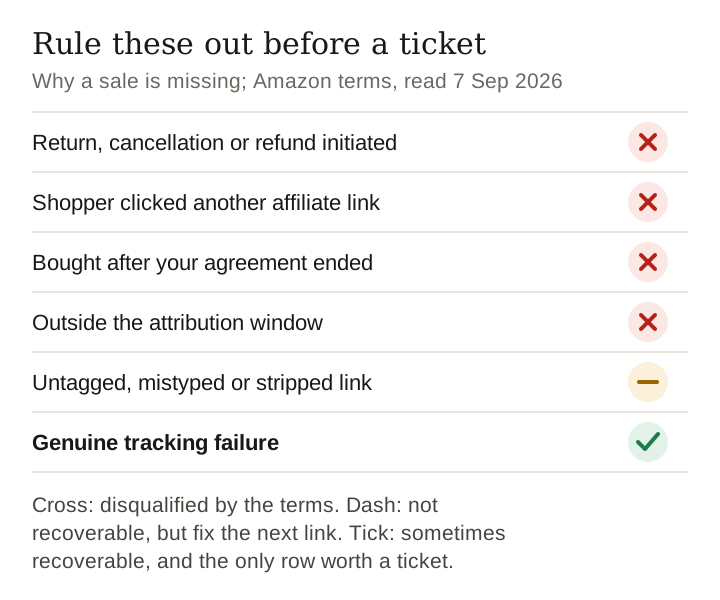
Rule these out first
| Reason the sale is not there | Is it recoverable? |
|---|---|
| A cancellation, return or refund was initiated on the order | No. It is disqualified by the published terms, and “initiated” is enough — the return does not have to complete. |
| The shopper clicked a different affiliate link before ordering | No. Under Amazon’s terms that ended your session. |
| The purchase happened after your agreement was terminated | No. Explicitly excluded. |
| The order fell outside the attribution window | No, and this is the one people misread as a bug. |
| The link was untagged, mistyped, or stripped by a platform | No, but it is fixable going forward and it is the most common cause you control. |
| A genuine tracking failure | Sometimes, and only this row is worth a ticket. |
The first four are terms, not faults. A support conversation about them ends in the same place the terms already did, and the time is better spent on the fifth row, which is the one you can actually change.
What evidence actually exists on your side
Very little, and knowing exactly how little is what makes a claim realistic:
- Your own published link, with its tag. This is the strongest evidence you hold, and it is the one thing you can verify yourself before you complain — open the live post and read the URL.
- A SubID, if you set one. Amazon permits additional “sub-tag” Associate IDs on request and subject to approval, so that you can attribute performance to a specific link. The same terms forbid associating a sub-tag with a specific end user, so a SubID identifies your placement, never your reader.
- Timestamps you control. When the post went live, when the link was last edited.
- What you do not have: the click. The network’s record of it is the record. Amazon commits only to “commercially reasonable efforts to accurately and comprehensively track Qualifying Purchases”, and there is no published mechanism for a creator to audit that tracking.
Most links already carry a parameter you are not using
We pulled priced US product rows on 7 September 2026 and looked at the destination URLs the feed hands a publisher. Most already carried a query string, some advertisers put one on every row, and the most common parameter names were PiID[] and utm_source.
The eight seeds, published so this can be re-run: running shoes, espresso machine, leather handbag, office chair, wireless earbuds, dog bed, coffee mug, hiking boots. Root shoppingProducts, keyword filter only, three pages of 100 rows per seed, deduplicated on advertiser plus title plus link, then post-filtered on each row’s own targetCountry. Asking price is the sale price where a row carries one and the list price otherwise; peer-to-peer asks of $500 or more and repdigit asks are dropped as placeholders. US rows, 7 September 2026.
Two practical consequences. First, a link you were handed is often already parameterised, so pasting it into a shortener or a link-in-bio tool that rewrites query strings is a real way to break attribution before anyone clicks. Second, if you are adding a SubID, you are often appending to an existing query string — check the joining character rather than assuming.
The sequence, in order
- Check the live link first. Open the post as a reader, copy the URL that actually loads, and confirm your tag survived. Platforms rewrite links.
- Date the sale against the window. If the order sits outside it, stop here.
- Wait out the reporting lag before reporting a gap. A sale that has not appeared today is not yet a missing sale; commissions are reported and then validated on the programme’s own cycle.
- Collect what you have: the link with its tag, the SubID if any, the publication time, the landing URL and the approximate order time.
- Raise it once, specifically. One link, one time window, one question. A general “my commissions look low” is not actionable by anyone.
- Instrument the next one. A unique SubID per placement turns the next dispute from an argument into a lookup.
What we cannot promise
Keep reading
Method and scope
- Terms: Amazon Associates Program Policies, Commission Income Statement §1 and §2 and the reporting section, read 7 September 2026 (the page states Updated: April 14, 2026).
- URL measurement: The eight seeds, published so this can be re-run: running shoes, espresso machine, leather handbag, office chair, wireless earbuds, dog bed, coffee mug, hiking boots. Root
shoppingProducts, keyword filter only, three pages of 100 rows per seed, deduplicated on advertiser plus title plus link, then post-filtered on each row’s owntargetCountry. Asking price is the sale price where a row carries one and the list price otherwise; peer-to-peer asks of $500 or more and repdigit asks are dropped as placeholders. US rows, 7 September 2026. - Not measured: claim outcomes, resolution times, or how often tracking genuinely fails. No account, no data, no estimate.
Frequently asked
Why did my affiliate commission not appear?
Most often because the sale was disqualified rather than lost. Published Amazon terms exclude any order where a cancellation, return or refund has been initiated, purchases made after an agreement ends, and orders where the shopper clicked a different affiliate link first. Only after those are ruled out is a tracking failure likely.
What evidence do I have that a click happened?
Your published link and its tag, a SubID if you set one, and your own timestamps. You do not have the click itself: the network's record is the record, and no published mechanism lets a creator audit it.
Can a link shortener break attribution?
It can. Most destination URLs in a US feed pull on 7 September 2026 already carried a query string, and any tool that rewrites or drops query parameters can remove the part that identifies you.
How should I raise a missing commission?
Once, and specifically: one link, one time window, one question, with the tagged URL, the SubID if any, publication time and approximate order time attached. A general report that earnings look low cannot be investigated.
How often do these claims succeed?
We do not know and we will not guess. LinkToLooks holds no affiliate account and has never filed a claim, so any success rate here would be invented.
Last verified 7 September 2026 against the Amazon Associates Program Policies, read that day, for the disqualification list, the sub-tag rules and the tracking-efforts language; and against priced US product rows pulled from eight keyword seeds for the destination-URL findings. No claim outcome or resolution time is published here.
How this page was made. Drafted with AI (Claude); not yet independently re-checked. How we work