LinkToLooks · Guides · Creator Desk
Creator Desk
Do link shorteners hurt affiliate links?
We traced retailer product URLs from one network’s feed and timed the hop a shortener adds, so you can decide this on numbers instead of folklore.
Part of: For creators
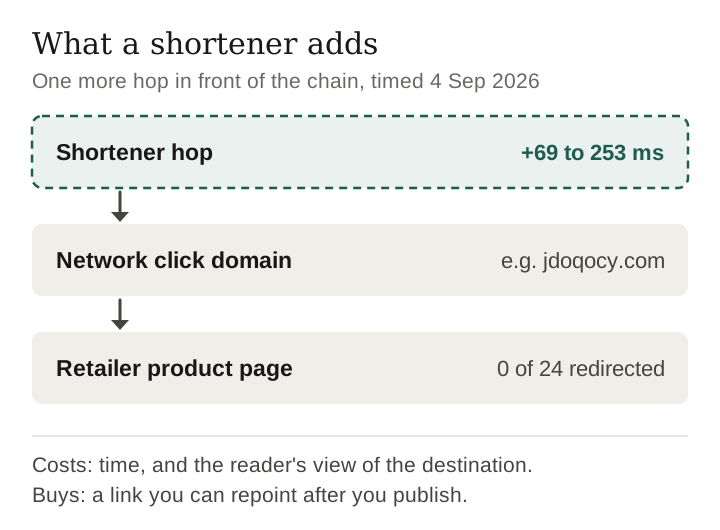
We found no published search-engine rule against shortened affiliate links, and no evidence that a shortener costs you sales. What it costs is measurable in a different currency: time, and the reader’s view of where the link goes. A network tracking link often redirects before it reaches the shop — a CJ link, for example, is served from a CJ click domain such as anrdoezrs.net, dpbolvw.net or jdoqocy.com — so a shortener adds a hop to a chain that already has at least one. The retailer product URLs at the end of that chain were direct when we traced them: none redirected on the way to the product page.
That added hop costs between 69 and 253 milliseconds of connection time on our machine, hides the destination from the person deciding whether to tap it, and puts a third party you do not control between your reader and the sale. Whether that trade is worth it depends entirely on what you are using the short link for.
What we actually measured
The claim we wanted to test is the one every affiliate blog repeats: that shorteners look spammy and depress clicks. We cannot test the click half of that — see below — but we can test the mechanical half, because redirect chains are public and free to trace.
We pulled live listings from one affiliate network’s catalogue and followed the destination URL of 24 of them without letting the client follow redirects automatically, so each hop had to be requested and counted one at a time. Be clear about what that is. It is the retailer’s own product URL, as the feed lists it. It is not the tracking link a network gives an approved creator, and we hold no network approvals, so we had none of those to trace.
| What we traced | Result |
|---|---|
| Product URLs followed | 24, across two retailers |
| Destination URLs that redirected before the product page | 0 |
| Median time to first byte | 0.73 s |
| Fastest | 0.47 s |
| Slowest | 14.67 s (Replacements Ltd.) |
| URLs that refused a scripted request outright | 1 (HTTP 403) |
Last verified 4 September 2026 against 24 retailer product URLs from one affiliate network’s catalogue, traced one hop at a time
Read the second row carefully, because it is easy to over-read. The retailer destinations in this feed are direct: none of them redirected before the product page. That is not the same as saying an affiliate link is direct. The link a network gives an approved creator is a tracking link, and a CJ tracking link, for example, is served from a CJ click domain (CJ’s own example uses jdoqocy.com; Geniuslink’s CJ guide shows anrdoezrs.net and dpbolvw.net) and redirects to the retailer from there. So the chain a reader follows already has at least one redirect before a shortener is involved, and a short link puts one more in front of it.
Note the slowest row too. A 14.67-second response has nothing to do with shorteners and everything to do with the retailer, and it is a far larger number than anything in the next section. If you are worried about the speed of your links, the retailer you picked matters far more than whether you shortened the URL.

What one extra hop costs
An added hop is a new domain to resolve, a new TCP connection to open and a new TLS handshake to complete before the redirect can even be read. We measured that floor directly — three handshakes to each host, median reported, from one machine on one connection on 4 September 2026.
| Host | TCP connect | TLS handshake | Floor cost of the hop |
|---|---|---|---|
| rebrand.ly | 7 ms | 61 ms | 69 ms |
| tinyurl.com | 10 ms | 77 ms | 88 ms |
| t.co | 32 ms | 59 ms | 92 ms |
| bit.ly | 100 ms | 152 ms | 253 ms |
| poshmark.com (retailer, for comparison) | 22 ms | 87 ms | 110 ms |
| www.madewell.com (retailer, for comparison) | 117 ms | 152 ms | 271 ms |
Two honest caveats on that table. DNS resolution came back in about a millisecond for every host because the answers were already cached locally, so these totals are connect-plus-handshake only and understate a cold first-visit lookup. And they are one machine’s numbers on one network — your reader in another country will see different ones.
What survives those caveats is the ordering. The slowest shortener we measured was faster to connect to than one of the two retailers, and the fastest was roughly a fifteenth of a second. If somebody tells you a shortener is costing you sales because of speed, ask them for the number. This is the number, and it is small.
Keep reading on link mechanics
What a shortener genuinely buys you
Taking a position: shorteners are treated as a hygiene question when they are really a tooling question. There are three jobs they do that a raw affiliate URL cannot, and they are all real.
A link you can change after you publish it
This is the one that matters most and gets discussed least. A raw retailer URL in a caption is permanent — when the product sells out, the caption points at a dead page for as long as the post exists. A short link is an indirection you own, so the destination can be repointed later. On platforms where captions cannot be edited after posting, this is the only mechanism that exists.
A click count that does not depend on the network
Affiliate networks report sales. Most report clicks poorly or late. A shortener counts every tap itself, which lets you tell “nobody clicked” apart from “people clicked and did not buy”. Those two failures need completely different fixes and the network’s dashboard often cannot separate them.
A URL a person can type or read aloud
Print, podcasts, video where the link is spoken rather than tapped. A 180-character marketplace URL with a tracking string cannot be dictated. This is a genuine use case and it has nothing to do with tidiness.
Four things that break, in order of how much they matter
1. The reader can no longer see where they are going
This is the largest cost and it is not technical. A raw retailer URL tells the reader the destination is a shop they have heard of. A shortened one tells them nothing, at a moment when they are deciding whether to trust you. Some platforms expand short links in the preview and some do not, so you cannot rely on it being resolved for them.
2. You have added a dependency that can disappear
Every link you have ever published now depends on a company staying in business and keeping its free tier. Shortener shutdowns have taken working links offline before. The raw URL has no such dependency: if the retailer is gone, the link was dead anyway.
3. Debugging gets a layer harder
When a link stops converting you now have two systems to check instead of one, and the failure can sit in either. Confirm the short link resolves to a URL that still carries your tracking parameters intact — a shortener that drops or re-encodes a query string will break attribution silently, and the link will still appear to work.
4. Some communities and filters treat them as a signal
Stated carefully, because this is where the folklore lives: a number of forums, subreddits and group moderators do block or auto-remove shortened links by policy, and some email spam filters score them. That is a moderation reality, not a search-ranking one, and it varies by venue. Check the rules of the specific place you are posting rather than generalising.
What we do on our own pages, and why
Our guides link the retailer URL directly or send it through a first-party /go/ redirect on our own domain, which is one more hop of the kind this page describes. We hold no affiliate approvals, so none of our links carries network tracking and none of them pays us.
What suits us is not the right choice for everybody. Our pages are editable forever, so we do not need the repointing ability a short link buys. A creator posting to a platform where captions freeze on publication has the opposite constraint and should probably reach the opposite conclusion.
What we cannot tell you
- Whether shortened links get clicked less. We have no click data, for any platform, including our own. Neither does anyone publishing a percentage: we have not found a single “shorteners reduce clicks by N%” claim with a primary source behind it.
- Whether any platform demotes them algorithmically. No platform documents this. Moderator policy is documented and observable; ranking behaviour is not.
- Whether a specific shortener preserves your parameters. That is per-tool behaviour and it changes. Test yours rather than trusting this page.
The honest summary is that the mechanical costs are small and measurable, the editorial cost — a reader who cannot see the destination — is real but unmeasured, and the benefit is entirely about whether you need to change a link after you publish it.
Frequently asked
Do shortened links hurt SEO?
Affiliate links should carry rel="nofollow sponsored" whether they are shortened or not, which means they are not passing ranking signals in either form. There is nothing for a shortener to take away.
Is a branded short domain better than a generic one?
It addresses the largest cost in this article — the reader can at least see it is yours — and it removes the dependency on somebody else’s domain staying alive. It costs a domain registration and some setup.
How many redirects is too many?
Each hop we measured added roughly 70 to 250 milliseconds of connection time. The practical limit is not latency, it is fragility: every hop is another system that can break, expire or strip a parameter.
Should I shorten a link that is already an affiliate redirect?
Trace it first. Many network tracking links already redirect before the shop: a CJ link, for example, is served from a CJ click domain such as anrdoezrs.net, dpbolvw.net or jdoqocy.com. A shortener puts one more hop in front of that chain. The retailer destinations we traced were direct, but a destination is not the link you share.
Method and scope
On 4 September 2026 we pulled live listings from one affiliate network’s catalogue and followed 24 destination URLs with automatic redirect-following disabled, recording every status code and location header. Separately we opened three connections to each of four shortener hosts and two retailer hosts, timing DNS, TCP and TLS separately, and report the median. All figures come from one machine on one connection on one day. These were retailer destination URLs as the feed lists them, not network tracking links: we hold no network approvals, so we had no tracking links of our own to trace. The CJ click domains named on this page come from CJ’s own Junction article on account IDs and Geniuslink’s guide to adding CJ IDs, both read 29 September 2026. We did not create any shortened links and we hold no click data for any platform.
Keep reading
How this page was made. Drafted with AI (Claude); not yet independently re-checked. How we work