LinkToLooks · Guides · Creator Desk
Creator Desk
How to keep a link archive that survives a platform change
Everything a creator builds sits on rented land. This is the cheapest possible insurance, and it takes about twenty minutes to start.
Part of: For creators
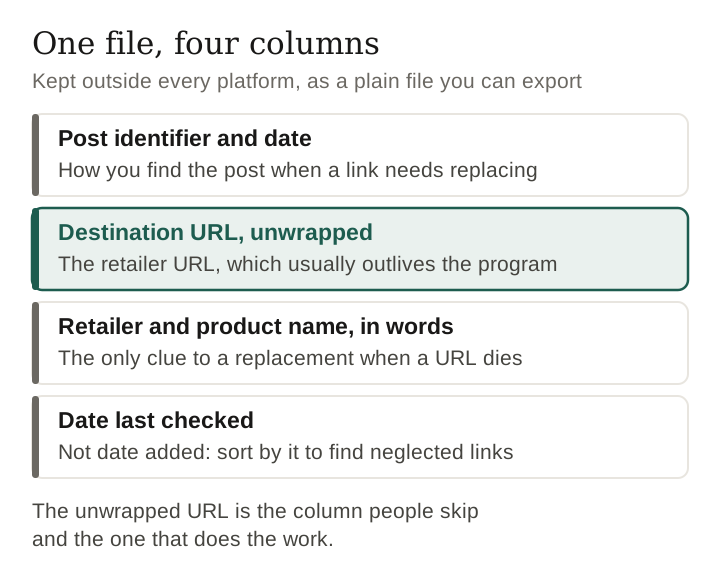
Keep one file, outside every platform, with four columns: what you posted, where you posted it, what you linked, and when. That is the whole system, and it is the difference between a platform rule change costing you an afternoon and costing you a back catalogue.
This is not a hypothetical risk. Platforms change what links are allowed, where they can sit, and whether they are clickable, and they do it without warning creators first.
What actually goes wrong
Four failure modes, all of them ordinary:
- The platform changes its link rules. Where a link may sit, how many are permitted, whether it is clickable at all. Your old posts do not get updated when this happens.
- Your link-in-bio service changes or closes. Every link you handed out through it is a redirect through somebody else's business.
- The retailer restructures its URLs. The product still exists; your link does not.
- The program ends. Your tracking links stop tracking, and often stop redirecting at all.
In every one of these, the thing you need is the same: a list of what you linked and where. Without it, recovering means scrolling your own feed and guessing.
Some sense of how fast this churns: as a routine check we re-requested 665 image URLs supplied by live US retailer feeds, and 246 of them — 37% — failed to return an image on the same day the feed served them. Product URLs are more durable than image URLs, so do not read that as a link failure rate. Read it as the rate at which retail infrastructure moves underneath you without telling anyone.
The four columns, and why each one earns its place
- Post identifier and date. The permalink if you have it. This is how you find the post again when a link inside it needs replacing.
- The destination URL, unwrapped. Not the tracking link — the actual retailer product URL underneath it. Tracking links are network-specific and die with the program; the retailer URL usually outlives both.
- Retailer and product name, in words. When a URL dies, this is the only thing that lets you find a replacement. A dead URL tells you nothing about what it pointed at.
- Date last checked. Not date added. The column you sort by when you have an hour and want to spend it on the most-neglected links first.
The unwrapped destination URL is the column people skip and the one that does the work. A tracking link is a claim on a commission; a product URL is a description of an object. If you keep only the first, a program change leaves you with a list of dead tokens.
Keep reading
Three habits that keep it alive
- Write the row when you write the caption, not later. An archive built retrospectively never gets built.
- Check the top ten by traffic monthly. Sort by last-checked, take the ten oldest that still get views, open them. Twenty minutes.
- Record what you could not link, too. The items you failed to find are your best list of what to look for again later, and they are the content nobody else has.
Where to keep it barely matters — a spreadsheet is fine. What matters is that it is not inside the platform whose change you are insuring against, and that you can export it as a plain file.
The wider point about rented land
An archive is a small thing that stands for a large one. A creator's audience, posts and links all live inside systems that can change their terms unilaterally, and the only assets that survive that are the ones held outside: an email list, a site, and a record of your own work.
We are not going to tell you to build a website instead. That is a bigger decision with a long runway. The archive is the version of the argument that costs nothing and pays out the first time anything breaks.
One honest limit: an archive does not recover commissions you never earned, and it does not stop a link breaking. It shortens the gap between something breaking and you noticing, which is the only part of this you control.
Frequently asked
What should a creator's link archive contain?
Four columns: post identifier and date, the unwrapped retailer product URL, the retailer and product name in plain words, and the date you last checked the link.
Why record the retailer URL instead of the tracking link?
Tracking links are network-specific and stop working when a program ends. The retailer's own product URL usually outlives both the program and the platform.
How often should I check my old links?
Sort by last-checked date and open the ten oldest that still get traffic, once a month. Checking everything is the plan that never happens.
Where should I keep it?
Anywhere outside the platform you are insuring against, in a format you can export as a plain file. A spreadsheet is entirely sufficient.
Method and scope
- This page describes a practice rather than a measurement. The failure modes listed are ordinary and observable; no frequency or probability is claimed for any of them.
- No creator examples, quotes or case studies appear here, because we have no connected creators and will not invent one.
Last verified 2 September 2026 against 665 live retailer image URLs re-requested, of which 246 failed
Keep reading
How this page was made. Drafted with AI (Claude); not yet independently re-checked. How we work