LinkToLooks · Guides · Creator Desk
Creator Desk
How to pick a product that will still be in stock next month
Four things in a listing tell you whether the link can survive the post. We measured all four on 5,111 live listings, and one of them turns out to be empty.
Part of: For creators
Four things in a listing predict whether the link will still work in a month, and you can read all four before you post. We pulled 5,111 live US listings on 7 September 2026 and measured each one.
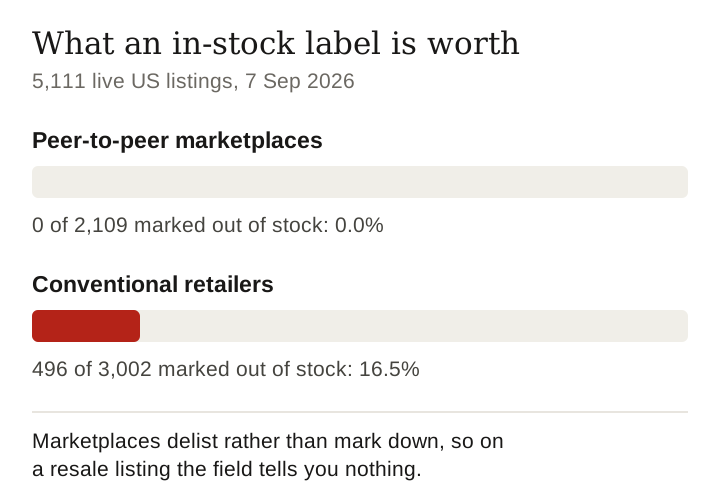
The most useful finding is a warning about the obvious signal. Of 2,109 rows from peer-to-peer marketplaces, exactly zero were marked out of stock — not one. Those sellers do not mark a sold item as unavailable, they remove the listing. So “in stock” on a resale listing tells you nothing at all, while the same word from a conventional retailer is real: 16.5% of their rows said out of stock.
Why a dead link costs more than a missed sale
A link that 404s or lands on “this item is no longer available” costs you the commission, and it costs you something harder to get back: the reader who followed your recommendation and found nothing. Evergreen posts make this worse, because the post that keeps earning is the post that keeps sending people to a link you chose months ago.
You cannot know which listing will sell out. You can know which listings can be restocked, and that is most of the decision.
1. Is the seller a marketplace or a shop?
This is the strongest signal in the data, and it is visible from the retailer name alone.
| Search term | US rows | Peer-to-peer | Marked used | In a variant group |
|---|---|---|---|---|
| gold necklace | 322 | 100% | 66% | 0% |
| denim jacket | 323 | 99% | 87% | 1% |
| hiking boots | 309 | 97% | 88% | 3% |
| wool scarf | 299 | 95% | 83% | 3% |
| running shoes | 217 | 94% | 91% | 6% |
| hardcover book | 291 | 79% | 70% | 1% |
| yoga mat | 301 | 55% | 38% | 28% |
| lego set | 246 | 42% | 25% | 46% |
| wireless earbuds | 337 | 18% | 9% | 60% |
| french press | 201 | 14% | 9% | 73% |
| board game | 227 | 8% | 3% | 40% |
| face serum | 306 | 6% | 2% | 56% |
| stand mixer | 283 | 2% | 1% | 79% |
| dog bed | 232 | 1% | 0% | 100% |
| cast iron skillet | 291 | 0% | 0% | 70% |
| throw pillow | 369 | 0% | 0% | 100% |
| table lamp | 275 | 0% | 0% | 100% |
Seventeen of the eighteen seeds; bluetooth speaker sits between earbuds and board game on every column.
Read the top and the bottom of that table as two different jobs. A listing at the top is one object photographed in one house: when it sells, it is gone and no equivalent link exists. A listing at the bottom is a row in a catalogue that a shop intends to keep selling.
The share is decided by the search term, not by any choice you make. Jewellery, clothing and footwear in this catalogue are resale. Homeware and appliances are retail. If your niche sits at the top of that table, link rot is a structural feature of your niche and the answer is a link-checking habit, not a better product choice.
2. What the availability field is worth
Every row carries an availability value. Across the whole pull, 89.7% said in stock and 9.5% said out of stock. Split by seller type, the field stops looking like one field:
| Seller type | Rows | Marked out of stock |
|---|---|---|
| Peer-to-peer marketplaces | 2,109 | 0 — 0.0% |
| Conventional retailers | 3,002 | 496 — 16.5% |
Zero out of 2,109 is not a low rate, it is a different convention. Those platforms delist rather than mark down, so the field carries no information for them and cannot be used as a filter. Meanwhile a sixth of conventional-retailer rows were already unbuyable at the moment we read them — and 29% of the stand-mixer rows were, in a category otherwise full of good signals.
3. Does the listing belong to a variant group?
44.6% of rows carried an itemGroupId, the field that says “this is one size or colour of a product that comes in several”. It matters here for a specific reason: when a grouped item goes out of stock, the shopper usually lands on a page where the other variants are still buyable. When an ungrouped one-of-one goes, there is nothing to land on.
Like almost every completeness field we have measured, it is a retailer switch rather than a per-product property — in an earlier study, 26 of 27 advertisers sat at exactly 0% or exactly 100% coverage. So this is another thing you check once per programme, not once per post.
Keep reading
4. How old is the row?
Each row states when the retailer last updated it. Across 5,111 rows the median age was 72 days, 23.5% had been touched within a week, and the oldest was 2,049 days — a listing last updated in January 2021 and still being served today.
| Age of the row | Rows | Share already marked out of stock |
|---|---|---|
| 0–7 days | 1,184 | 6.2% |
| 7–30 days | 831 | 4.2% |
| 30–90 days | 2,226 | 2.5% |
| 90–365 days | 541 | 47.7% |
| Over a year | 329 | 22.8% |
The jump at ninety days is large enough to act on, and it is not a straight line: rows over a year old are less likely to be flagged than rows three to twelve months old. We can describe that and we cannot explain it. One plausible reading is that a truly abandoned row stops being updated in any direction, including to say it has gone; we have not tested it and we are not going to assert it.
The check, in the order that is quickest
- Drop anything the feed already calls out of stock. Free, instant, removes roughly one conventional-retailer row in six.
- Look at the retailer name. A marketplace listing is one-of-one until proven otherwise, whatever the availability field says.
- Prefer a grouped variant over a lone row where you have the choice, because the shopper has somewhere to land when one size goes.
- Check the update date, and treat 90 days as the line. Unless the row is from a marketplace that batch-stamps, in which case ignore it.
- For evergreen posts, keep the list and re-check it. None of the above prevents rot, it only ranks the risk. A quarterly pass over the links in your best-performing posts does more than any amount of picking.
What we did not measure
This is a set of leading indicators, not a survival rate. We did not re-check these 5,111 listings later to see which ones actually died, so nothing here says “X% of these links will be dead in a month” and no sentence on this page should be read that way. That study needs two dates and we have one.
We also cannot tell a temporary stockout from a discontinued line: the availability value is the advertiser’s own, and it means whatever that advertiser makes it mean. One network, one account, one evening, US-targeted rows only.
Method
Scope, so this can be repeated rather than believed: root shoppingProducts on the CJ product API, filtered on keywords and advertiserCountries: ["US"], four pages of 100 rows per seed, deduplicated on advertiser plus title plus destination link, then post-filtered on each row’s own targetCountry. Asking price is salePrice where a row carries one and price otherwise; peer-to-peer asks of $500 or more and repdigit asks are dropped as seller placeholders. 5,111 US rows, 101 advertisers, 7 September 2026.
The eighteen seeds, published so the pull can be re-run: wool scarf, running shoes, denim jacket, table lamp, throw pillow, cast iron skillet, stand mixer, french press, bluetooth speaker, wireless earbuds, board game, lego set, face serum, dog bed, yoga mat, hiking boots, hardcover book, gold necklace. Peer-to-peer is a name match against a fixed list of resale marketplaces, which is why it is a floor: a resale seller trading under a shop name would be counted as conventional.
Keep going
Frequently asked
Does the in-stock field tell you if an item is available?
Only from conventional retailers. In our 7 September 2026 pull, 496 of 3,002 conventional-retailer rows said out of stock, against 0 of 2,109 peer-to-peer rows. Marketplaces delist rather than mark down.
How can you tell if a listing is one-of-one?
The retailer is the clearest signal. Peer-to-peer marketplace rows are single objects; catalogue retailers restock. In this pull the peer-to-peer share ran from 0% to 100% depending only on the search term.
Does an old listing mean a dead listing?
Not directly, but rows last updated 90 to 365 days ago were 47.7% marked out of stock, against 2.5% for rows updated in the last 30 to 90 days.
Can you predict which links will die?
No, and this page does not claim to. We measured signals present before posting; we did not re-check the listings later, so there is no survival rate here.
What is the single quickest improvement?
Discard rows the feed already marks out of stock. It removed about one conventional-retailer listing in six in this pull, and it costs nothing.
Last verified 7 September 2026 against 5,111 live US listings from 101 advertisers, checked for availability, seller type, variant grouping and last-updated age.
How this page was made. Drafted with AI (Claude); not yet independently re-checked. How we work