LinkToLooks · Guides · Creator Desk
Creator Desk
What do you do when a product you linked sells out?
Part of: For creators
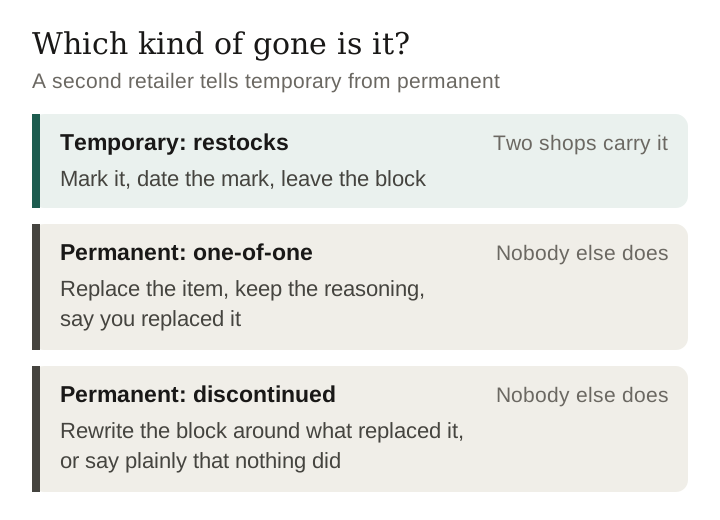
Work out which kind of gone it is first. Temporary — mark it and date the mark. One-of-one — replace the item, keep the reasoning, say you replaced it. Discontinued — rewrite the block around what replaced it, or say plainly that nothing did. The one-check test: look for the same product at a second retailer.
First decide which kind of gone it is
Out of stock is not one condition. Three different things wear the same label and they need different responses.
| Kind | What it looks like | The right response |
|---|---|---|
| Temporary — restocks | Ordinary retail stock, item still listed, many retailers carry it | Mark it, date the mark, leave the block |
| Permanent — one-of-one | Peer-to-peer or replacement listing, single item | Replace the item, keep the reasoning, say you replaced it |
| Permanent — discontinued | The product itself is gone from the market | Rewrite the block around what replaced it, or say plainly that nothing did |
Telling them apart takes one check: look for the same product at a second retailer. If two shops carry it, it is temporary. If nobody does, it is one of the other two.

How often this happens, by inventory type
We ran identical queries with and without an in-stock filter. The difference is the share of catalogued listings that were not purchasable at that moment.
| Product family | Catalogued | In stock | Not purchasable |
|---|---|---|---|
| Corelle | 11,525 | 5,113 | 55.6% |
| Enamelware | 3,658 | 2,480 | 32.2% |
| Pyrex | 4,568 | 3,317 | 27.4% |
| Skillet | 10,179 | 8,724 | 14.3% |
| Tupperware | 1,982 | 1,754 | 11.5% |
| Jadeite | 6,884 | 6,498 | 5.6% |
Method: CJ product API, US advertisers, paired keyword queries with and without the in-stock filter, 2 September 2026.
The useful reading is not the individual numbers, it is the five-fold spread. If you write about discontinued patterns, more than half of what you could link is already gone and you should be filtering for stock before you write. If you write about ordinary retail products, an out-of-stock link is an event rather than a condition.
Last verified 30 September 2026 for the skillet prices, against the CJ product feed; the stock figures come from paired queries across six product families, run with and without the in-stock filter on 2 September 2026
Fixing the page, in order
- Check a second retailer before doing anything. Half the time the item is fine and one shop is out.
- If it restocks: mark it in place. ‘Out of stock as of 2 September; it has restocked before’ keeps the block honest and useful.
- If it is gone: replace the item, keep the reasoning. The paragraph explaining why an 8-inch pan beats a 12-inch one does not stop being true because one listing sold.
- Say what you changed and when. One line at the point of the change. Silent substitutions are how a page stops being trustworthy.
- Never redirect to a homepage. Send the reader to the nearest real equivalent, or to nothing at all.
- Update the dated verification line. If you touched the prices, the date must move with them.
The same pan at two retailers, about $4 apart: $20.99 and $24.90 on 30 September 2026. This is what makes an ordinary retail recommendation robust: when one listing dies you have somewhere to move it, and the reader loses nothing.
What to actually write in the mark
The annotation is a piece of writing and most people get it wrong by being either too quiet or too apologetic. Three formats cover almost every case.
The temporary mark
- States the condition, the date, and an alternative in one sentence each.
- Does not apologise, because nothing has gone wrong.
The substitution note
- Tells the reader the page changed and what did not change.
- Protects you from the accusation that matters — a silent swap to a different product under the same recommendation.
The honest dead end
- The hardest one to write and the one readers remember.
- Better than quietly substituting something worse to keep a link live.
Checking a back catalogue without losing a day
- Sort by what breaks. Pages built on one-of-one inventory first; pages built on ordinary retail last. The rates above tell you the order.
- Check status, not content. You are looking for listings that no longer resolve or no longer carry stock — a fast pass, not a rewrite.
- Fix in batches by retailer. When one retailer drops a line, it usually takes several of your links with it, and they are all fixed the same way.
- Move the dated verification line only when you changed something. An updated date on unchanged content is a small lie that compounds.
- Keep a note of what you fixed. Next time, that note tells you which pages are structurally fragile rather than unlucky.
Preventing it at the writing stage
- Prefer items stocked by more than one retailer. It is the single strongest predictor of a durable link, and it takes one search to check.
- Filter for in-stock when you build the list. Otherwise you are publishing a catalogue that includes things nobody can buy.
- Write reasoning that outlives the listing. A block that only says ‘buy this’ becomes worthless the moment it sells; a block that explains a trade-off does not.
- Keep one-of-one items in clearly labelled sections. If a section is explicitly ‘single vintage pieces, live today’, a dead link there is expected rather than embarrassing.
- Re-check on a schedule. Whatever cadence you can actually keep. Monthly beats an intention to do it weekly.
A one-of-one item will sell. Featuring single items is still worthwhile — but in a section that says so, next to writing that survives their sale.
Keep reading
Frequently asked
What should you do when a linked product sells out?
Fix the page, not the link. Decide whether the item restocks; if it does, keep the block and mark it out of stock with a date. If it does not, replace the item and say in the text that you replaced it.
Should I delete an out-of-stock item from a roundup?
Only if the whole block becomes useless without it. Often the reasoning is still worth reading and the honest move is to keep the block, mark it, and add a live alternative underneath.
How often do listings go out of stock?
It depends on the inventory type. In our 2 September 2026 paired queries, 55.6% of catalogued Corelle listings were unavailable, against 14.3% for skillets and 11.5% for Tupperware.
Should I redirect a dead affiliate link to the homepage?
No. A reader who clicked a specific product and lands on a homepage has been sent somewhere they did not ask for. Send them to the closest real equivalent, and say in the page that you did.
Does an out-of-stock link hurt my page?
It costs you the reader's trust before it costs you anything else. It is also a wasted crawl and a broken promise made by your own anchor text.
Keep reading
How this page was made. Drafted with AI (Claude); not yet independently re-checked. How we work