LinkToLooks · Guides · Creator Desk
Creator Desk
Should you link the set or the single item?
The set is worth more per order in exactly the categories where people assume it is not, and worth less in the categories where everyone assumes it is.
Part of: For creators
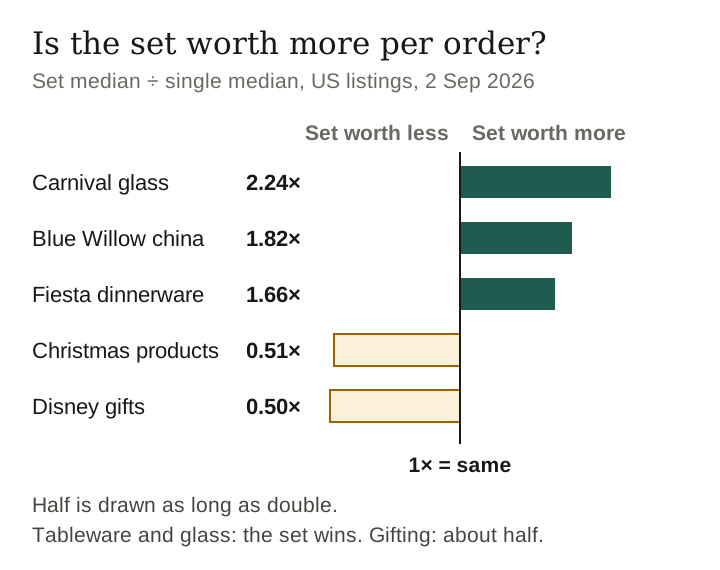
In home and tableware categories the set wins on order value by 1.7 to 2.2 times. In gifting categories the set loses, at about half the single-item order value. Measured across live US listings on 2 September 2026 by splitting each category on whether the listing title names a set, collection, bundle or piece count.
The reason for the inversion is not subtle once you see it: in home goods a “set” is a service for four, while in gifting a “set” is usually a multipack of small items. The word means opposite things in the two catalogues, which is why a general rule about linking sets is worthless.
The measurement
| Category | Set median | Single median | Ratio |
|---|---|---|---|
| Carnival glass | $89.49 | $39.99 | 2.24× |
| Blue Willow china | $59.99 | $32.99 | 1.82× |
| Fiesta dinnerware | $78.00 | $46.99 | 1.66× |
| Christmas products | $18.00 | $34.99 | 0.51× |
| Disney gifts | $25.00 | $50.00 | 0.50× |
Live US listings split on whether the title names a set, collection, bundle, lot or piece count. CJ product API, 2 September 2026. Prices checked 2 September 2026
The tableware and glass results are the ones that match intuition. The gifting results do not, and they are the more useful half of the table: linking the “set” in a Disney gift guide halves your order value.

Why the inversion happens
One word, two catalogues, two meanings.
- In tableware, a set is a service: twelve or sixteen pieces, four place settings, one box. The single item is one mug at $11.99 against a $159.95 set. That is a thirteen-fold difference in one category.
- In gifting and seasonal, a set is usually a multipack of the cheapest thing in the range — four ornaments, three small mugs, a bundle of stocking items — while the expensive products are sold individually.
- So the word is not describing quantity in any consistent way. It is describing a merchandising decision that runs in opposite directions in the two catalogues.
Which means the honest rule is not “link sets” or “link singles”. It is look at the two medians in your own category before you decide, and the method for doing that is four sentences long: search your category, note the price of a typical set, note the price of a typical single, compare.
Three arguments against the set link
Order value is one input and it is not the only one. Three things push the other way, and two of them we can measure.
1. Sets go out of stock differently
A set is a single SKU that either exists or does not. Open stock is many SKUs, so a link to a category page for individual pieces survives a stockout that kills a set link. We measured stock states rather than durability, so treat this as a mechanism rather than a measurement.
2. The set is a bigger ask
$159.95 is a considered purchase; $11.99 is not. We hold no conversion data at all — none, on any product — so we cannot tell you how much of the order-value advantage survives contact with a real audience. Anyone who tells you they can should show you their numbers.
3. Colour and variant availability
In the dinnerware family we measured, one retailer showed twelve colours of the same set live and another showed two. A set link that lands on a page without the colour you photographed is a worse experience than a single-item link that lands correctly.
The position: link both, in that order
An argued claim rather than a hedge. Link the single item first and the set second, in the same paragraph, wherever the category supports both.
The single item matches what your reader is looking at in the photograph and carries the lower barrier. The set is there for the reader who was already going to buy four of them, and in the tableware categories we measured that reader is worth 1.7 to 2.2 times as much per order. You do not have to guess which reader you have; you can offer both in one sentence and let them choose.
What would change our mind: conversion data showing that a second link in the same sentence reduces total clicks. That is a real risk, it is exactly the kind of thing we cannot see, and if your own analytics say so then your analytics beat this argument.
Frequently asked
Is it better to link a set or a single product?
It depends on the category. In tableware and glass the set carried 1.7 to 2.2 times the order value of a single item; in Christmas and Disney gifting it carried about half.
Why do gifting sets have lower order values?
Because in those catalogues a “set” is usually a multipack of inexpensive items, while the expensive products are sold individually. The word means the opposite of what it means in tableware.
How do I check this for my own category?
Search your category, note the typical price of a listing whose title names a set or a piece count, note the typical price of a single item, and compare. That is the whole method.
Does a higher order value mean higher earnings?
Only if it converts. We hold no conversion data on any product and publish none, so order value here is the measurable half of the question, not the answer to it.
Method and scope
- Live US listings from the CJ product API, in-stock filter, pulled 2 September 2026, split on whether the listing title contains set, collection, bundle, lot or a piece count.
- Title-based classification is imperfect: it will call a “set of 2 mugs” a set, which is correct, and it will miss a set whose title does not say so, which understates the set population.
- Medians are asking prices at the moment of the pull, not realised order values.
- We hold no click, conversion or commission data of any kind.
Last verified 2 September 2026 against live US retailer listings pulled
Keep reading
How this page was made. Drafted with AI (Claude); not yet independently re-checked. How we work