LinkToLooks · Guides · Creator Desk
Creator Desk
How do you write about a product you have not tested?
Part of: For creators
Describe the evidence rather than performing the experience. Every claim sits somewhere on a ladder — used it, handled it, read the spec, pulled the listing, read other buyers, inferred from the category — and the only real failure is writing as though you were a rung higher. “Listed at $25.99 on 2 September; we have not handled this one” beats an implied test every time.
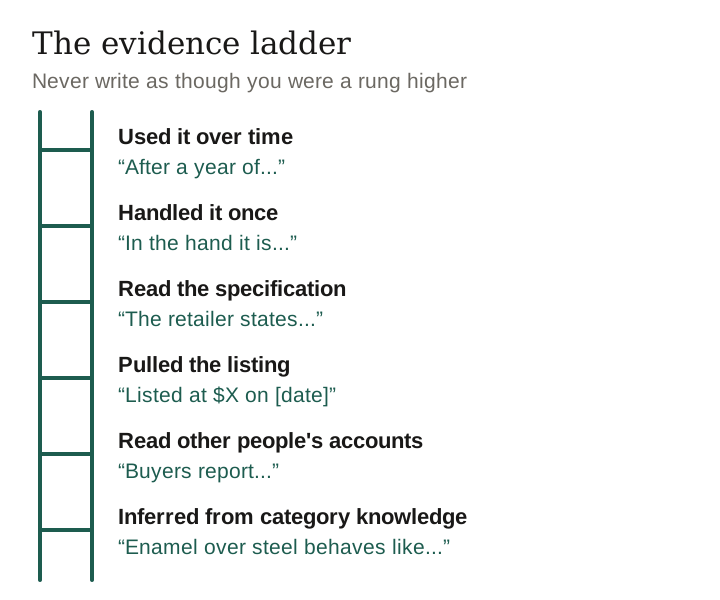
The evidence ladder
Every product claim you make sits on one of these rungs. The writing problem is not which rung you are on — it is writing as though you were on a higher one.
| Rung | What it supports | Honest phrasing |
|---|---|---|
| Used it over time | Durability, real-world behaviour | “After a year of...” |
| Handled it once | Weight, finish, size, feel | “In the hand it is...” |
| Read the specification | Material, dimensions, stated features | “The retailer states...” |
| Pulled the listing | Price, availability, who sells it | “Listed at $X on [date]” |
| Read other people's accounts | Common complaints and praise | “Buyers report...” |
| Inferred from category knowledge | General mechanisms | “Enamel over steel behaves like...” |
Most useful product writing lives on the middle rungs, and that is fine. A page that says ‘listed at $25.99 on 2 September; we have not handled this one’ is more useful than a page that implies a test it never ran, because the reader can weigh it.
What a listing genuinely cannot tell you
- Whether the photograph is the item. Stock imagery is standard practice and is not itself dishonest, but it means the picture is evidence of the model, not of the object.
- Build quality. Nothing in a listing distinguishes a well-made pan from a badly made one at the same stated specification.
- Whether the price is a real discount. A struck-out price is a claim, not a measurement.
- Whether the item is what the title says. In our own pulls, a search for one American cast iron brand returned a musician's back catalogue and an electrical parts line; a search for another returned opera recordings and automotive parts.
- Whether it will still be there tomorrow. That varies from 5.6% to 55.6% unavailable depending on the inventory type.
Five traps we hit in our own data this week
These are not hypotheticals. Every one of them came out of pulls we ran on 2 September 2026, and each would have produced a false statement if we had not looked at the rows.
- Demo and test rows. Some catalogue rows come from demonstration accounts rather than real retailers. They look like products and are not purchasable.
- Overseas banners inside a US query. The same 2.5-quart baker appeared at $82.00, $116.70 and $127.93 from three banners of one department store. Two of those are not US prices.
- Placeholder-looking prices. One row in a jadeite pull read $9,999.00. It may be real; it has the shape of a placeholder. Either way it should not be quietly averaged into a market figure.
- Keyword-stuffed titles. Titles that repeat their own noun three times are written for search, not description, and tell you nothing about the item.
- Category mismatches. A CorningWare search returned two original still-life paintings at $3,360 and $4,460, three t-shirts and a pair of earrings alongside the cookware.
Phrasing that stays honest without sounding hedged
The fear is that admitting limits makes writing weak. It does the opposite when the limit is stated once and specifically, rather than sprayed across every sentence.
| Instead of | Write |
|---|---|
| “This pan is fantastic quality.” | “Cast iron of this weight and thickness behaves predictably; we have not handled this particular one.” |
| “A steal at $25.99.” | “$25.99 on 2 September, which is under the $35.99 median for the category that day.” |
| “Reviewers love it.” | “The recurring complaint in buyer reviews is X.” |
| “Made from premium materials.” | “The retailer states enamel over steel.” |
| “The best option for most people.” | “The cheapest of the nine retailers carrying it, and the size most people use daily.” |
Notice that the honest versions are not longer by much, and they carry more information. Attribution is not hedging. Hedging is ‘this may possibly be quite good’; attribution is ‘the retailer states X’.
Why we write this way
Last verified 2 September 2026 against live CJ product-feed pulls supplying every price, availability figure and catalogue oddity described on this page
Keep reading
Frequently asked
Can you write about a product you have not tested?
Yes, if you are explicit about what your evidence is. What you cannot do is imply experience you do not have. The rule is to describe the evidence, not to perform the experience.
What can a product listing actually tell you?
Price, retailer, stated material, stated dimensions and stock status. It cannot tell you build quality, how it feels in use, or whether the photograph shows the item being sold.
How do I phrase it honestly?
Attribute every claim to its source in the sentence: 'listed at $25.99', 'the retailer states enamel over steel', 'we have not handled this one'. It costs a few words and it is the whole difference.
Are product listings reliable?
Only partly. In our own pulls we found demo-account rows, overseas banners priced in other currencies inside a US query, placeholder-looking prices, and titles that repeat a keyword three times.
Does admitting you have not tested something lose readers?
It loses the reader who wanted a review. It keeps the reader who wanted to know what is available, which is the larger group and the one that comes back.
How this page was made. Drafted with AI (Claude); not yet independently re-checked. How we work