LinkToLooks · Guides · Reference Desk
Reference Desk
Le Creuset colours and eras, dated
Colour gives you a twenty-year window at best. Here is the evidence hierarchy that actually narrows it, and the table we refuse to publish.
Colour dates a Le Creuset piece to a window, not a year. Flame has run continuously since 1925; most other colours have introduction and retirement dates, so a colour tells you the earliest a piece could have been made and sometimes the latest.
The base markings do the real work. Everything else on this page is supporting evidence, and we say plainly where the evidence runs out.
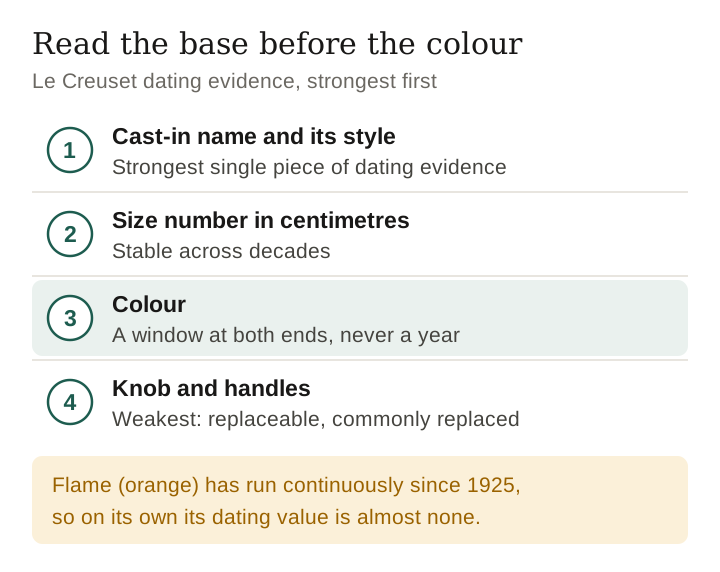
Read the base first
A collector reference is only as good as its hierarchy of evidence. For this maker the hierarchy is unusually clear, and colour sits third.
- The cast-in name and its style. Present on the underside. Its form, and the presence or absence of a country of manufacture, is the strongest single piece of dating evidence a pot carries.
- The size marking. A number in centimetres cast into the base identifies the piece within the line and is stable across decades.
- The colour. Narrows the window at both ends, because colours enter and leave the range. Never a year on its own.
- The knob and handles. Weakest evidence, because both are replaceable and are commonly replaced.
Colours as a dating window
The useful way to think about a Le Creuset colour is as a bracket. A colour that entered the range in a given decade cannot appear on a pot made before it; a colour that was retired cannot appear on one made after. That gives you a window, and the window is often twenty years wide.
| Colour family | What it tells you | Reliability |
|---|---|---|
| Flame (orange) | In the range continuously since 1925 | Almost none on its own — it never left |
| Retired colours | Piece was made no later than the retirement date | Good upper bound |
| Current-range colours | Piece was made no earlier than the introduction date | Good lower bound |
| Gradient finishes | Characteristic of the maker, widely imitated by others | Identifies a style, not a maker |
| Faded or repaired enamel | Age or use, not a production date | None |
Dating reliability as assessed for this guide. Specific introduction and retirement years vary by market and should be checked against the maker's own colour archive for the piece in front of you.
We are deliberately not publishing a colour-to-year table. The versions circulating online disagree with each other, colours were released on different schedules in different markets, and we cannot verify a year-by-year list from any source we hold. A table that looks authoritative and is wrong is worse for you than this paragraph.
Keep identifying
Lines and shapes
Shape narrows identification faster than colour does, because shapes are tied to named lines that ran for known periods.
- Round oven. The core shape, made continuously in many sizes. Least diagnostic.
- Oval oven. Introduced for roasting; sizes quoted in centimetres on the base.
- Braiser. Wide and shallow with a low lid.
- Bread oven. A recent shape with a domed lid; its presence dates a piece to the modern range. Our pull found these listed at $314.95.
- Stoneware and enamel-on-steel. Different materials entirely, sold under the same brand, and frequently confused with the cast iron in resale listings. The kettle and stoneware pieces in our pull ran $35.00 to $120.00 against a $419.95 median for cast iron pots.
What the current market looks like
Dating a piece is more useful when you know what the live market is doing around it. These are live US listings from this morning, not auction records.
| Group | Live listings | Median | Range |
|---|---|---|---|
| All Le Creuset listings in the catalogue | 6,047 (800 sampled) | $124.95 | $9.95 – $1,245.00 |
| Pot-shaped pieces only | 157 | $419.95 | $22.00 – $684.95 |
| Everything else (stoneware, textiles, accessories) | 643 | under $124.95 | wide |
Brand-filtered catalogue pull, 3 September 2026.
Prices checked 3 September 2026 against live US retailer listings pulled.
The gap between the $124.95 all-listings median and the $419.95 pot median is the single most useful number here for a collector: most of what is sold under this name is not a cast iron pot. When you see a low price attached to the brand, check which material you are being offered before you conclude you have found a bargain.
Where this evidence stops
- We cannot date your specific piece from a photograph, and neither can anyone else without the base.
- We hold no year-by-year colour archive we can verify, so we do not publish one.
- Current listing prices are not values. They are asking prices on one morning, and resale asking prices in particular are aspirational.
- We have not handled any piece described here. Enamel condition, hairline cracks and repairs all require the object in hand.
Frequently asked
What is the original Le Creuset colour?
Flame, the orange gradient the foundry launched with in 1925. It has been in the range continuously since and is the colour most closely associated with the maker.
How do I date a Le Creuset pot?
Base markings are the primary evidence: the presence and style of the cast-in name, the country of manufacture, and whether a size is given in centimetres. Colour narrows a window, because colours are introduced and retired; it does not give a year.
Are retired Le Creuset colours worth more?
Sometimes, and unevenly. Our pull found 6,047 live Le Creuset listings across all product types with a $124.95 median and a range from $9.95 to $1,245.00. That spread is driven by piece type and size at least as much as by colour.
Is a knob material a reliable date?
No. Knobs are replaceable and are routinely replaced on pots that have been in use for decades. Treat a knob as weak supporting evidence only.
Method and scope
- 6,047 live US in-stock Le Creuset listings in the catalogue on 3 September 2026, of which 800 were sampled and 157 identified as pot-shaped by title.
- Comparative pulls: Staub (1,665 listings) and Lodge (727).
- Dating hierarchy assembled from the maker's published product information and from markings visible in live listings. No colour-to-year table is published here because we cannot verify one.
- Prices are live asking prices at the moment of the pull, not realised sale values.
Last verified 3 September 2026 against 6,047 live US Le Creuset listings in the catalogue, 800 of them sampled and priced
Keep identifying
How this page was made. Drafted with AI (Claude); not yet independently re-checked. How we work