LinkToLooks · Guides · Creator Desk
Creator Desk
Retailers list one product at several URLs. Which one should you link?
Four kinds of product URL, measured across 2,320 live listings, and the fifteen-second check that finds the durable one.
Part of: For creators
In a pull of 2,320 live listings on 3 September 2026, 680 of them — 29.3% — sat on a URL that another listing in the same pull also used, and 203 product titles appeared at more than one address from the same retailer. One product routinely has several URLs, and they are not interchangeable.
The one you link decides three things: whether the page still exists in six months, whether a shopper lands on the item or a list of items, and whether your tracking parameters survive the trip.
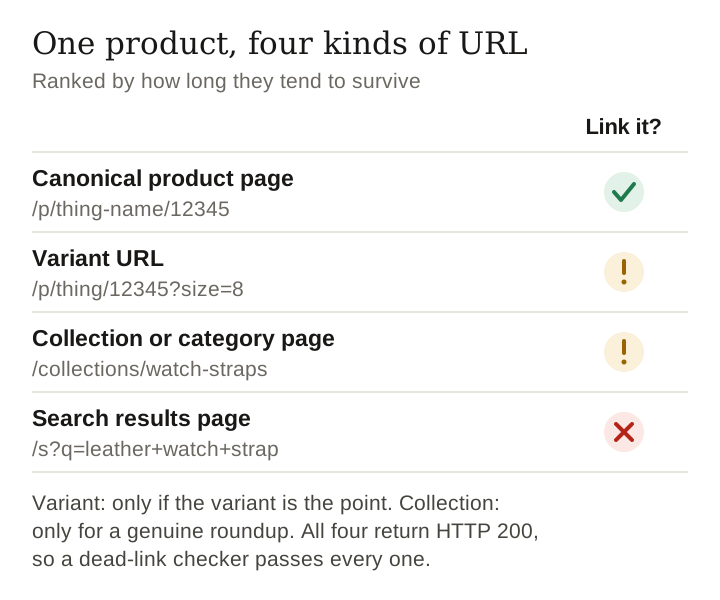
The four URLs a product can have
Ranked by how long they tend to survive.
| Kind of URL | Looks like | Survives? | Link it? |
|---|---|---|---|
| Canonical product page | /p/thing-name/12345 | Longest — it is the page the retailer maintains | Yes |
| Variant URL | /p/thing/12345?size=8 or a distinct id per size | Dies when that variant does | Only if the variant is the point |
| Collection or category page | /collections/watch-straps | Long-lived, but stops containing your product | Only for a genuine roundup |
| Search results page | /s?q=leather+watch+strap | Never stable — results reorder constantly | No |
The trap is that all four return HTTP 200 forever. A dead-link checker will pass every one of them while three quarters no longer show the thing you recommended.

How often this actually happens
We pulled 2,320 live in-stock listings across six product categories on 3 September 2026 and compared their destination URLs, ignoring query strings so that a URL differing only in tracking parameters counted as the same page.
| Measurement | Count | Share of 2,320 |
|---|---|---|
| Distinct URL paths | 1,834 | 79.1% |
| Paths used by more than one listing | 194 | — |
| Listings sitting on a shared path | 680 | 29.3% |
| Retailer + title pairs appearing at more than one URL | 203 | — |
| Listings carrying a variant group id | 937 | 40.4% |
Read those middle rows together and the picture is symmetrical, which is the part worth understanding. Sometimes several products share one URL — a page that lists a whole set, or a group of variants collapsed onto one address. Sometimes one product is spread over several URLs — 203 of them here, from the same retailer, with the same title.
Neither is a mistake by the retailer. Both mean the same thing for a creator: the URL you happened to copy is not necessarily the one the retailer considers the home of that product.
Keep reading
How to pick the durable one
A short procedure that takes about fifteen seconds per link.
- Get to the product page from the site’s own navigation, not from your search results and not from a Google Shopping click. The URL you arrive on that way is usually the canonical one.
- Strip the query string and reload. If the page still shows the same product, everything after the
?was tracking and the shorter URL is the better link. If the product changes, you were on a variant URL and the parameter was load-bearing. - Check the page’s own canonical tag if you are comfortable viewing source:
<link rel="canonical">is the retailer telling you which URL it considers the real one. That is the answer, from the only party who knows it. - Prefer a URL with an identifier in it — a product code or numeric id — over one made entirely of words. Word-only URLs get rewritten when marketing renames the product; ids usually do not.
- Never link a URL containing your own search query. See below.
Why a search results page is the worst choice
It is the most tempting link to copy, because it is the page you were on when you found the thing. It is also the one guaranteed to stop working, and it fails in a way that looks like success.
- Results reorder with stock, price and the retailer’s own ranking. Your reader sees a different first item than you did.
- It returns 200 forever, so no link checker will ever flag it.
- It sends a shopper who wanted one specific thing to a page of thirty things, which is the opposite of a recommendation.
- Some networks will not attribute a sale from a search page at all, though we have not verified that for any specific network and will not claim it for one.
Our own corpus of outbound links contains a handful of these — seven URLs carrying an _nkw parameter, which is eBay’s search keyword field. That is a link to a search, not to an item, and it is exactly the mistake this section is about. We are not exempt from it.
What a redirect does to your parameters
Picking the right URL is only half of it, because the URL you link is not always the URL that loads. On 3 September 2026 we traced 80 live product URLs: 77 redirected zero times, three redirected, and two of those three dropped query parameters on the way while still returning 200.
That is a small sample and we are not going to inflate it into a rate. What it establishes is that the failure exists and is silent: a redirect can discard a tracking parameter and hand back a perfectly healthy page. The two-minute check is to open your own link, let it settle, and read the address bar on the page you land on.
Frequently asked
Which product URL should a creator link?
The canonical product page, reached through the retailer’s own navigation, with tracking parameters stripped and an identifier in the path if one is available. That is the URL the retailer maintains.
How do I find the canonical URL?
View the page source and look for <link rel="canonical">. It is the retailer stating which address it considers the real one.
Is it bad to link a category page?
Not for a genuine roundup. It is bad as a substitute for a product link, because the category outlives your product and the reader arrives at a page that no longer contains what you recommended.
Do several URLs for one product hurt anything?
Not for the retailer — its canonical tag resolves it. For you it matters because the non-canonical copies are the ones that get retired. In our sample 203 retailer-and-title pairs appeared at more than one address.
Can I just strip everything after the question mark?
Usually, but check. Strip it, reload, and confirm you still see the same product. On variant URLs the parameter is doing real work and removing it silently changes what you linked.
Method and sample
- Sample: 2,320 unique live listings pulled through the CJ shopping-product API on 3 September 2026 across six seed categories, de-duplicated on retailer, title and destination URL.
- URL comparison ignored scheme-identical query strings, so two listings differing only in tracking parameters counted as one path.
- Two of eight seed categories failed on a DNS error during the run and are simply absent; the sample is six categories.
- Not verified: how any individual network handles attribution from a search results page. Those terms sit behind publisher logins we do not hold.
- A floor, not a census. Duplicate detection here is strict, so the real duplication rate is higher than the numbers above.
Last verified 3 September 2026 against 2,320 live product URLs pulled and compared for duplicate and variant addressing
How this page was made. Drafted with AI (Claude); not yet independently re-checked. How we work