LinkToLooks · Guides · Creator Desk
Creator Desk
TikTok or Instagram for product discovery?
Part of: Instagram for creatorsTikTok for creators
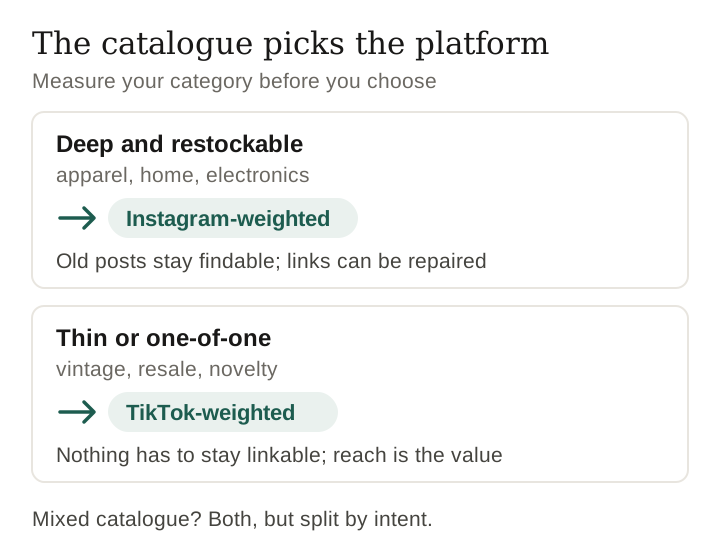
Neither platform wins in general. The choice follows your catalogue: if the products you cover have a deep, restockable retail catalogue, the searchable and permanent surface of Instagram compounds, because one post can be re-found and re-linked for years. If your products are one-of-one, seasonal or novelty items, TikTok’s push-based discovery suits them better, because nothing is being asked to stay linkable. Measure the catalogue before you pick the platform.
The comparison everyone runs, and why it misleads
Most versions of this comparison rank the two platforms on audience size, average engagement and demographic skew. Those are real numbers, but they answer a media-buyer’s question, not a creator’s. A creator is deciding where to spend production hours over the next year, and the variable that decides whether those hours compound is not audience — it is whether the products you talk about will still be buyable, and linkable, in six months.
That is a property of your category, not of the platform. So the useful comparison starts by measuring the category.

Catalogue depth, measured on 1 September 2026
A correction made on 28 September 2026: this table first printed the feed’s own reported listing totals (apparel at over 150 million, for example). Those totals are the feed’s estimates, and re-running the same query does not reproduce them, so we have removed them. The medians and retailer counts come from the rows we actually pulled on 1 September and stand as that day’s reading.
Category figures from US retailer product feeds, pulled during the writing of this page. The median is computed from a 600-row sample of each category drawn across six offsets, and the advertiser column counts distinct retailers appearing in that sample.
| Category | Feed’s reported listing count | Median price in sample | Retailers in sample |
|---|---|---|---|
| Apparel & Accessories | — | $50.00 | 18 |
| Home & Garden | — | $186.08 | 14 |
| Furniture | — | $267.49 | 13 |
| Office Supplies | — | $31.12 | 14 |
| Animals & Pet Supplies | — | $38.99 | 18 |
| Electronics | — | $44.99 | 17 |
| Health & Beauty | — | $66.12 | 11 |
| Sporting Goods | — | $59.98 | 17 |
| Toys & Games | — | $34.99 | 18 |
| Baby & Toddler | — | $57.19 | 27 |
| Food, Beverages & Tobacco | — | $31.70 | 27 |
| Luggage & Bags | — | $69.64 | 22 |
Method: CJ product API, advertiserCountries: US, availability: IN_STOCK, pulled 1 September 2026. Listing counts are listings, not distinct products — variants and cross-posted duplicates inflate them. The sample is drawn in the API’s own ordering rather than at random, so the medians describe the sampled rows and the retailer counts are a floor, not a census.
The spread is the point. By the feed’s own reckoning on 1 September, apparel and home goods ran to tens of millions of live listings and luggage, baby goods and food to hundreds of thousands. Those totals are not exact, but a gap of that size is not an artefact of counting. A creator in the first group can rebuild a dead link with an equivalent product in seconds. A creator in the second group often cannot, and that single fact should drive the platform decision more than any engagement benchmark.
Keep reading
The structural differences you can verify yourself
These are properties any creator can confirm on their own account today, which is why we are willing to state them. Platform feature claims that require reading the platform’s own documentation are in the limits section instead.
Post lifespan
- An Instagram post stays on a permanent, browsable profile grid. Someone who finds you in March can scroll to something you posted in January and tap it.
- A TikTok video lives primarily in a recommendation feed. It can resurface months later, which is a genuine advantage, but that resurfacing is not something you control or schedule.
- Consequence: on Instagram, a back catalogue is an asset you can deliberately maintain. On TikTok it is a lottery ticket that occasionally pays.
Where a link can sit
- Both platforms treat the profile as the reliable place for an outbound link, and neither makes ordinary captions clickable.
- That means both funnel your entire catalogue through a single profile slot unless you use in-app commerce features, which is the structural reason link-in-bio pages and storefronts exist at all.
Search behaviour
- Both have in-app search, and both are used as search engines by younger audiences.
- Instagram’s grid gives a searcher a browsable archive when they land; a TikTok profile gives them a video list. For product content specifically, the grid is easier to shop.
Matching the surface to the catalogue
| If your category is… | The compounding surface is… | Because |
|---|---|---|
| Deep and restockable (apparel, home, electronics) | Instagram-weighted | Old posts stay findable and their links can be repaired with equivalents, so the back catalogue keeps earning. |
| Thin or one-of-one (vintage, resale, novelty) | TikTok-weighted | Nothing is being asked to stay linkable, so the value is in reach at the moment of posting. |
| Mixed | Both, but split by intent | Evergreen explainers and comparisons on the grid; time-boxed finds and restock alerts on video. |
| Seasonal (gifting, holiday) | Whichever you already have reach on | Seasonal windows are too short for platform-building; use the audience you have. |
Our editorial judgment, stated as such: for a creator covering a deep category, the biggest return is not choosing a platform at all but making the existing back catalogue linkable. Most creators have more unmonetised published posts than they have hours to make new ones.
A four-question test
- If a product I featured sells out, can I swap in an equivalent in under a minute? Yes points to Instagram; no points to TikTok.
- Does my audience find me by searching, or by being served me? Search rewards a browsable archive; being served rewards volume.
- Is my content still true in six months? Comparisons and explainers are; "look what just dropped" is not.
- Do I have a back catalogue already? If so, the highest-value work is behind you, not in front of you.
What we could not verify
Last verified 1 September 2026 against live US retailer product-feed counts pulled for the twelve categories in the depth table. The platform statements are structural behaviour a creator can check in the app; no platform documentation was readable from this host
Frequently asked
Is TikTok or Instagram better for product discovery?
It depends on the depth of the retail catalogue in your category. Deep, restockable categories reward Instagram, because old posts stay findable and their links can be repaired. Thin or one-of-one categories suit TikTok, because nothing has to stay linkable.
Which categories have the deepest affiliate catalogues?
On 1 September 2026 the feed reported apparel and accessories as its largest category, followed by home and garden, with luggage, baby goods and food far smaller. Its exact totals are estimates we could not reproduce, so we do not print them.
Do I have to choose one platform?
No, and most creators should not. Split by intent instead: evergreen comparisons and explainers where they can be found again, time-boxed finds where reach is pushed to people who do not follow you.
Why does catalogue depth matter more than audience size?
Because it decides whether your published work keeps earning. In a deep category a sold-out product can be replaced with an equivalent and the post keeps working; in a thin one the post is finished when the listing is.
Sources and scope
- Category listing counts and medians: CJ product API, US advertisers, in-stock only, pulled 1 September 2026. Method stated in full above the table.
- No platform feature claim on this page is sourced from TikTok or Instagram documentation; see the limits section for why.
Keep reading
How this page was made. Drafted with AI (Claude); not yet independently re-checked. How we work