LinkToLooks · Guides · Creator Desk
Creator Desk
UGC creator or influencer: which business are you in?
Part of: For creators
A UGC creator sells content: files handed to a brand, which the brand posts from its own accounts. An influencer sells distribution: a post that goes out to an audience the creator built. The deliverable, the customer, the pricing basis and the risk profile are different in every one of those four places, and the single sharpest difference is that UGC work does not require an audience at all.
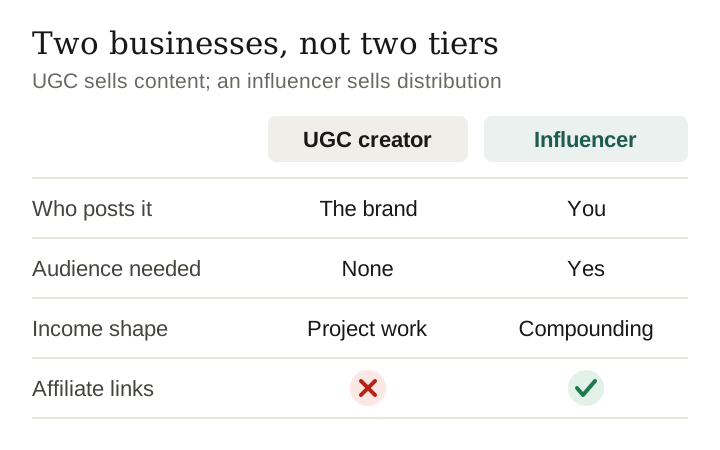
The split, in one table
| UGC creator | Influencer | |
|---|---|---|
| What is sold | Content files, as a production service | Access to an audience |
| Who posts it | The brand, from its own accounts or paid ads | You, from your account |
| Audience needed | None. A private account with 40 followers can do this work. | Yes. The audience is the product. |
| Priced on | Per asset, per concept or per shoot day | Per post, against audience size and engagement |
| Usage rights | The point of the deal, and priced into it | An add-on, priced separately |
| Income shape | Project work: starts and stops with briefs | Compounding, while the account and platform hold |
| Can carry affiliate links | Not from the UGC deliverable — you are not the one distributing | Yes |
| Discoverable by brands via | Portfolio, marketplaces, direct outreach | Your public account and its metrics |
Read the "audience needed" row twice. It is the reason the two paths suit completely different people, and it is the row most often blurred by advice that treats UGC as a starter tier of influencing. It is not a tier. It is a different customer buying a different thing.
What the UGC business actually is
You are a small production studio. The brand is buying creative assets it can run in paid media, on its product pages, or in its own feed — usually because it wants assets that look like a real person filmed them rather than studio-shot advertising.
What the work looks like
- A brief with a concept, a hook, a shot list and a set of required talking points.
- Delivery of raw and edited files, in named aspect ratios, usually with a variant or two.
- No posting from your account, often no attribution to you at all.
- Revisions, which is why the revision-round clause matters more here than anywhere.
What it requires from you
- Reliable production: light, sound, framing, and delivery on the date agreed.
- A portfolio, because that is what is being bought. Spec work for products you already own is a legitimate portfolio, and a reasonable place to start.
- A rate you can hold, because there is no audience metric to anchor the negotiation.
What it does not require
- Followers.
- A posting cadence.
- A public account at all, in many briefs.
Keep reading
What the influencer business actually is
You are selling attention you already own. The brand is buying the fact that a specific group of people will see the product in a context they trust, and the asset is almost incidental — a brand that only wanted the footage would commission UGC instead, and more cheaply.
What the work looks like
- A post or series on your channels, to a schedule, with disclosure.
- Reporting back: reach, engagement, link taps, sometimes sales.
- Exclusivity, frequently, because the brand is buying your recommendation and does not want it shared with a competitor next week.
What it requires from you
- An audience, and a defensible account of who they are.
- Consistency, because the audience is a subscription that lapses.
- Willingness to spend your own credibility. This is the real cost and it is not on any invoice.
Usage rights sit in opposite places
This is the practical consequence creators get wrong most often, in both directions.
- In UGC, usage is the product. The brand cannot use what it bought without rights, so a broad licence is normal — and must be priced into the asset fee from the start. Quoting a UGC rate as if it were a day rate, then discovering the licence is perpetual and worldwide, is the classic underpricing mistake.
- In influencer work, usage is an add-on. The fee bought a post. Running that post as a paid advertisement, whitelisting it from your handle, or putting it on packaging is a separate use and a separate number.
The mistake in the other direction is just as expensive: charging influencer-style usage add-ons on a UGC brief tends to lose the work, because the brand is buying a licence, not reach, and can commission the same assets elsewhere.
The risk profiles are mirror images
| Risk | UGC | Influencer |
|---|---|---|
| Losing your platform account | Survivable — the portfolio is the asset | Severe — the audience is the asset |
| An algorithm change | Little direct effect | Direct effect on reach and therefore on rates |
| Client concentration | High. Two brands can be most of your income. | Lower, but the audience is a single point of failure |
| Income between briefs | Zero. Project work stops. | Affiliate and residual income continue |
| Scaling | Bounded by your hours, until you hire | Bounded by audience growth |
Our editorial read: UGC is the more reliable way to earn money in the first year and the harder thing to compound; influencing is the reverse. That is a judgment, not a measurement, and anyone quoting you a percentage on it is guessing.
Only one of them can carry affiliate income
Affiliate income requires that you distribute the link. A UGC creator hands over files and never publishes, so there is no click to attribute and no commission to earn. This is the structural reason the two paths diverge over time rather than converging:
- An influencer accumulates a back catalogue of posts that can carry links, and each new post adds to the stock.
- A UGC creator accumulates a portfolio, which wins the next brief but earns nothing while it sits there.
- Creators who do both are better off running them as separate businesses with separate rate sheets, because the buyers are different people even inside the same company.
How to choose, honestly
- Pick UGC if you like production more than performance, you want income that does not depend on an audience you do not yet have, and you are comfortable with work that carries no byline.
- Pick influencing if you already publish consistently, you want income that keeps working after the campaign ends, and you accept that your reach is rented from a platform that can change the terms.
- Do both only with two rate sheets and two portfolios. The single blended rate card is where people quietly sell a perpetual licence at a per-post price.
Last verified 10 October 2026 against no new primary source. This page describes two business models and their economics; it quotes no rates, no market sizes and no earnings figures
Frequently asked
What is the difference between a UGC creator and an influencer?
A UGC creator makes content the brand posts from its own accounts; an influencer posts to an audience they built. UGC is a production service and needs no followers. Influencing sells distribution and cannot exist without an audience.
Do you need followers to be a UGC creator?
No. The deliverable is files, and the buying decision is made on a portfolio. A UGC brief does not depend on the creator’s own account, because the brand posts the content.
Can UGC creators earn affiliate commission?
Not from the UGC work itself. Affiliate commission requires you to publish the link and generate the click, and a UGC creator hands the content to the brand instead of posting it.
Which pays better, UGC or influencer work?
There is no honest general answer, and anyone giving one is quoting a benchmark they cannot source. The structural difference is shape rather than size: UGC pays per project and stops between briefs; influencer income is smaller per unit of effort early and compounds later.
Should I do both?
You can, but keep two rate sheets. The common failure is quoting a per-post influencer rate on a brief that is really a perpetual content licence.
Sources and scope
- Usage-rights and exclusivity mechanics referenced here are set out in full in what a creator contract should say.
- The affiliate side of the distinction — why a click has to be yours to be paid on — is covered in how much a creator earns per sale.
- No rate benchmark, market size or earnings figure is asserted on this page.
Keep reading
How this page was made. Researched and drafted with AI (Claude); checked by a separate automated pass on 10 October 2026. How we work