LinkToLooks · Guides · Creator Desk
Creator Desk
What should a creator contract actually say?
Part of: The business of being a creatorFor creators
A creator contract earns or loses its money in five places: what the brand may do with your footage, what you are forbidden to post for whom, when you get paid, what happens if the campaign is cancelled, and how many rounds of revisions you owe. Everything else is scheduling. If a brief arrives with a fee and a deadline and nothing else, those five are the questions to send back.
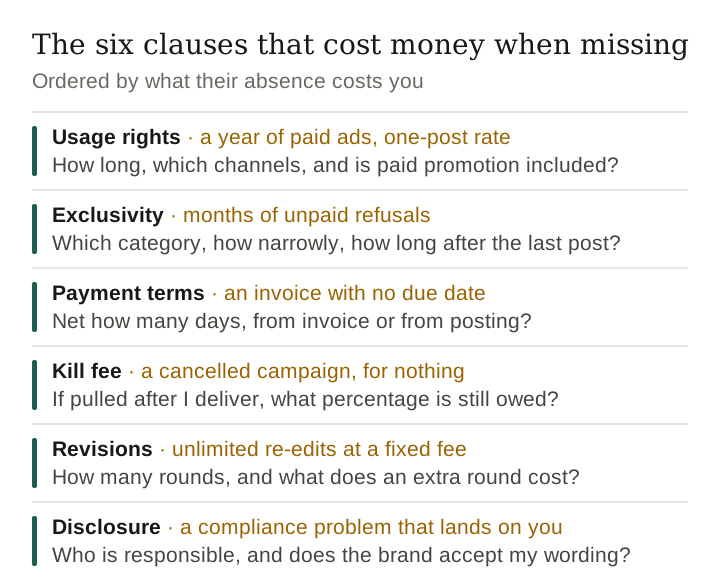
The six clauses that cost money when missing
These are ordered by what their absence costs, not by where they usually appear in a document. A brief that names a fee and a posting date has told you almost nothing about the deal.
| Clause | What its absence costs you | The question that surfaces it |
|---|---|---|
| Usage rights | The brand runs your photo as a paid advertisement for a year and pays you a one-post rate. | For how long, on which channels, and does that include paid promotion? |
| Exclusivity | You turn down every competing brand for months without being paid for the refusals. | Which category, how narrowly defined, and for how long after the last post? |
| Payment terms | An invoice that sits unpaid because no due date was ever agreed. | Net how many days, from invoice or from posting, and what happens after that? |
| Kill fee | A campaign cancelled after you have shot it, for nothing. | If this is pulled after I deliver, what percentage is still owed? |
| Revisions | Unlimited re-edits at a fixed fee. | How many rounds are included, and what does an extra round cost? |
| Disclosure | A compliance problem that lands on you, not on the brand. | Who is responsible for the disclosure, and does the brand accept my wording? |
Notice that five of the six are answerable in one sentence each. A brand that will not answer them in writing has told you something useful about how the invoice stage is likely to go.
Usage rights, the expensive one
Usage is where a creator most often gives away the thing that was actually worth money. The fee you negotiated was for making a post. Usage rights decide whether the brand may also run that post as an advertisement, on channels you do not control, to audiences you did not build, for as long as it likes.
Term
- A defined term — 30 days, 90 days, six months — is a price you can quote against. "In perpetuity" is not a term, it is a transfer.
- If a brand needs perpetual rights, that is a legitimate ask. It is simply a different product from a post, and should carry a different number.
- Watch for a short term on the organic post and a silent, longer term on the paid use.
Media
- Organic social, paid social, the brand website, email, retail point of sale, out-of-home print and broadcast are separate uses. A single line reading "all media" collapses them all into the one fee.
- Retail and out-of-home are the ones creators most often discover after the fact, because they are the least likely to appear in your own feed.
Whitelisting and paid amplification
- Whitelisting means the brand runs advertisements from your handle, with your face and your name, targeted at audiences of their choosing.
- It is not the same as boosting an existing post, and it is not covered by a general usage clause unless it is named.
- Ask for a spend cap, a term, and the right to review the targeting. All three are normal asks; none of them are automatic.
Exclusivity: what you are actually selling
An exclusivity clause is a promise not to earn money somewhere else. That makes it a cost, and costs should be priced. The three variables are category, breadth and duration, and brands draft all three wider than they need.
- Category. "Skincare" is a category. "Beauty" is most of an industry. "Any competitor of the brand" is undefined until someone names the competitors, so ask for the list.
- Breadth. Does it cover paid work only, or also organic mentions, affiliate links and gifted product? An exclusivity that silently covers affiliate links can switch off an income stream you already had.
- Duration. Exclusivity that runs from signature to 90 days after the final post is much longer than a campaign. Count the actual days before you agree the fee.
The honest way to price it: work out what that category has earned you in the last equivalent period, and treat the exclusivity as a fee for turning that off. If you have never earned anything in the category, exclusivity is nearly free to give and you can trade it for something you do want.
Payment terms and net days
Net terms are a financing arrangement and they are negotiable, but only before signature. The things worth fixing in writing:
- The trigger. Net 30 from invoice is not net 30 from posting, and net 30 from "brand approval of content" can run indefinitely if approval never formally arrives.
- The invoice route. Many delays are procurement, not bad faith: a purchase order number that nobody issued, or an invoice sent to a person rather than a payables address.
- Late payment. A stated consequence, even a modest one, changes the order in which your invoice is processed.
- Agency in the middle. If an agency pays you only once the brand pays them, you are financing the brand. Ask whether payment is conditional on their receipt.
This is the same operational lag that affiliate income has, from a different direction, and it is worth reading both together — the money in this industry is nearly always slower than the work.
Kill fees and cancellation
Campaigns get cancelled for reasons that have nothing to do with you: a product launch slips, a budget is frozen, a legal review kills a claim. Without a kill fee, the cost of that lands entirely on the person who already did the shoot.
- Tie the percentage to the stage, not to a single number: a share on signature, a larger share once content is delivered, the whole fee once it is live.
- Ask what happens to exclusivity if the campaign is killed. If the clause survives cancellation, you are still locked out of the category for a campaign that never ran.
- Reshoots requested for reasons outside the brief are new work. Say so before the first shoot, not after the second.
Approvals and the endless-round problem
An approvals clause with no numbers in it is the most common way a well-paid brief turns into a badly paid one. Three specifics fix most of it:
- A stated number of revision rounds, with a price for further rounds.
- A review window — if feedback does not arrive within, say, five business days, the content is deemed approved. Without this, a slow reviewer can hold your posting date and your payment date hostage at once.
- Consolidated feedback. One document per round, not three people replying separately over a week.
Our editorial judgment, for what it is worth: the review window is the clause creators most often forget to ask for and the one that most reliably saves them time. It costs the brand nothing to agree, which is exactly why it is easy to get.
Where affiliate income sits in all this
Affiliate links are usually governed somewhere else entirely — by a network agreement you accepted separately — and that mismatch causes real problems.
- Check whether the brand deal forbids affiliate links on the same post. Some do, because they do not want to pay twice for one placement.
- Check whether exclusivity covers affiliate activity. If it does, you may be turning off existing links without realising.
- Disclosure obligations do not disappear because a contract is silent about them. They are yours regardless of what the brief says.
We have written the disclosure side of that separately, from the regulation rather than from folklore.
Last verified 1 September 2026 against no new primary source. This page states contract mechanics and negotiation practice, not law, and no clause text here is quoted from any specific agreement
Frequently asked
What should a creator contract include?
At minimum: the deliverables and posting dates, the fee and payment terms, usage rights with a defined term and named media, any exclusivity with its category and duration, a kill fee, a stated number of revision rounds, and who is responsible for disclosure.
What are usage rights in a creator contract?
Usage rights define what the brand may do with the content after you post it — for how long, on which channels, and whether it may be used in paid advertising. A one-post fee does not automatically include advertising use, and it is priced separately by most working creators.
Should I accept an exclusivity clause?
Only when its category, breadth and duration are written down and priced. Exclusivity is a promise not to earn elsewhere, so its cost is whatever that category would otherwise have paid you over the same period.
What is a kill fee?
A percentage of the agreed fee that is still owed if the brand cancels. Sensible contracts stage it: a share on signature, a larger share once you have delivered content, the full fee once it is live.
Does a contract remove my disclosure obligation?
No. Disclosure of a material connection is the endorser’s responsibility, and a contract that is silent about it does not change that. Agree the wording in advance so the brand cannot object to it afterwards.
Sources and scope
- Disclosure obligations are covered in our own reading of the regulation on affiliate disclosure rules for creators, which cites the rule text directly rather than repeating industry summaries.
- Payment-lag mechanics, from the affiliate side, are set out in how creators actually get paid.
- No contract text, fee benchmark or kill-fee percentage on this page is quoted from any specific agreement, because we hold none.
How this page was made. Drafted with AI (Claude); not yet independently re-checked. How we work