LinkToLooks · Guides · Creator Desk
Creator Desk
Some links can never earn. Publish them anyway
An argument, and the price of making it: we hold no approvals, so this position costs us nothing and costs a working creator real money.
Part of: For creators
The position, stated up front. Some links can never earn. Not “not yet”, not “not until you are approved” — never, because the destination runs no creator programme at all. We argue you should publish them anyway when they are the right answer, and that being willing to say so out loud is a reasonable test of whether a recommendation was ever about the reader. This argument is cheap for us to make and we say why below.
Last verified 8 September 2026 against one affiliate network’s 2,041 US advertisers and five marketplaces’ own public pages, all read during this batch
Three ways a link is unmonetisable
They are worth separating, because only one of them is permanent and creators tend to treat all three as the same problem.
1. No programme exists
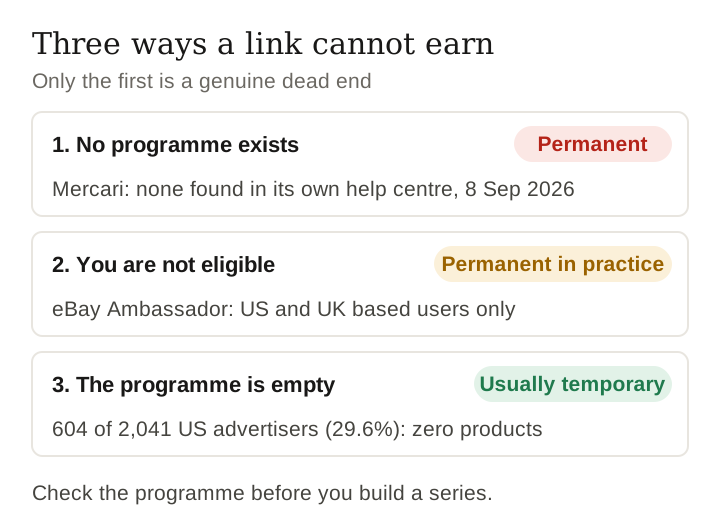
The destination has no affiliate or creator programme to join. We went looking for one at Mercari on 8 September 2026 and found no affiliate or creator-earnings section anywhere in its own help-centre navigation, and no programme page we could reach. This is the permanent case: no amount of applying changes it.
2. A programme exists and you are not eligible
eBay Partner Network’s own homepage names a creator-facing route, eBay Ambassador, and restricts it to US and UK based users. A creator elsewhere is looking at a programme that exists and is closed to them. Temporary in principle, permanent in practice for most people.
3. A programme exists and has nothing in it
Of the 2,041 US advertisers in the directory we read, 604 — 29.6% — had a largest feed carrying zero products. You can be approved into one of these and still have nothing to link. This one is usually temporary and always worth checking before you apply.
Only the first is genuinely a dead end. It is also the one worth having a policy about, because it will come up on exactly the posts where the reader most wanted a specific answer.
The case for linking it anyway
The argument is short. The reader asked where to get the thing, not where you get paid. If the honest answer to “where is this available” is a marketplace with no programme, then a link to that marketplace is the correct answer and a link to a monetisable substitute is a worse one, dressed up.
Three consequences follow, and they are all in the creator’s own interest rather than being purely moral.
- Substitutions are visible. A reader who wanted a specific item and got pointed at an approximate one on a different site notices. Not every time; enough times.
- Being right is the asset. The reason anyone clicks your monetised links is that your unmonetised ones were accurate. Spending that down for one commission is a bad trade in an obvious direction.
- The alternative is a silent editorial filter. If you only ever feature what you can earn from, your recommendations are a function of your approvals, and your readers cannot see the shape of what you left out.
That last one is the real cost and it is invisible from the outside. A creator with four approvals is not a creator with a taste for four retailers; they look identical on the page.
Why this is easy for us to say
We should be honest about the price of this position, which for us is zero.
We hold no affiliate approvals and have earned nothing. Every link on this site is currently an unmonetised link, so “link the thing that cannot pay you” costs us exactly nothing to advocate. A creator with a functioning income is being asked to give up a real commission on a real sale, and that is a different decision made by someone with more at stake.
We are not going to pretend otherwise, and we would rather you weighed the argument knowing who is making it. What we can say is that our position does not change when the approvals arrive, and that we will publish the first time it costs us something.
The strongest argument against us
There is a real one and it deserves better than a strawman.
Unmonetised links are not free. A creator’s time is the scarce input. Every hour spent researching, photographing and writing about a product that cannot pay is an hour not spent on one that can, and a creator whose work does not pay stops making work. Pushed far enough, “always link the right answer” produces excellent recommendations from someone who has gone back to a day job.
That is correct, and it changes the shape of our claim rather than defeating it. The defensible version is narrower: when you have already decided to cover something, cover it accurately. Choosing what to cover is a business decision and monetisation belongs in it. Choosing where to point once you are writing is an editorial decision and monetisation does not.
The line is between selection and substitution. Declining to write about a category with no programmes is legitimate. Writing about it and quietly sending readers somewhere else is not.
Keep reading
What this looks like in practice
Four habits, none of which require a tool.
Say which links pay you
Not a blanket disclosure at the bottom — a marker on the links themselves. A reader who can see that three of your seven links earn you nothing has been given a reason to trust the other four.
Put the accurate link first
Where both exist, the item the reader asked about goes first and the monetisable alternative goes second, labelled as an alternative. That ordering is the whole ethic in one gesture and it costs almost no traffic.
Check the programme before you build a series
One unmonetisable link is an editorial choice. Discovering after twenty posts that your favourite retailer has no programme is a planning failure. Check the destination before you commit a format to it.
Keep the count
Knowing what share of your links cannot earn is useful information about your own niche, and it is the number that tells you when a second network would actually help.
Frequently asked
Should I link a retailer that has no affiliate programme?
If it is the right answer to the reader’s question, yes. The defensible line is between selection and substitution: declining to cover a category with no programmes is a legitimate business decision, while covering it and pointing readers at a monetisable near-substitute is not.
Which marketplaces cannot be monetised?
It varies and it changes. On 8 September 2026 we could find no creator or affiliate programme for Mercari in its own help-centre navigation. eBay’s creator-facing programme exists but is restricted to US and UK based users, which is a different kind of block.
Can I be approved into a programme with nothing to sell?
Yes. 604 of the 2,041 US advertisers in the directory we read — 29.6% — had a largest feed carrying zero products. Check the product count before applying.
Does linking unmonetised destinations hurt my earnings?
Per link, yes, by exactly the commission you did not earn. The argument for doing it is that accuracy is what makes the rest of your links worth clicking, and that is not measurable on a single post.
How should I disclose which links pay me?
Mark the individual links rather than relying only on a page-level notice. A reader who can see which links earn and which do not has been given a reason to trust the ones that do.
Method, scope and limits
The programme checks were made on 8 September 2026 by fetching each company’s own public pages with a desktop browser user agent and reducing the response to visible text before reading it. The empty-feed figure comes from the 2,041 distinct US advertisers visible to our own affiliate publisher token, reduced to one entry per advertiser by keeping the largest feed.
What this cannot show. We could not find a Mercari programme; that is not proof one does not exist, and we did not count guessed URLs returning 404 as evidence of anything. The eligibility and empty-catalogue figures are one network and one morning. Most of all, this page is an argument rather than a measurement — the numbers bound it, they do not prove it, and a creator whose income depends on the answer is entitled to weigh it differently than a publisher who has earned nothing.
Keep reading
How this page was made. Drafted with AI (Claude); not yet independently re-checked. How we work