LinkToLooks · Guides · Creator Desk
Creator Desk
What a W-8BEN is, and why a US network asks for it
Descriptive, sourced from the IRS pages themselves, and explicit about what we could not verify.
Part of: For creators
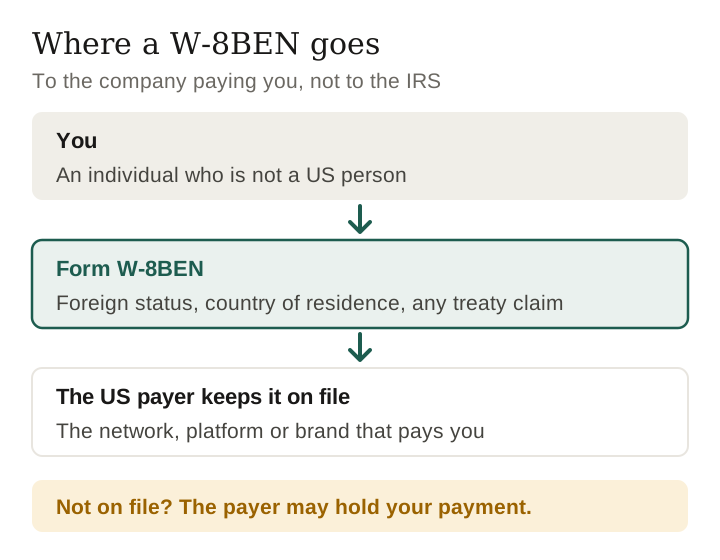
A W-8BEN is how an individual who is not a US person tells a US payer that they are foreign. The IRS titles it “Certificate of Foreign Status of Beneficial Owner for United States Tax Withholding and Reporting (Individuals)”. It goes to the company paying you, not to the IRS.
The tax side of it is on the IRS’s own page about withholding: most types of US-source income received by a foreign person “are subject to U.S. tax of 30%”, and a reduced rate or an exemption may apply where an Internal Revenue Code section provides a lower rate, or where a tax treaty between the person’s country of residence and the United States does. Holding the payment is the payer’s own step: Amazon’s Operating Agreement reserves the right to hold commission income until you provide tax information it has asked for. The form is where you claim that treaty rate. Without it, the payer has no basis to apply one.
This page is descriptive, not tax advice. It says what the form is, who asks for it and where the official text lives. It does not tell you what to write on yours, and for that you want the form’s own instructions or an accountant in your country.
What the form actually is
Its full title is the most useful sentence about it. From the IRS page, read on 7 September 2026:
“About Form W-8 BEN, Certificate of Foreign Status of Beneficial Owner for United States Tax Withholding and Reporting (Individuals)”
Three words in that title do the work.
- Certificate. It is a statement you sign, not an application anybody approves.
- Beneficial owner. It says the money is yours, rather than being routed through you to somebody else.
- Individuals. There is a separate form for entities, which is why a creator who has incorporated gets asked for a different one.
It is given to the withholding agent — the network, platform or brand paying you — who keeps it on file. That is why it arrives as a form inside a payment dashboard rather than as something you file anywhere.
Why the network asks before it pays
From the payer’s side this is not an administrative preference. A US payer that cannot document a payee’s status is exposed for the tax it should have withheld. One solution, and the one Amazon’s Operating Agreement reserves in writing, is to hold the payment until the certificate exists, which is the hold a payee sees on a payment while that tax information is missing.
It is the same mechanism as the W-9 that US creators fill in, and we have written that one up separately. The difference is what the form establishes: a W-9 says I am a US person, here is my taxpayer number; a W-8BEN says I am not, here is where I am resident.
Amazon’s Associates Program Policies, read the same day, put the residence question directly into the programme terms: a non-US Associate agrees that, unless their tax information says otherwise, they “will perform all services under the Agreement outside the United States”. The tax information is part of the contract, not a step beside it.
For scale, a worked example priced from a Wayfair North America listing: take a $49.07 order. At a 5% rate that is a $2.45 commission, and 30% of it, if the default applied to it at all, would be 74 cents. The form is not proportional to the money, which is exactly why it catches people out.
Where the 30% comes from
The IRS page on non-resident alien withholding, last reviewed 14 March 2026, states the default plainly: most types of US-source income received by a foreign person “are subject to U.S. tax of 30%”, with a reduced rate or exemption possible where the Internal Revenue Code or a tax treaty provides one.
Thirty per cent is therefore the rate that can apply, to income subject to this withholding, when nothing has been established; the form’s instructions say a missing form may instead lead to backup withholding. It is not a penalty and it is not the network’s choice. It is the rate that stands in the absence of the documentation the form provides.
What a treaty claim is, and what we can and cannot say
If your country has an income tax treaty with the United States, the treaty may set a lower rate than 30% for the relevant kind of income. The W-8BEN has a part for claiming it, and the claim is what turns the default into the treaty rate.
The IRS publishes the rates in its Tax Treaty Tables page, last reviewed 23 February 2026. Table 1 is described there as listing “the income tax and withholding rates on income other than for personal service income”, such as interest, dividends, royalties, pensions and annuities, and social security payments, in a revision dated May 2023.
We are not reproducing rates from it, for a reason that matters: a treaty rate depends on the income article you are claiming under, and quoting one number next to the words “affiliate income” would be inventing a mapping we have not verified. The table is public, it is one click away, and it is the right place to look your own country up.
W-8BEN, W-8BEN-E, W-9: which one is yours
| Form | Who gives it to the payer | What it establishes |
|---|---|---|
| W-9 | US persons and US entities | US status and taxpayer identification number |
| W-8BEN | Individuals who are not US persons | Foreign status, country of residence, and any treaty claim |
| W-8BEN-E | Entities that are not US persons | The entity version of the same certificate |
Titles and scope from the IRS pages for each form, read 7 September 2026.
One certificate generally covers that network’s payments until it lapses at the end of the third calendar year after you sign it, or until your circumstances change.
The practical trigger for the third row is incorporating. A creator who signs up personally and later moves the work into a company has become a different payee even though the person has not, and the W-8BEN instructions say a foreign entity uses Form W-8BEN-E instead. The exception the IRS instructions name: the owner of a disregarded entity, not the entity, gives the W-8BEN.
Keep reading
What we could read, and what we could not
Every source in the table below was fetched on 7 September 2026, and the IRS pages again on 10 October 2026. Where a source would not answer, that is stated rather than filled in from memory.
| Source | Result | Date the page states |
|---|---|---|
| IRS — About Form W-8 BEN | HTTP 200, 102,502 bytes | Last reviewed or updated 1 October 2025 (2 October 2026 when re-read on 10 October 2026) |
| IRS — NRA withholding | HTTP 200, 116,467 bytes | Last reviewed or updated 14 March 2026 |
| IRS — Tax treaty tables | HTTP 200, 106,306 bytes | Last reviewed or updated 23 February 2026; Table 1 rev. May 2023 |
| IRS — About Form W-8 BEN-E | HTTP 200, 101,716 bytes | Last reviewed or updated 30 March 2026 |
| IRS — Form and instructions PDFs | HTTP 200, both served | Rev. October 2021; read 10 October 2026 — see below |
| CJ — publisher service agreement | HTTP 404 | — |
| Awin — publishers | HTTP 200 on 10 October 2026; no payee tax content | — |
| Awin — US Tax forms (1099 & W9) FAQs | HTTP 200 on 10 October 2026; covers W-9 and W-8 forms | Last published 12 March 2026 |
| Awin — AWIN LTD Standard Terms for Publishers | HTTP 200 on 10 October 2026; payment subject to tax information | No date in the text; file named August 2025 |
How this page was sourced
Every claim above is either quoted from a named IRS page with the date that page states, taken from the Form W-8BEN instructions (Rev. October 2021) or the IRS page on withholding agents (last reviewed 21 March 2026), taken from Amazon’s and Awin’s published programme terms and help pages, or explicitly marked as something we did not verify. The order value in the scale example is a worked example, and the commission and withholding figures in it are arithmetic on it. Nothing here is drawn from other creator content.
Where you should go next depends on which question you have: for the form itself and its instructions, the IRS page for Form W-8 BEN; for your country’s treaty position, the IRS tax treaty tables; for what a specific network requires, that network’s own payee settings, because Amazon’s terms say that it may deduct or withhold taxes it is legally obliged to, may request tax information and may hold commission income until it is provided; Awin’s terms make payment subject to tax information and its US Tax FAQ covers W-8 forms; and CJ’s agreement URL returns 404.
Keep going
Frequently asked
What is a W-8BEN?
The IRS titles it Certificate of Foreign Status of Beneficial Owner for United States Tax Withholding and Reporting (Individuals). A non-US individual gives it to the US company paying them, not to the IRS.
Why will a network not pay me until I complete it?
A US payer that cannot document a payee's status carries the exposure for tax it should have withheld, so a payer may hold payment until the certificate exists; Amazon's Operating Agreement reserves the right to.
Where does the 30% figure come from?
The IRS page on non-resident alien withholding states that most types of US-source income received by a foreign person are subject to US tax of 30%, with a reduced rate or exemption possible under the Code or a tax treaty.
Does a tax treaty reduce it?
It may. The claim is made on the form itself, and the rates are in the IRS tax treaty tables, Table 1, revision May 2023. Which rate applies depends on the income article, which is why we do not quote a number here.
What is the difference between W-8BEN and W-8BEN-E?
W-8BEN is for individuals; W-8BEN-E is the entity version. A creator who incorporates becomes a different payee, and the W-8BEN instructions send a foreign entity to Form W-8BEN-E.
Is this tax advice?
No. This page describes what the form is and cites the official pages. It does not tell you what to put on yours.
Last verified 10 October 2026 against IRS pages for Form W-8 BEN, NRA withholding, the tax treaty tables and Form W-8 BEN-E, all fetched, plus Amazon's published Associates Program Policies; the IRS pages re-read, and the Form W-8BEN instructions, Amazon's Operating Agreement and Awin's tax FAQ and publisher terms read, 10 October 2026.
How this page was made. Researched and drafted with AI (Claude); checked by a separate automated pass on 12 October 2026. How we work