LinkToLooks · Guides · Creator Desk
Creator Desk
What a 1099 means for a creator
It is a payer telling the IRS what it paid you — and the threshold everybody quotes for the creator form is not the one the current instructions give.
Part of: For creators
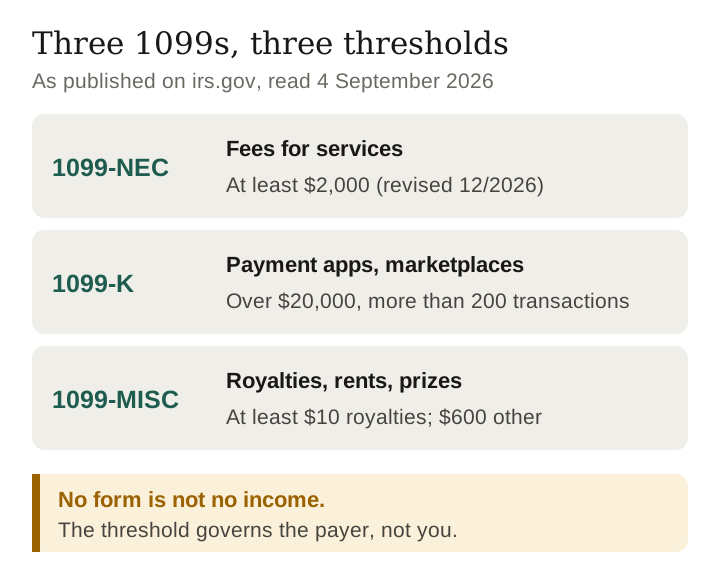
A 1099 is not a bill and not a tax. It is a payer telling the IRS what it paid you, with a copy to you. Two of them reach creators. Form 1099-NEC covers fees for work, and the current IRS instructions — revised 12/2026 — put the filing threshold at $2,000. Form 1099-K covers money that arrived through a payment app or online marketplace, and the IRS page we read today sets that threshold at over $20,000 in more than 200 transactions.
The number most creator articles still quote for 1099-NEC is $600. That was the long-standing figure. The instructions currently published do not say $600, and we have linked them so you can check rather than take our word for it.
The three forms, and which one you get
Creator income arrives by several routes and the route decides the form. Nothing you do changes which one you receive.
| Form | Reports | Typically sent by | IRS page |
|---|---|---|---|
| 1099-NEC | nonemployee compensation — fees, commissions, prizes and awards for services | a brand paying you directly, an agency, some affiliate networks | About Form 1099-NEC |
| 1099-K | payments for goods or services received through a payment card, payment app or online marketplace | a payment processor or marketplace, not the brand | Understanding your Form 1099-K |
| 1099-MISC | rents, prizes and awards not for services, royalties, other income | a payer covering something outside the NEC definition | About Form 1099-MISC |
Last verified 4 September 2026 against the live IRS pages for Forms 1099-NEC, 1099-K and 1099-MISC
The distinction that trips creators is the second row. A 1099-K is sent by the processor, not the brand. If a brand pays you through a marketplace or an app, the brand may send you nothing at all and the platform may send you a 1099-K covering the same money.
The thresholds, quoted and dated
| Form | Threshold as published today | Source |
|---|---|---|
| 1099-NEC | at least $2,000 paid to a person in the course of your business for services | Instructions for Forms 1099-MISC and 1099-NEC, revised 12/2026 |
| 1099-K | over $20,000 and more than 200 transactions through a payment app or online marketplace; card payments have no minimum | Understanding your Form 1099-K, reviewed 28 June 2026 |
| 1099-MISC | at least $10 in royalties, or at least $600 in rents, prizes and awards and other income payments | About Form 1099-MISC |
Two details in that table are worth reading twice.
- Card payments have no minimum. The IRS page states that if customers pay you directly by credit, debit or gift card, you get a 1099-K regardless of how many payments there were or how large. The $20,000 figure applies to payment apps and marketplaces, not to card processing.
- A payer may send a form below the threshold. The same page says platforms may send a 1099-K with lower amounts. A threshold is a point above which reporting is required, not a ceiling below which it is forbidden.
Keep reading on creator money
The rule that catches people: no form is not no income
This is the single most expensive misunderstanding in creator finance, and it is worth stating without hedging: the reporting threshold governs the payer, not you. A payer below the threshold has no obligation to file the form. Your obligation to report income you received is a separate rule that the missing form does not touch.
Three ordinary situations where nothing arrives and the income still counts:
- Four brands paid you $900 each. No single payer crosses $2,000, so no 1099-NEC is required from any of them. You received $3,600.
- An affiliate network paid you through a payment app, under the app’s threshold and under the network’s.
- A brand outside the United States paid you. US information reporting does not reach them at all.
The converse error is quieter and just as common: treating a form that did arrive as the final word on the amount. It is one payer’s report of one channel. Your records are the complete account, which is the entire argument for keeping them.
When the same money is reported twice
This happens more to creators than to almost anyone else, because creator money moves through intermediaries. A brand pays through a marketplace; the marketplace files a 1099-K; the brand also files a 1099-NEC for the same engagement. Two forms, one payment.
The IRS 1099-K page is explicit that you should use the form with your other records to figure your income, which is a polite way of saying the forms are inputs and not the answer. The practical version:
- Reconcile every form you receive against your own record of that payer and that payment. Match on dates and amounts, not on totals.
- If two forms describe the same money, you have a duplicate to resolve, not double income to report.
- If a figure on a form is wrong, the fix is with the payer who issued it. They can issue a corrected form. You cannot correct theirs.
- Personal money moving between friends and family is not payment for goods or services and should not be on a 1099-K at all — the IRS page carries a section on exactly this.
What actually arrives, and when
- A copy to you and a copy to the IRS. The version you get is a statement of what was reported about you, and the agency already has the same numbers.
- Payment card companies, payment apps and marketplaces must send your 1099-K copy by 31 January, per the IRS page.
- Forms describe the calendar year just ended. The one that lands in January is about last year, which is why a December payment can be a January surprise.
- Nothing is withheld by default. Unlike a payslip, a 1099 payment usually arrives whole. That is a cash-flow feature and a planning problem in the same fact.
The IRS publishes two adjacent pages that describe what follows from that last point: self-employment tax, which it states as a rate of 15.3 per cent made up of 12.4 per cent Social Security and 2.9 per cent Medicare, and estimated taxes, where it says most taxpayers avoid the underpayment penalty if they owe less than $1,000 after withholding and credits. Both pages are free, primary, and shorter than the articles summarising them.
What to do in the week it lands
- Read which form it is before anything else. NEC, K and MISC describe different things and the difference matters to how it reconciles.
- Find the payer’s name on it and check it is who you think. A marketplace name where you expected a brand name is the duplicate-reporting case above.
- Match the total to your own record for that payer. If you keep one, this takes minutes. If you do not, this is the moment you find out.
- Note gross against net. A form may report the gross amount before a platform fee you never saw. That difference is not an error and it is not yours to keep.
- Contact the payer about anything wrong, in writing, quoting the form and the figure.
- Keep it with the year’s records, alongside the invoices and statements it is meant to agree with.
Frequently asked
Do I owe tax because a 1099 arrived?
The form does not create the obligation. It reports a payment that was already income when you received it. What you owe depends on your whole situation and is a question for someone qualified.
I earned $1,200 from one brand and got no form. Is that right?
It is consistent with the instructions currently published, which set the 1099-NEC threshold at $2,000. The absence of a form says nothing about whether the income is reportable by you.
Why did a marketplace send a 1099-K when the brand paid me?
Because the marketplace processed the money. The 1099-K reports the channel, not the relationship, which is why the same payment can appear on a form from a company you never negotiated with.
What if the amount on the form is wrong?
Contact the payer that issued it and ask for a corrected form. They filed it and only they can amend it. Keep the correspondence.
Does this apply outside the United States?
No. These are US information returns. A creator elsewhere may still receive one if a US payer reports a payment, and separately owes whatever their own country requires.
Method and scope
Every figure on this page was read from irs.gov on 4 September 2026: the About pages for Forms 1099-NEC, 1099-MISC and W-9, the “Understanding your Form 1099-K” page, which states it was last reviewed on 28 June 2026, and the Instructions for Forms 1099-MISC and 1099-NEC, revised 12/2026, where the $2,000 nonemployee compensation threshold is given. We quote thresholds and definitions only. We compute nothing, we model no liability, and we hold no data about your circumstances. Tax rules change and IRS pages are revised without notice, so check the date on the page you land on. This is a US-only description.
Keep reading
How this page was made. Drafted with AI (Claude); not yet independently re-checked. How we work