LinkToLooks · Guides · Creator Desk
Creator Desk
Currency conversion for non-US creators
You are exposed twice: once on the payout, and once inside the catalogue itself, where one US-marked row in nine is not priced in dollars.
Part of: For creators
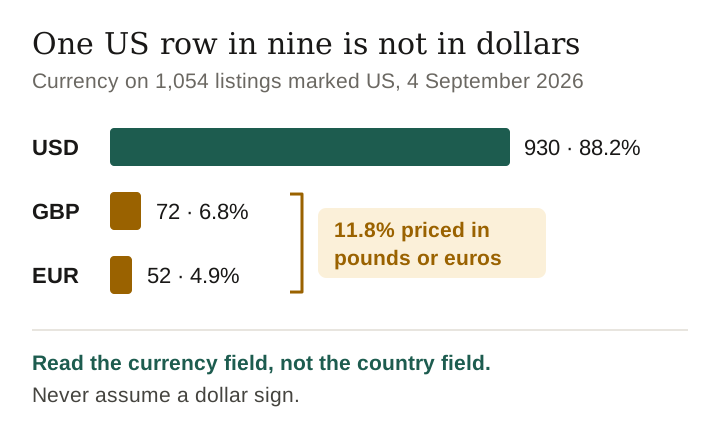
A non-US creator linking US programmes is exposed to currency twice, and the second exposure is the one nobody warns about: the catalogue itself is not all in dollars. We pulled 2,930 affiliate listings across eight product families on 4 September 2026. 1,054 of them carry a targetCountry field reading US — and 124 of those, 11.8 per cent, are priced in pounds or euros rather than dollars.
The first exposure is the familiar one: you earn in dollars and spend in something else. The second is that a “US” row in a product feed is not a promise of a dollar price, so a page you build from that feed can show a shopper a number in the wrong currency entirely.
What one pull actually contains
Eight seed terms, five pages of a hundred rows each, deduplicated. Here is where the listings said they were for.
| Destination country | Listings |
|---|---|
| US | 1,054 |
| GB | 684 |
| IE | 246 |
| GR | 126 |
| FI | 92 |
| DK | 88 |
| IT | 78 |
| NL | 71 |
Last verified 4 September 2026 against a live affiliate catalogue pull of 2,930 deduplicated listings taken
Thirty-six countries and twenty currencies came back from a pull nobody asked to be international. The US share was 36 per cent. Euro-priced rows outnumbered dollar-priced rows overall: 953 against 940, with 755 in sterling.
Worth saying plainly what this measurement is and is not. It is a keyword-driven sample of one network as our account sees it, on one morning. It is not a census of affiliate retail. What it does establish is that the default state of a feed is international, and any single-currency assumption is something you impose afterwards.
The 11.8 per cent inside the US rows
| Currency on rows whose targetCountry is US | Listings | Share |
|---|---|---|
| USD | 930 | 88.2% |
| GBP | 72 | 6.8% |
| EUR | 52 | 4.9% |
This is the finding a creator can act on today. If you build any page, storefront or comparison from a product feed and filter it to the US, roughly one row in nine still carries a non-dollar price. Render that number with a dollar sign in front of it and you have published a wrong price.
We are not guessing at the cause and will not pretend to. The country field and the currency field are populated by the advertiser, and an advertiser serving several markets can produce a row that says US and prices in euros. What matters operationally is that the two fields disagree often enough to break a page.
Keep reading on links and prices
Where a non-US creator actually loses money
Four distinct costs, and they are usually discussed as one.
The conversion spread on the payout
- The rate you are given is not the mid-market rate you see quoted.
- The gap is a margin, and it is charged whether or not it appears as a line item.
- It applies to the whole payout, every time.
The transfer or receiving fee
- Sometimes the sender charges, sometimes the receiving bank, sometimes an intermediary in between.
- A fixed fee is a large percentage of a small payout, which is exactly the shape of an early creator payout.
- This is the strongest argument for a higher payout threshold: fewer transfers, fewer fixed fees.
Timing risk between earning and receiving
- A commission locks in dollars when the sale clears and converts when the payout lands, often weeks later.
- You carry that gap. Nobody is hedging it for you.
- Nothing in a dashboard shows it, because the dashboard is in dollars.
The audience mismatch underneath all of it
- If you live outside the US, your audience probably does too.
- A US programme paying a US commission on a US-shipping product is not a good fit for that audience, whatever the rate looks like.
- This is the expensive one, and it is invisible because it shows up as low conversion rather than as a fee.
What to do about each of the four
- Read the currency field, not the country field. If you publish prices from a feed, take the currency from the row and render it. Never assume a dollar sign.
- Batch your payouts if you can. Where a threshold is adjustable, a higher one means fewer fixed fees. Where it is not, this is one honest reason a high threshold is not purely a grievance.
- Price your rate card in your own currency when the brand is local, and state the currency explicitly when it is not. A dollar sign is not a currency to a client in another country.
- Compare a local programme against the US one properly. A lower headline rate that pays in your currency, to your audience, on a product that ships to them, can beat a higher US rate that fails on all three.
- Record the rate you actually received, not the rate that was quoted. Over a year that difference is the real cost of earning abroad, and it is the only version of the number that is yours.
What we cannot tell you
- What any network’s conversion rate or fee is. We hold no affiliate approvals and have received no payout, so we have no statement to read. Anybody publishing a table of network FX margins should be asked where they got it.
- Whether a non-US creator earns more or less overall. That needs earnings data from real creators. We have none.
- Why a given row says US and prices in euros. The fields come from the advertiser. We can show you how often it happens and not why.
Frequently asked
Can I be paid in my own currency?
Sometimes, depending on the payer and the method. The question worth asking is not whether they will, but what rate they use when they do — a payout in your currency at a poor rate is a conversion fee with the label removed.
Should I join US programmes at all if I am not in the US?
It depends far more on where your audience is than on where you are. If your audience is largely US, the programme fits and the conversion cost is a cost of doing business. If neither of you is US, you are paying to reach people who cannot buy.
Why does a US-filtered feed contain other currencies?
Because the country and currency values are separate fields populated by the advertiser. In our pull today, 11.8 per cent of rows marked US were priced in pounds or euros.
Does the shopper see the same currency I do?
Not necessarily. Retailers commonly redirect or reprice by visitor location, so the price in the feed and the price your reader sees can differ. We have a separate page on what happens to a link when the shopper is outside the US.
Method and scope
One pull on 4 September 2026 against a single affiliate network, through the root that returns shopping products, filtered by keyword only, with our own company identifier and no country or category filter applied — no country filter argument exists on that root for any caller. Eight seeds, five pages of one hundred rows each, deduplicated on advertiser, title and destination URL, giving 2,930 rows across 47 advertisers. The US view is a post-filter on each row’s own targetCountry value, not a query filter. Currency is taken from the sale price where present and the list price otherwise. This is a keyword-driven sample of one network as our account sees it on one morning; it is not a census, and the counts are a floor. We hold no payout, exchange-rate or earnings data of our own.
How this page was made. Drafted with AI (Claude); not yet independently re-checked. How we work