LinkToLooks · Guides · Creator Desk
Creator Desk
What happens when a shopper uses someone else's link?
Most affiliate programs pay the last link clicked, which means the commission on a sale you caused can be claimed by something the buyer met thirty seconds before checkout.
Part of: For creators
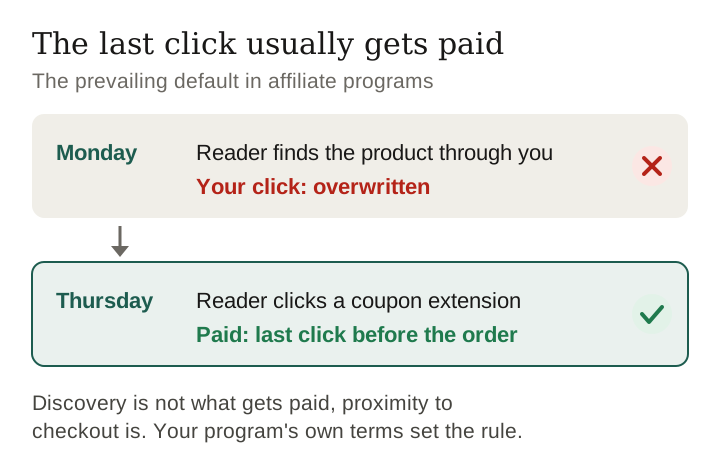
Under a last-click model, the final link clicked before the order takes the commission. If a reader finds a product through you on Monday and clicks another creator's link, a deal site, or a browser coupon extension on Thursday, the later click is usually the one that gets paid.
Last-click is the prevailing default in affiliate programs, but it is not a law. The rule that applies to you is written in each program's own terms, and that is the document to read rather than any article about it — including this one.
The models, and which one you are probably under
| Model | Who gets credited | Where a creator meets it |
|---|---|---|
| Last click | The final link clicked before the order | The prevailing default in affiliate programs |
| First click | The first link in the chain | Rare, occasionally used for awareness campaigns |
| Linear | Split equally across every touch | Multi-touch programs, usually large advertisers |
| Time decay | Weighted toward the most recent touches | Multi-touch programs |
| Position based | Weighted to the first and last touch | Multi-touch programs |
Model names as described in the general marketing-attribution literature. Which one applies to any specific program is stated in that program's own terms.
Single-source attribution — crediting one event with the whole sale — is widely criticised in the marketing literature precisely because it fails to account for every factor that led to the purchase. Creators feel that criticism from the losing end of it.
The practical consequence: discovery is not what gets paid, proximity to checkout is. That is worth knowing before you conclude that your content does not convert. It may convert beautifully and be credited elsewhere.
What overwrites your click, in rough order of frequency
- A coupon or cashback extension at checkout. The reader opens it to hunt for a code, the extension fires its own affiliate link, and the last click is now theirs.
- A second creator's link. Two people posting the same product in the same week is normal, and the later click wins.
- A deal site the reader visits to check the price. Same mechanism.
- The retailer's own email. The reader clicks a promotional email between your post and the purchase.
- The cookie simply expiring. Nothing overwrote it; the window closed. Nobody gets the commission.
- The click never registering at all. An in-app browser, a tracking blocker, or a reader who copied the product name into a search box instead of tapping.
The last two are the ones creators mistake for the first four. A missing commission is more often a click that never landed than a click that was stolen.
Keep reading
What you can actually do about it
- Shorten the gap between interest and click. Attribution rewards proximity to checkout, so a link that is available at the moment of interest beats a link the reader has to go looking for later.
- Prefer one durable destination. A page you control that carries the current links means a reader returning next week still routes through you, rather than searching and landing on whatever the search engine offers.
- Read the cookie window before the rate. A seven-day window is a very different business from a twenty-four-hour one, and the difference is exactly this problem.
- Do not build a business on a category readers research for weeks. Long consideration cycles are where last-click hurts most, which is part of why cheap impulse categories suit small accounts.
- Stop diagnosing it from your dashboard alone. Clicks with no sales can mean overwritten attribution, a closed window, or a product nobody wanted. Those need different fixes and the dashboard does not distinguish them.
What we cannot verify, said plainly
- We cannot tell you what share of sales gets reattributed. No credible public number exists, and the parties who could produce one have an interest in its size. We will not estimate it.
- We cannot tell you any specific program's model or window. We hold no network approvals, so we have never seen a program's terms from the inside.
- We cannot tell you whether a particular extension overwrites a particular retailer's cookie. That varies by retailer, by extension and by month.
- What we can tell you is where the answer lives for you specifically: the program's terms in your network dashboard, which state the model, the window, and whether coupon sites are permitted to claim attribution at all. Several advertisers exclude them. It is worth knowing which of yours do.
Background on attribution models: Attribution (marketing) — Wikipedia, read 2 September 2026.
Frequently asked
Who gets the commission if two creators link the same product?
Under last-click attribution, the creator whose link was clicked most recently before the order, provided that click falls inside the program's cookie window.
Do coupon extensions steal affiliate commissions?
A coupon or cashback extension that fires its own affiliate link at checkout becomes the last click and can take the credit. Whether it does depends on the retailer and the program's terms, which some advertisers write to exclude coupon sites.
Why do I get clicks but no sales?
Three different causes look identical in a dashboard: the cookie window closed, a later click overwrote yours, or the click never registered because of an in-app browser or a tracking blocker.
Is last click the only attribution model?
No. First click, linear, time decay and position-based models all exist. Last click is the prevailing default in affiliate programs, and the model that applies to you is in the program's own terms.
Method and scope
- Attribution model names and the criticism of single-source attribution are drawn from the general marketing-attribution literature, cited in the body.
- No figure is given for how often attribution is overwritten. We do not have one and consider every publicly circulating estimate unverifiable.
- We hold no affiliate approvals, so we have never read a program's terms from inside a network dashboard.
- No specific network, retailer or browser extension is accused of any behaviour here; the mechanisms described are generic and the page says where to check the specifics.
Last verified 2 September 2026 against published attribution-model reference material
Keep reading
How this page was made. Drafted with AI (Claude); not yet independently re-checked. How we work