LinkToLooks · Guides · Creator Desk
Creator Desk
What to do when a brand pays late
Escalate on a schedule, in writing, and stop delivering before you stop being polite — three of the four causes are administrative, and only one is a dispute.
Part of: For creators
Escalate on a schedule, in writing, and stop delivering before you stop being polite. A late payment is almost always one of four things: the invoice never entered the system, it entered against the wrong entity, it is sitting behind an approval nobody chased, or the client cannot pay. The first three are administrative and are fixed by finding the right person. Only the fourth is a dispute.
The sequence below is built from contract mechanics rather than from stories. We have no creator anecdotes to offer — no connected creators, no survey, no panel — so what follows is the structure of the problem and the moves it allows, not a claim about how often each one works.
The four reasons, and how to tell them apart
| Reason | Tell | What actually fixes it |
|---|---|---|
| Never entered the system | nobody can find the invoice; your contact is apologetic and vague | resend to accounts payable directly, with the purchase order number |
| Wrong entity or missing reference | it was received but rejected; you hear nothing because the rejection went nowhere | ask which entity and which reference they need, then reissue |
| Stuck behind an approval | everyone confirms it is in the queue; nobody names a date | ask for the name of the approver and the expected date, in writing |
| Cannot or will not pay | responses stop, or terms are renegotiated after delivery | stop work, formal demand, and a decision about how far to take it |
The diagnostic question that separates the first three from the fourth is short and worth asking early: “Can you tell me the invoice status in your system and the scheduled payment date?” A company that can answer has an administrative problem. A company that cannot answer, repeatedly, has a different one.
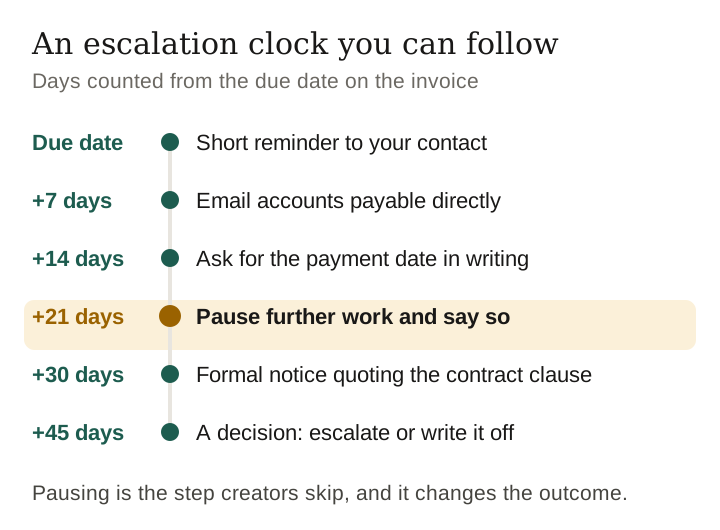
An escalation clock you can actually follow
Dates are from the due date on the invoice, not from when you noticed. Adjust the spacing to the relationship; keep the structure.
| When | Move | Tone |
|---|---|---|
| Due date | short reminder to your contact, invoice attached | assume an oversight |
| +7 days | email accounts payable directly, copy your contact | still administrative |
| +14 days | ask for the payment date in writing and name the amount and the invoice | firm, specific, unemotional |
| +21 days | pause further work and say so plainly; ask for a call | clear consequence, no ultimatum language |
| +30 days | formal notice quoting the contract clause and the amount outstanding | formal |
| +45 days | decide: escalate to their finance lead, use whatever your contract allows, or write it off deliberately | a decision, not a drift |
The step creators skip is the fourth, and it is the one that changes the outcome. Continuing to deliver while unpaid teaches the other side that the due date is decorative. Pausing is not aggressive — it is the ordinary consequence of unpaid work, and it should be stated as a fact rather than threatened.
The step creators dread is the last one, and it deserves saying plainly: writing off a small amount deliberately, and declining to work with that client again, is a legitimate outcome. What is not legitimate is letting it drift unresolved for a year while you keep taking their briefs.
Keep reading on creator business
What each message should say
- The invoice number and the amount, in the first line. Finance teams search on numbers. A message that opens with pleasantries and buries the reference is a message that gets filed.
- The due date, as a date. Not “net 30”.
- One question with one answer. “What is the scheduled payment date?” beats a paragraph of context.
- The attachment, every time. Never make someone find the previous email.
- No apology for asking. You are not requesting a favour; you are asking for the status of an agreed obligation.
- Everything in email. A phone call that fixes it is good; a phone call with no written follow-up did not happen.
Keep the thread in one place, in order. If this ever becomes formal, the sequence of dated messages is the substance of your position, and it is far more persuasive than any single strongly-worded letter.
The leverage you have, honestly assessed
We would rather be accurate than encouraging here, because the encouraging version wastes people’s time.
- Real: withholding future work. Immediate, costs you nothing you were being paid for, and is the only lever that operates on the same timescale as the problem.
- Real: withholding assets they have not received. Raw files, usage rights, extended licences. Only if the contract does not already grant them — read it before relying on it.
- Real, and slow: formal process. Small claims or the local equivalent exists and works, at a cost in time and fees that often exceeds a small invoice.
- Weak: contractual late-payment interest. Worth including in the contract because it signals seriousness. Rarely worth pursuing alone.
- Do not: publicly naming them. It feels like leverage. It is a public dispute with somebody who has a legal team, it does not release the payment, and it is read by every other brand considering working with you.
Taking a position: the strongest lever a creator has is the one they use least, which is simply stopping. Every other option is slower, costlier, or both.
Preventing it next time, at contract stage
- Name the paying entity in the contract, not the brand you are talking to. Wrong entity is one of the four reasons and it is entirely preventable.
- Get the purchase order number before you deliver. Some finance systems will not pay without one and will not tell you that.
- Agree what triggers payment — delivery, approval, or publication — and write it down. Ambiguity here is the most common source of a legitimate-looking delay.
- Split larger work. A deposit and a balance limits the exposure and surfaces a payment problem before you have delivered everything.
- Ask for the accounts payable address at signing, when everyone is helpful, rather than at day fourteen when they are not.
- Diarise the due date. The reminder on the due date is the cheapest intervention available, and it only works if you noticed.
Frequently asked
How long is too long?
Anything past the due date you agreed is late. The useful threshold is not a number of days but whether the other side can tell you a scheduled payment date. If they cannot by day fourteen, treat it as a problem rather than a delay.
Should I charge interest?
Only if the contract provides for it, and expect it to function as a signal rather than as income. Whether statutory interest applies where you trade is a question for someone qualified there.
Can I take the content down?
It depends entirely on what rights the contract granted and when they took effect. Many creator contracts grant usage on delivery rather than on payment, which is precisely the clause worth negotiating before you sign.
The brand went quiet. Is it worth pursuing?
Weigh the amount against the hours. A deliberate decision to stop, recorded, is a better outcome than an open item you revisit every month for a year.
Method and scope
This page is built from contract and invoicing mechanics, not from creator anecdotes: we hold no connected-creator data, no survey and no case studies, so nothing here claims a success rate. The escalation timings are a structure to adapt, not a standard anybody publishes. Remedies, interest and recovery routes are governed by your contract and your jurisdiction, and this is not legal advice. Published 4 September 2026.
How this page was made. Drafted with AI (Claude); not yet independently re-checked. How we work